October 23, 2026 | Bitcoin Mining · Gaming · Digital Infrastructure
NIP Group, the Nasdaq-listed parent of esports organization Ninjas in Pyjamas, announced on October 20 that it signed a deal to acquire Bitcoin mining machines rated at approximately 4.47 exahashes per second (EH/s). The machines already operate at third-party hosting facilities, but the transaction has not yet closed. This is the company’s third mining acquisition tranche, not its first entry into mining.
Key Takeaways
- The proposed purchase covers 4.47 EH/s of operating mining hardware.
- After closing, NIP expects a combined mining fleet of approximately 13.85 EH/s.
- Management forecasts 195 BTC monthly at full deployment; this is not reported production.
How the Purchase Works
According to the company’s SEC-filed announcement, NIP would issue sellers up to 247,091,740 Class A ordinary shares for the equipment. The agreement is dated September 24, 2026; closing remains subject to customary conditions. Shares, rather than cash, are the stated consideration. That makes potential dilution an important question for shareholders.
The projected 13.85 EH/s represents 13.85 million terahashes per second of SHA-256 mining capacity. It is not an electrical-power measurement. The announcement does not specify the ASIC models, fleet efficiency in J/TH, or site power demand, so an accurate megawatt or electricity-cost estimate cannot be derived from the announced hashrate alone. Our earlier Power Is Money analysis examines the energy-economics relationship, while a 2024 Bitaxe monitoring story illustrates why operators track power and performance together.
What 195 BTC a Month Really Means
NIP previously reported approximately 151.4 BTC over September–November 2025. Its new estimate of 195 BTC per month assumes full deployment and is sensitive to network difficulty, hashrate, uptime, and operating conditions. It should not be represented as Bitcoin already mined or held in treasury. Our September production comparison distinguishes actual mined BTC from fleet projections.
From Esports to Computing Infrastructure
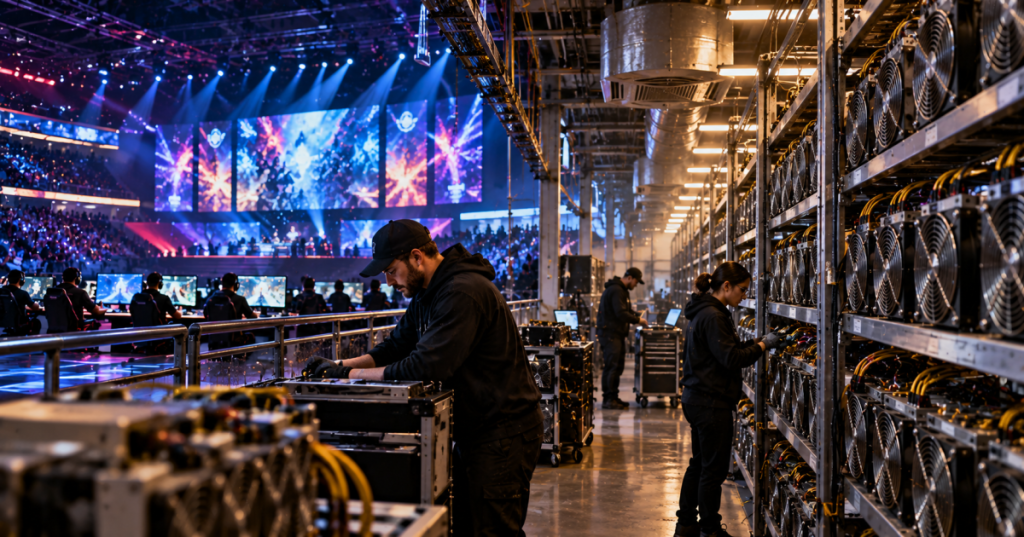
The company’s Ninjas in Mining division presents Bitcoin mining as an infrastructure business alongside its entertainment operations. Executives say some capacity may eventually support AI and high-performance computing. However, ASIC ownership does not automatically provide GPU-ready AI servers or contracts: the equipment and operating requirements differ. For context, BitcoinVersus.Tech recently compared modular AI factories with mining infrastructure.
What Comes Next
The key tests are confirmation that the transaction closed, realized hashrate, Bitcoin mined, energy and hosting costs, and whether the share-funded expansion improves operating performance. Until those figures are disclosed, 13.85 EH/s and 195 BTC per month remain company expectations, not audited results. For more company context, see NIP Group’s October 20 release.
BitcoinVersus.Tech Editor’s Note: We volunteer daily to ensure the credibility of the information on this platform is Verifiably True. If you would like to support to help further secure the integrity of our research initiatives, please donate using the QR code provided

For best QR-code scanning results, please scan this donation code from a desktop or larger screen. Mobile screens may prevent camera recognition.


Leave a Reply