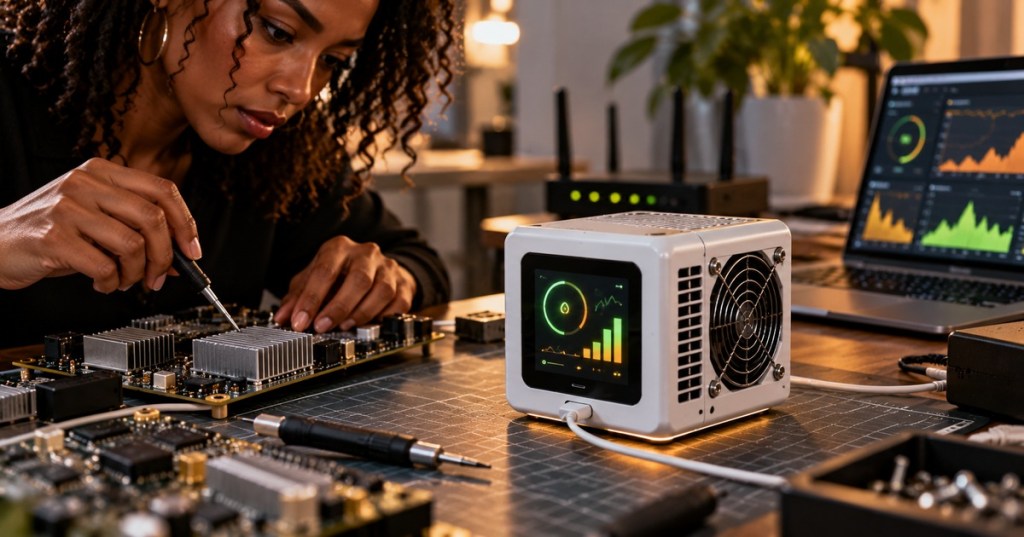
Power Mining has unveiled Bitcube, a palm-sized Bitcoin miner using Canaan’s Avalon A3197 ASIC chip, with an advertised maximum 777 GH/s (0.777 TH/s). Announced October 21, 2026, it combines USB-C power, Wi-Fi and a 2.73-inch touchscreen in a small desktop enclosure. The manufacturer is accepting preorders; the advertised performance and Christmas delivery target are not independently confirmed.
Key Takeaways
- Turbo mode is rated up to 777 GH/s; Quiet mode is approximately 550 GH/s.
- Manufacturer-listed 20–25 W wall power implies roughly 25.7–32.2 J/TH at maximum hashrate, not the advertised 20 J/TH chip figure.
- Bitcube remains a preorder; solo mining at this scale offers very low block-winning odds.
Canaan Chip Moves Into a Desktop Miner
Power Mining’s official specifications list a 74 × 74 × 80 mm case, a 2.73-inch touch display, an ESP32-S3 controller and a 50 mm fan. The €117.50 product is offered for preorder, with shipment targeted before Christmas. In its October 21 release, the Latvian company said direct access to Canaan chips reduces the need to salvage ASICs from larger mining machines.
Power Mining’s Bitcube product-introduction video; specifications shown are manufacturer claims, not independent tests.
Power Mining’s October 21 launch announcement introduces the 777 GH/s device.
Why Wall Power Changes the Efficiency Calculation
The product page lists 20 J/TH chip efficiency but 20–25 W total device consumption. Divide that wall power by 0.777 TH/s and the complete machine would use roughly 25.7–32.2 J/TH at full advertised speed. At $0.15/kWh, continuous operation would cost approximately $2.16–$2.70 per 30 days, excluding purchase cost. These are calculations from advertised inputs, not measured results.
Solo Mining Is a Learning Experience
At a hypothetical 1 ZH/s network hashrate, 0.777 TH/s would imply a statistical average wait of roughly 24,500 years for a solo block. An actual winner could emerge sooner—or never. BitcoinVersus.Tech documented another verified solo-mining block, and covered Bitaxe home-mining hardware in 2024. Small wins are possible but not representative of ordinary returns.
Previous BitcoinVersus.Tech video contextualizing solo mining and the rare discovery of a block; not a Bitcube test.
Power Mining describes the direct Canaan chip partnership and its solo-mining positioning.
What Still Needs Verification
Buyers should check delivered hardware, sustained speed, socket power, noise and shipment dates. The company advertises open-source software but a public source repository and license were not established in this review. Compare BitcoinVersus.Tech’s AxeOS firmware guide for an example of verifiable open-source mining software. The separately advertised 2.4 TH/s Bitcube Pro is a future product, not this model.
BitcoinVersus.Tech Editor’s Note: We volunteer daily to ensure the credibility of the information on this platform is Verifiably True. If you would like to support to help further secure the integrity of our research initiatives, please donate using the QR code provided

For best QR-code scanning results, please scan this donation code from a desktop or larger screen. Mobile screens may prevent camera recognition.


Leave a Reply