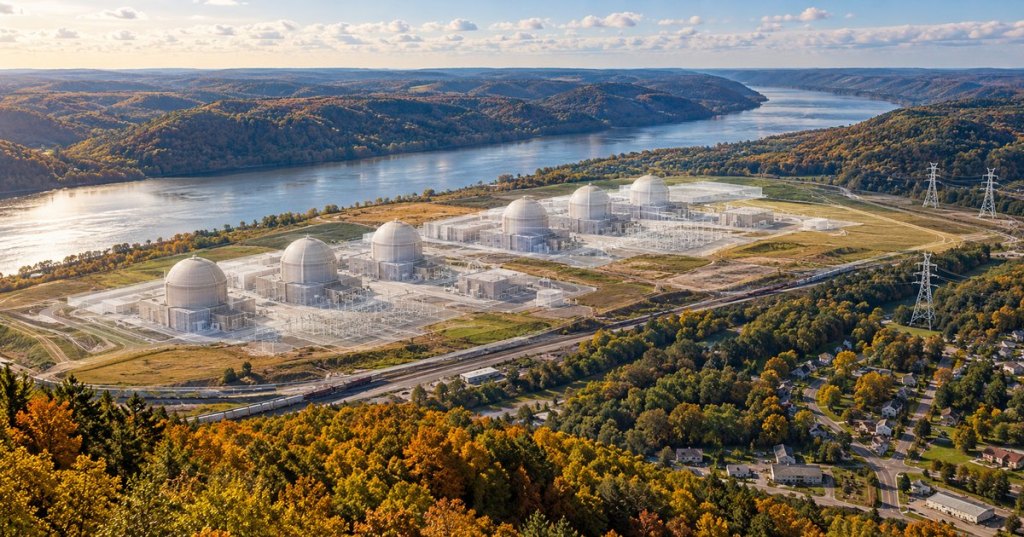
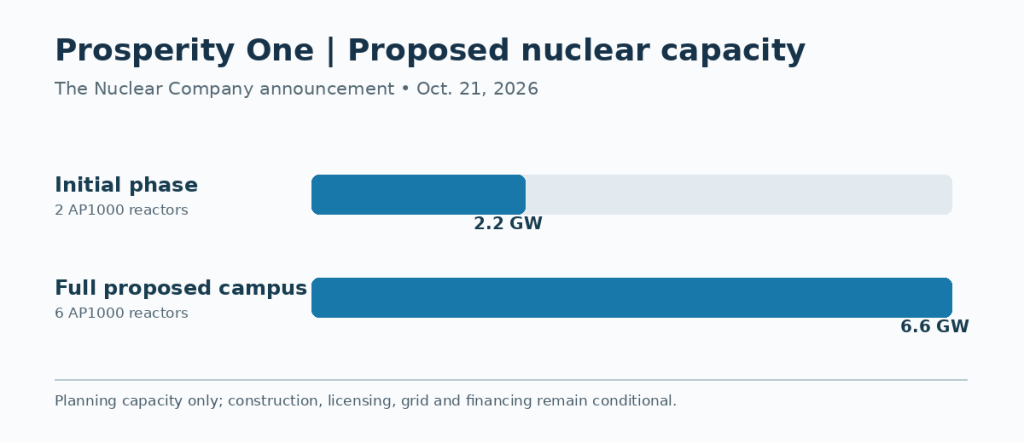
The Nuclear Company proposed a nuclear energy campus in Lewis County, Kentucky, on October 21, 2026, with space for up to six Westinghouse AP1000 reactors and approximately 6.6 gigawatts of generating capacity. Named Prosperity One, the project would sit along the Ohio River. Its size is a proposal—not electricity already being generated—according to the company’s announcement.
Key Takeaways
- The full proposal is six AP1000 reactors totaling approximately 6,600 MW.
- The conditional initial phase calls for two reactors, approximately 2,200 MW.
- The developer hopes to obtain approvals to begin construction in 2028; no reactor is operating there.
- Licensing, environmental reviews, grid arrangements and project financing remain major milestones.
Six Reactors, Beginning With Two
The developer says it controls the site and is working with landowner Sam Howard and local leaders. Next come environmental assessments, transmission studies and preparations for federal licensing. If fully built, Prosperity One could exceed Georgia’s four-unit Vogtle station in total generating capacity. But the initial two-unit phase would proceed only after feasibility work, permits and other prerequisites are satisfied.
The official announcement video offers a view of the developer’s ambitions; it should not be confused with evidence of a finished plant or approved construction.
A Familiar Reactor Design, but a New Site
Westinghouse’s AP1000 is a large light-water reactor using passive safety features. Two AP1000s operate at Vogtle in Georgia. On October 14, the Nuclear Regulatory Commission published a direct final rule renewing the AP1000 design certification and incorporating Revision 20, drawing on lessons from Vogtle. The rule is scheduled to take effect December 28, subject to its conditions. Standardized reactor-design approval does not constitute a license for the Kentucky site.
The Challenge Is Turning Capacity Into Power
The POWER industry report notes that the developer has not disclosed a power buyer, project budget or completed financing package. The proposed 2028 construction start therefore remains a target, not a guaranteed schedule. A six-unit campus would demand reactor manufacturing, skilled labor, cooling infrastructure and transmission capacity.
BitcoinVersus.Tech has covered AEP and X-energy’s 960 MW Indiana proposal, the Duane Arnold reactor restart effort and who should pay for new grid capacity. Prosperity One brings the debate to conventional large reactors: announcing gigawatts is the first step; delivering dependable electricity requires licenses, capital and years of physical construction.
BitcoinVersus.Tech Editor’s Note: We volunteer daily to ensure the credibility of the information on this platform is Verifiably True. If you would like to support to help further secure the integrity of our research initiatives, please donate using the QR code provided

For best QR-code scanning results, please scan this donation code from a desktop or larger screen. Mobile screens may prevent camera recognition.


Leave a Reply