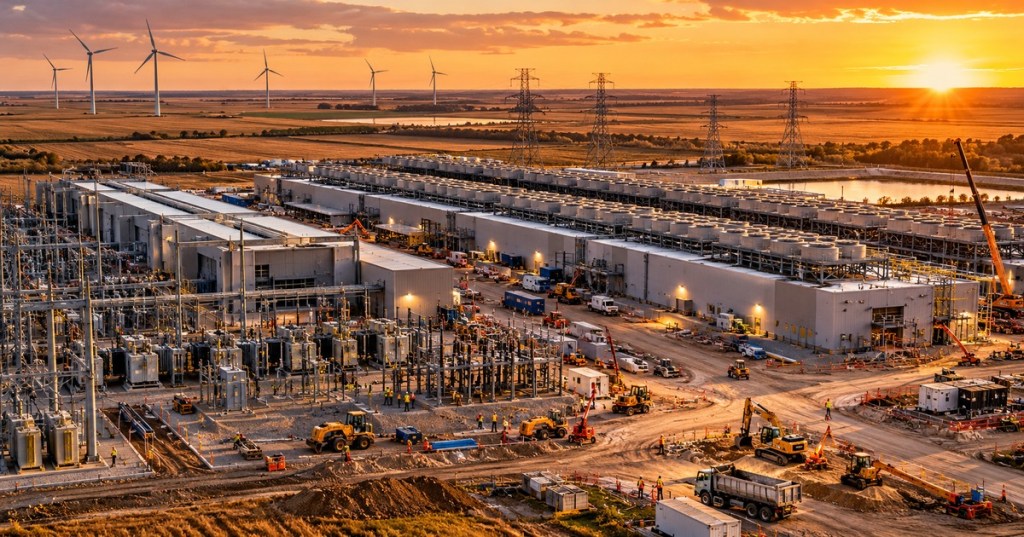
North Dakota is rapidly becoming a center for large AI data-center construction, but neighboring South Dakota is showing how state policy can change an investment decision. Applied Digital is building major AI campuses in Ellendale, Harwood and Oliver County while a proposed 430 MW campus near Toronto, South Dakota, has been shelved following the rejection of proposed tax incentives. A separate 500 MW-capable Sioux Falls project remains under consideration.
North Dakota: three major AI campuses
Ellendale — Polaris Forge 1. Applied Digital’s October 7, 2026 earnings release reports 250 MW of critical IT load operational, with a third 150 MW building under construction toward a 400 MW campus. The company leases the site to CoreWeave for AI workloads. Its operating capacity should not be confused with the separate legacy cryptocurrency-mining facility in Ellendale. Read the company’s October SEC-filed earnings release.
Harwood — Polaris Forge 2. The project near Fargo is an AI computing campus of roughly 280 MW in the current development record, with construction underway. The site has attracted large investment and a separate public dispute over annexation. The campus is not yet equivalent to 280 MW of energized AI compute. Engineering News-Record’s construction report details the development.
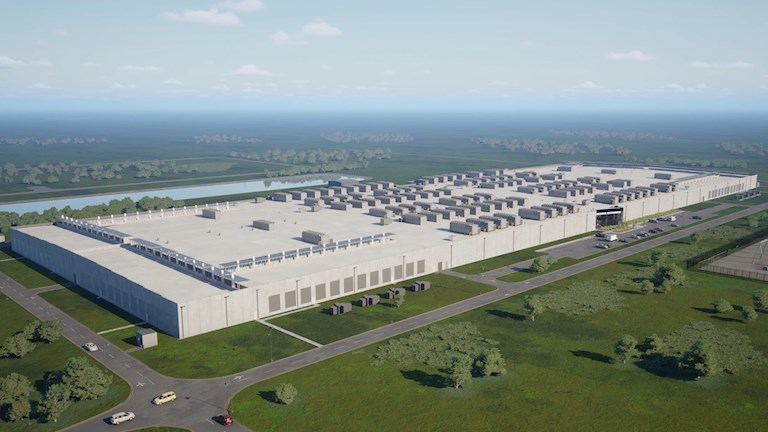
ABB’s official announcement describes the electrical infrastructure supporting Applied Digital’s AI campuses. The image is a project visualization, not proof that the entire site is operating.
Oliver County — Polaris Forge 3. Applied Digital identified a third North Dakota AI factory near Center/Hanover. A July road-use agreement advanced access planning, and the company’s October earnings release included the project among campuses in stages of construction. Project disclosures reference roughly 300 MW of critical IT load, while some site records describe approximately 430 MW of broader power capacity. Those figures should not be treated as interchangeable. Local permitting report; company filing.
South Dakota: one project withdrawn, another still proposed
The contrast is striking. Applied Digital’s proposed $5 billion, 430 MW development near Toronto in Deuel County was intended to tap South Dakota’s transmission infrastructure and relatively cool climate. But after lawmakers declined to approve sales-tax exemptions for large data centers, the company said the project no longer made economic sense under the current conditions. On April 2, an executive indicated its land agreement would be allowed to lapse. This is a withdrawn proposal, not an operating or actively building 430 MW AI campus. South Dakota Searchlight’s original report.
Meanwhile, a separate 500 MW-capable Gemini data-center proposal in northeastern Sioux Falls was described as unchanged following the same legislative decision. It remained a proposal seeking tenants and development arrangements, not an operational 500 MW facility. The difference illustrates why proposed power, contracted IT load and commissioned megawatts need separate reporting. See the April project-status comparison.
Why power and local policy matter
These campuses require far more than acreage. High-voltage substations, transformers, grid interconnection, liquid cooling, fiber connectivity, equipment procurement and long-term customer contracts determine whether a proposed megawatt becomes usable computing capacity. In North Dakota, the state’s transmission capacity study explicitly tracks large-load data-center projects. In South Dakota, the failed incentive effort demonstrates how taxes and local acceptance can influence project economics.
For readers following Bitcoin mining’s migration into AI infrastructure, the transition is particularly visible at Ellendale: Applied Digital still operates cryptocurrency hosting facilities while expanding separate GPU-oriented campuses. For broader context, see BitcoinVersus.Tech’s ranking of major AI data-center megaprojects and its comparison of AI factories with Bitcoin-mining infrastructure. There is no verified connection between these Applied Digital projects and Bill Gates’s North Dakota farmland purchases.
Editor’s Note: BitcoinVersus.Tech distinguishes operational IT capacity, announced project capacity and power-generation or grid-connection figures. Support independent reporting with a 5,000-satoshi donation by scanning the QR code below.

Scan the QR code with your Bitcoin wallet, ideally while reading on a separate screen.


Leave a Reply