
Venezuelan crypto lawyer Ana Ojeda, head of institutional business development at fintech company Blend, described the movement of stolen Binance funds as “Agentic money laundering” on October 30, 2026. Her comment followed blockchain investigators’ discovery of rapid, repeated transfers after the exchange’s October 29 security breach, raising a question about whether criminal transaction systems are becoming more autonomous.
The phrase is Ojeda’s characterization, not an established finding that artificial intelligence controlled the laundering. Chainalysis identified patterns suggesting automated execution but did not determine publicly whether the attackers used AI agents rather than conventional transaction scripts. Separately, bank regulators are scrutinizing agentic AI in financial services, including how institutions can control systems that operate with greater independence.
Thousands of Transfers and a Repeated 1-TRX Pattern
Chainalysis described thousands of transfers in a short period, including funds circulating between addresses and sometimes returning to wallets already involved. Numerous addresses first received exactly 1 TRX, then additional funds, before forwarding assets again. Researchers said the repetition suggested a programmatic process intended to complicate tracing. The patterns fit into a wider cybersecurity debate over AI-assisted attacks and defenses, but repetitive transfers alone cannot establish what software the attackers used.
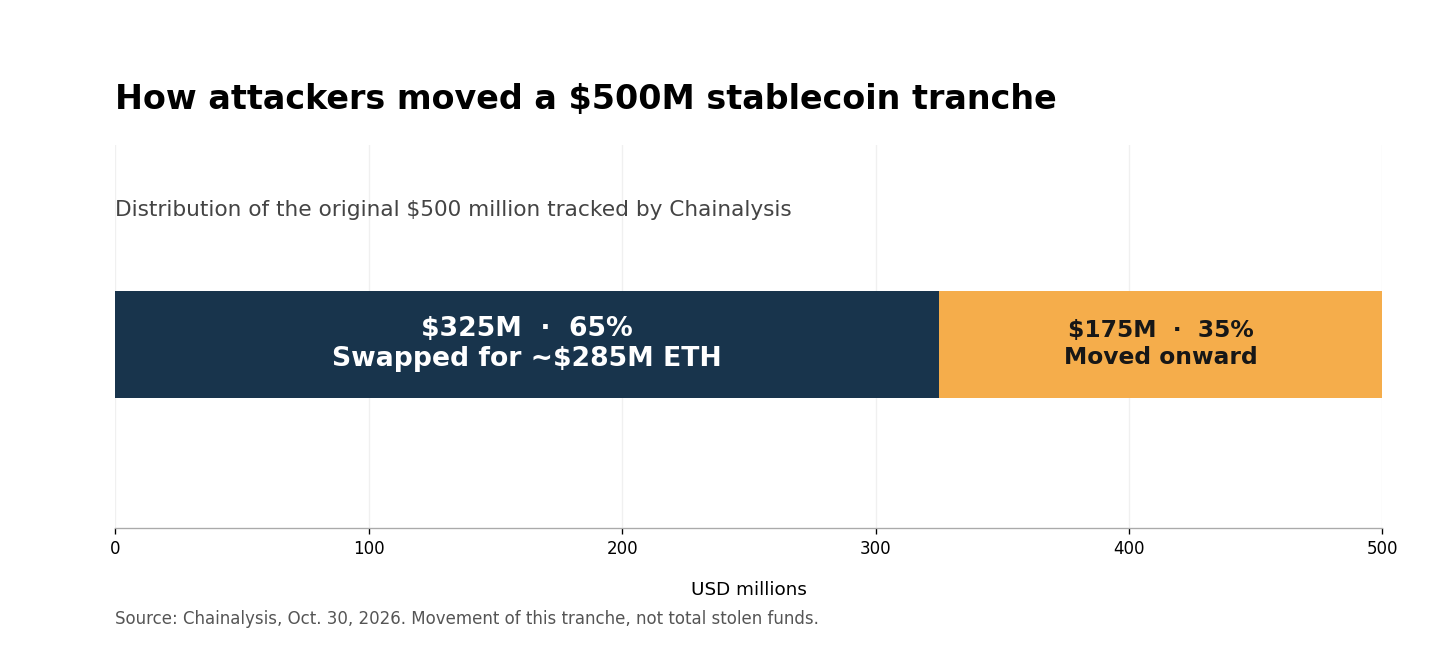
The firm also reported a race to convert tokens before stablecoin issuers could freeze them. One wallet received $500 million in stablecoins; about $325 million was exchanged for approximately $285 million in ETH over nearly 20 minutes. The remaining $175 million was subsequently transferred to intermediary addresses.
What Investigators Know — and What They Do Not
Chainalysis attributed the attack to North Korea-linked TraderTraitor, citing the commingling of Binance proceeds with funds from an earlier Bitget exploit. That is the analytics firm’s assessment; Binance has not publicly completed its investigation or independently identified the perpetrators.
In an October 30 security update, Binance estimated approximately $6.3 billion stolen and about $3 billion frozen on-chain. It said the investigation uncovered additional points of compromise beyond an initially suspected laptop intrusion and that it had found no evidence of leaked wallet private keys. The exchange pledged to cover customer losses.
For investigators, the unresolved issue is not simply the volume of transactions. It is whether the routing followed fixed automated rules or adapted independently to freezes and scrutiny. Until the underlying software or operational evidence is established, “agentic” remains a hypothesis rather than a confirmed explanation. Read our earlier initial breach report and Richard Teng follow-up for the incident timeline. The public fallout also included Changpeng Zhao’s response to Elon Musk over remarks about the attack.
BitcoinVersus.Tech
Editor’s Note: We volunteer daily to ensure the credibility of the information on this platform is Verifiably True. If you value our independent reporting, please consider donating 5,000 sats using the original Bitcoin donation QR code below. On mobile, save or screenshot the QR code and open it with your Bitcoin wallet’s QR scanner; for best results, scan from a laptop or larger screen.

Bitcoin donation address: 3C9o19EH5HSiwEPyCTmEKzxhNCbo2X6TTb.
BitcoinVersus.tech is not a financial advisor. This media platform reports on financial subjects purely for informational purposes.


Leave a Reply