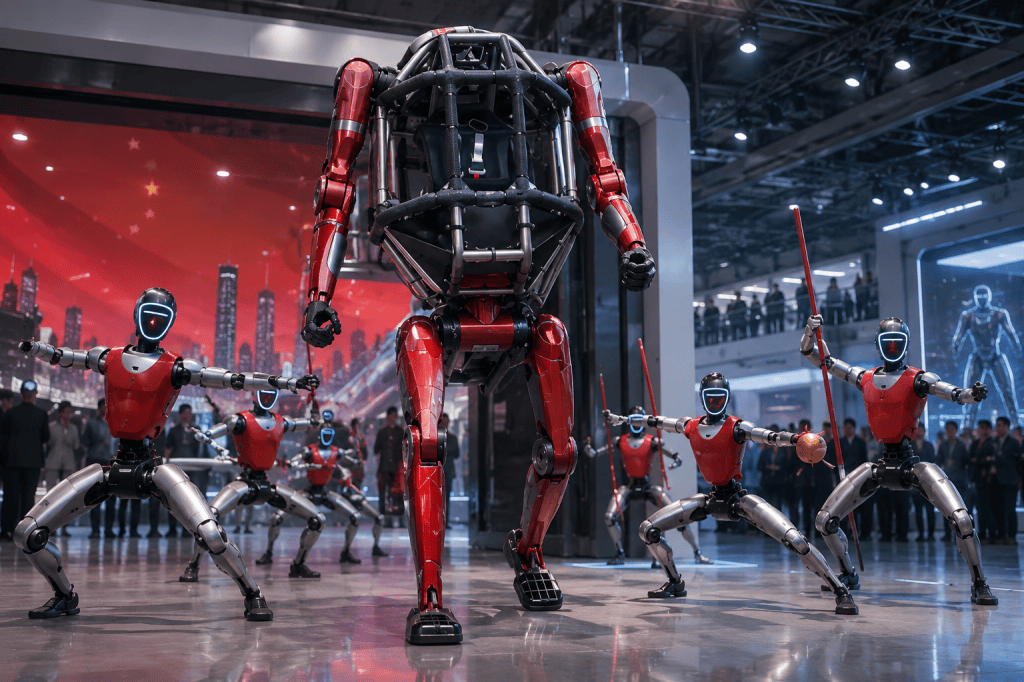
China’s rapidly expanding robotics industry has produced one of its most striking machines yet: Unitree Robotics’ GD01, a roughly 9-foot-tall, half-ton transformable mecha developed under founder and CEO Wang Xingxing.
Unveiled to TIME, the GD01 contains a torso-mounted cockpit for a human operator and can move using either two or four legs.
Its construction combines titanium-alloy limbs, carbon-fiber protection and heavy mechanical joints. Technically, the GD01 is better described as a piloted transformable mecha than a conventional autonomous humanoid robot, while Unitree’s smaller G1, H2 and R1 systems represent the company’s more practical push toward general-purpose humanoid robotics.
The real story behind GD01 is the increasingly close relationship between artificial intelligence, robotics and mass manufacturing. Unitree shipped more than 5,500 humanoids in 2025 according to TIME, while the company continues to push prices downward and broaden access to robotics hardware.
Its R1 now starts at $4,900 and offers up to 26 degrees of freedom in standard configurations, multimodal AI integration and open interfaces for robot joints and sensors.
Unitree is also building the software and data infrastructure needed for embodied AI: its G1-D platform includes robot-data acquisition, labeling, distributed model training, simulation, inference and support for open robotics frameworks.
Wang believes humanoids could experience a “ChatGPT moment” within roughly two to 10 years if robots become capable of generalizing instructions across unfamiliar environments rather than relying primarily on rigid task-specific programming.
That transition could eventually reshape factories, warehouses, maintenance operations and homes, but the industry is not there yet. TIME reports that current humanoids achieve roughly 30% to 50% of human efficiency on many general factory and warehouse tasks, and most Unitree humanoids are still being purchased by universities, research institutions and developers rather than deployed as industrial workers.
Wang nevertheless predicts that smaller household robots could become common within the next decade, while Morgan Stanley forecasts cited by TIME envision as many as 1 billion humanoid robots by 2050 and a potential $5 trillion industry.
Whether those forecasts materialize will depend heavily on progress in robot intelligence, vision-language-action models, training data, batteries, safety, manufacturing costs and the ability of robots to adapt reliably to environments they have never encountered before.
BitcoinVersus.Tech Editor’s Note:
We volunteer daily to ensure the credibility of the information on this platform is Verifiably True. If you would like to support to help further secure the integrity of our research initiatives, please donate here: 3C9o19EH5HSiwEPyCTmEKzxhNCbo2X6TTb
BitcoinVersus.tech is not a financial advisor. This media platform reports on financial subjects purely for informational purposes.


Leave a Reply