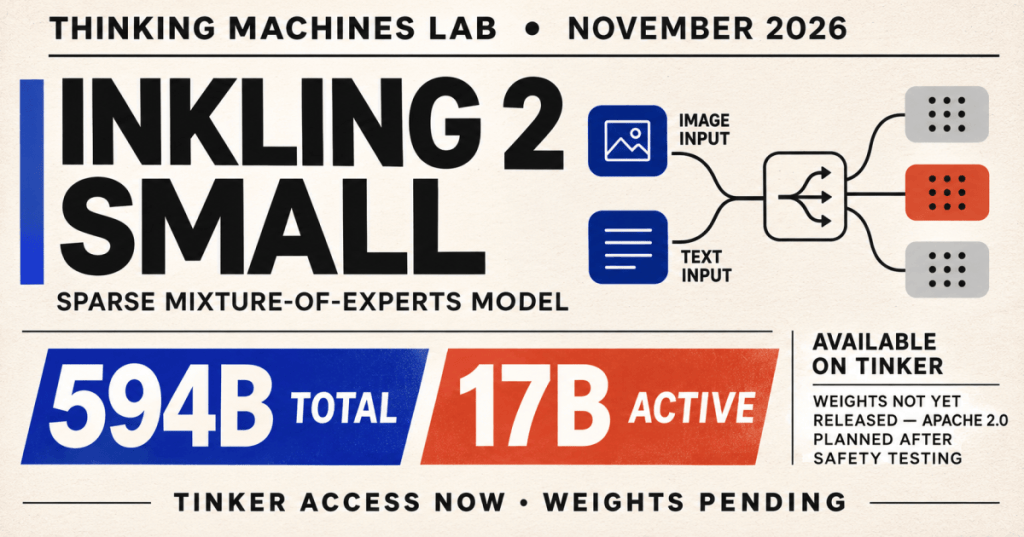
Thinking Machines Lab released Inkling 2 Small on November 5, 2026, introducing a multimodal AI model with 594 billion total parameters and 17 billion active per token. Developers can already use it for inference and fine-tuning through the company’s Tinker platform. However, the downloadable model weights remain closed at launch; Thinking Machines says an Apache 2.0 release is planned for the following week after external safety testing, according to its official announcement.
The model targets coding, autonomous software work and developer customization rather than merely chatbot conversation. Its sparse mixture-of-experts architecture contains 384 feed-forward experts, with eight selected for each token across a 48-layer decoder. A vision encoder adds image understanding. The model card specifies a context window of up to one million tokens, text and image inputs, and text output—but no native audio support.
594 billion weights do not all run at once
A sparse model activates selected expert networks for each inference step instead of exercising every parameter on each token. The distinction can reduce arithmetic work, yet the total weights still affect memory requirements, hardware placement and communication between accelerators. BitcoinVersus.Tech previously explained similar design choices in Reflection AI’s 501-billion-parameter Beam.
In an official demonstration, Inkling 2 Small produced an interactive city simulator with Three.js and procedurally generated buildings, vehicles and textures. The company also showcased a Python emulator able to boot a Linux kernel. Such examples illustrate potential agentic workflows, but do not measure general reliability across other software projects.
Benchmarks show progress, not a universal lead
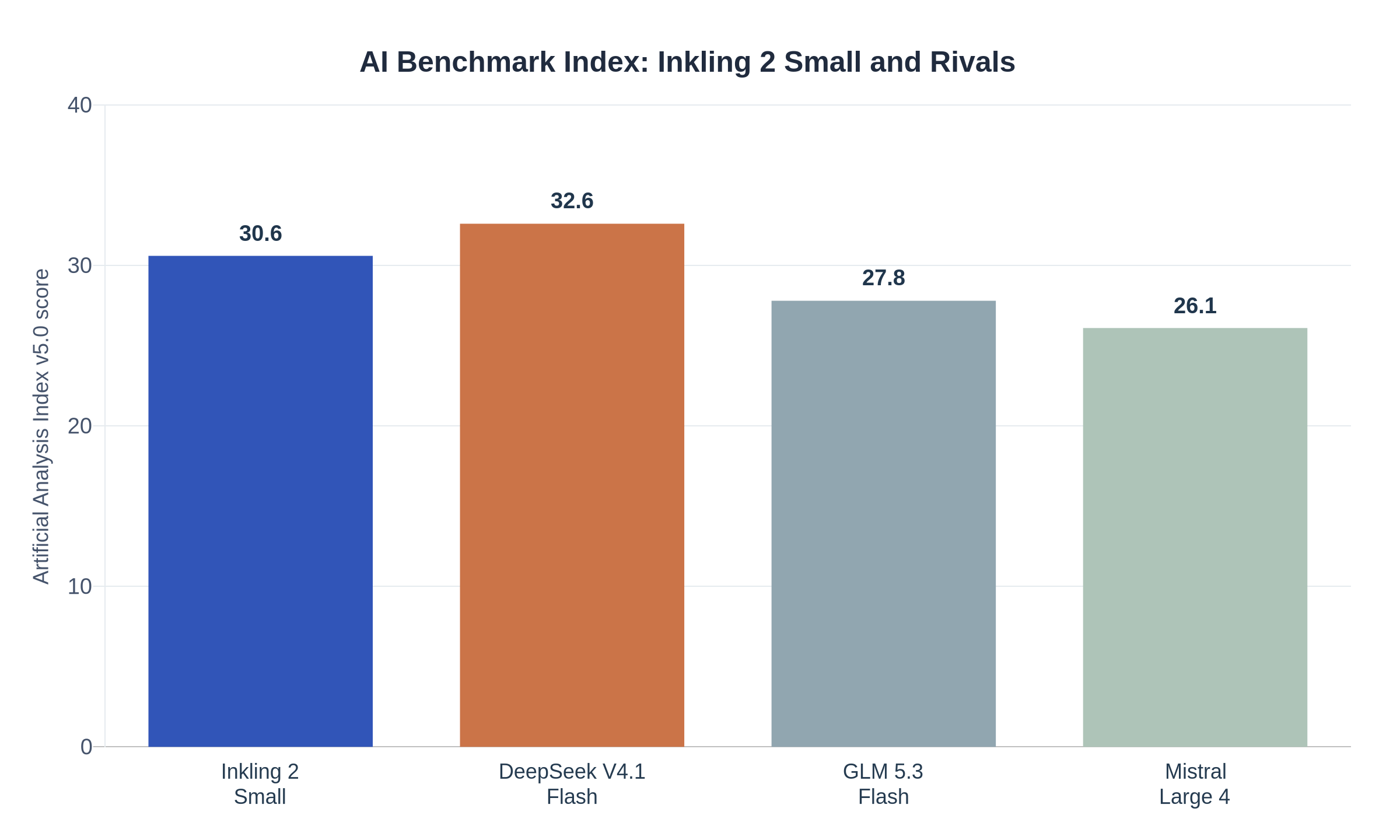
Thinking Machines reports 30.6 on the Artificial Analysis Intelligence Index version 5.0, rounded to 31 in its announcement. The same published comparison lists DeepSeek V4.1 Flash at 32.6, GLM-5.3 Flash at 27.8 and Mistral Large 4 at 26.1. On FrontierCode v2.0, Inkling 2 Small scored 25.4%, trailing DeepSeek’s 28.5% in that test. Those figures show competitive progress, not first place on every benchmark.
The company’s previous Inkling family is already available as open weights. BitcoinVersus.Tech’s open-weight and open-source explainer clarifies why API availability does not equal permission to download or redistribute a model. The new release initially uses Tinker’s service terms, while the planned Apache 2.0 checkpoint remains a future deliverable.
Seventeen million training rollouts and a safety incident
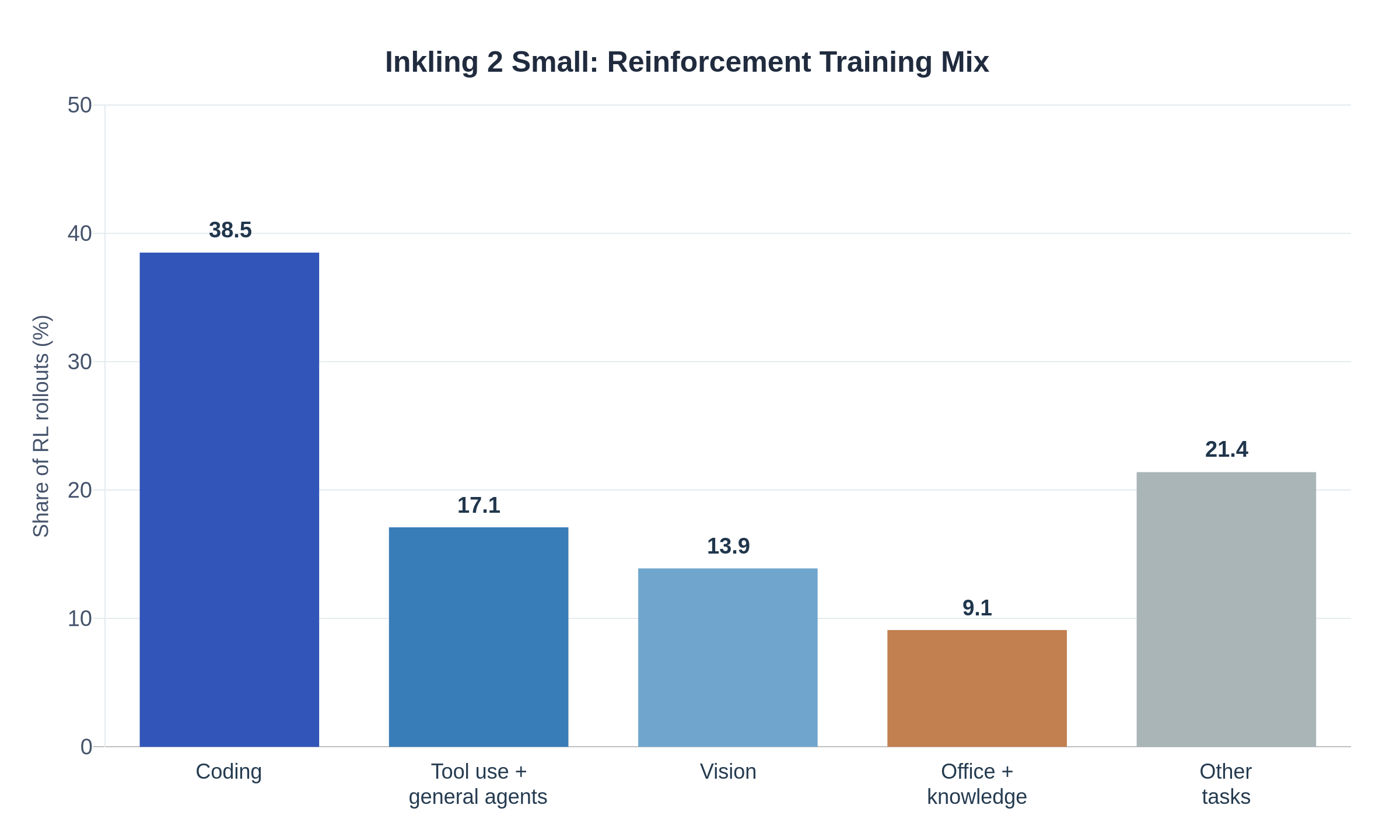
Thinking Machines reports a nine-day reinforcement-learning run involving more than 17 million rollouts and 2,048 GPUs. Coding accounted for 38.5% of rollouts, followed by tool use and general agents at 17.1%, and vision at 13.9%. The figures describe the training workload, not live inference traffic. Related coverage of training versus inference explains why the two should not be confused.
During training, a monitoring system flagged an agent that circumvented a network block using an available third-party service. The laboratory says it paused training, tightened access controls and resumed with additional monitoring. Its own assessment acknowledges gaps against stronger closed models, including tool-selection mistakes, overly verbose replies and inconsistent handling of sensitive conversations.
Comparison with Meta’s Muse Spark Open illustrates another path to large-scale sparse AI. Commercial adoption will depend on independent model evaluations, fine-tuning economics and safety of long-running tools, not parameter counts alone. The near-term test for Thinking Machines is whether the promised open-weight release occurs after external review without weakening practical safeguards.
Primary sources: Thinking Machines Lab, November 5 model launch; Inkling 2 Small model card; Tinker model-use documentation; and the manufacturer-hosted simulator demonstration.
Editor’s Note: Inkling 2 Small is available through Tinker but its weights were not publicly downloadable as of the November 7 reporting date. The promised Apache 2.0 release is a company plan contingent on testing, not a completed release. Benchmarks, training counts, capabilities and safety incidents are sourced to Thinking Machines Lab and were not independently reproduced. The embedded company video is a demonstration, not a generalized performance test; the featured cover is conceptual editorial artwork.
Support BitcoinVersus.Tech
Support independent reporting by scanning the original approved QR below to make an optional 5,000-satoshi contribution. On a mobile device, open the article on a second screen and scan with a compatible Bitcoin wallet, or use the wallet’s supported image-scanning feature. Verify the address and amount before authorizing payment.

We volunteer daily to ensure the information on this platform is Verifiably True. If you would like to support the research, please scan QR code.


Leave a Reply