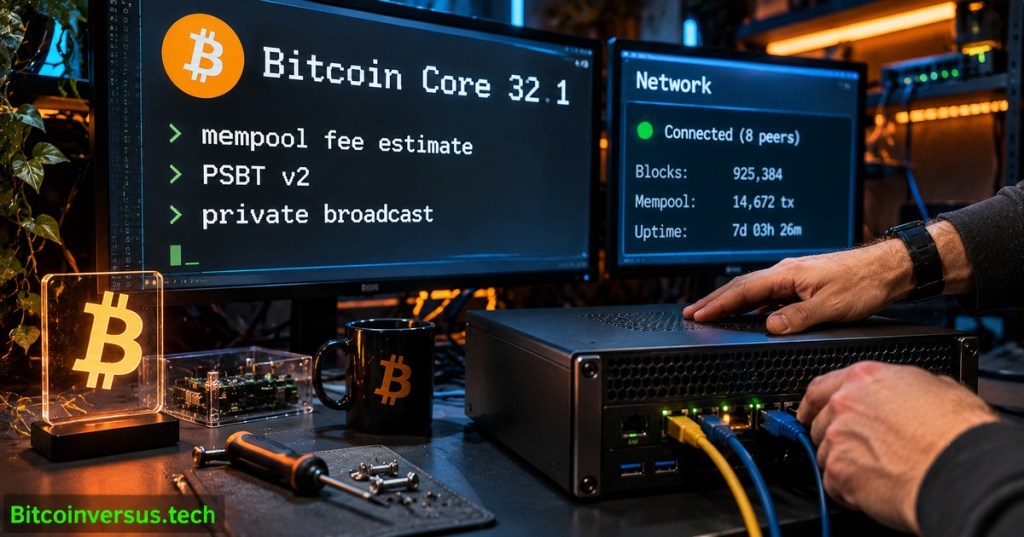
Bitcoin Core 32.1 is available after developers withheld version 32.0 over late release problems. The new major version was made available October 27–28, 2026, with changes to Bitcoin fee estimation, partially signed transactions, transaction relay and full-node administration. Although the update changes software behavior, it does not rewrite Bitcoin’s consensus rules or force every wallet user to upgrade immediately. Its security and compatibility changes still matter for operators.
Bitcoin Magazine’s Bitcoin 2026 Open Source stage, May 18: developer niftynei explains Bitcoin Core, mempool engineering and the wider development ecosystem. Authentic developer commentary recorded months before version 32.1, not footage from its release.
Why version 32.0 never shipped
Maintainers tagged 32.0 on October 21, but withheld a completed public release after discovering last-minute issues. They tagged 32.1 on October 26, then made official release files available. Earlier BitcoinVersus.Tech coverage of the fourth release candidate preceded the decision. The project’s final release notes and signed GitHub release record establish the published version; developers advise downloading binaries from the project’s official download server rather than GitHub-generated archives.
A second estimator enters the Bitcoin fee market
The `estimatesmartfee` RPC now combines a historical block-policy estimator with one based on the current mempool. In automatic mode, the software selects the lower available fee estimate. The newer estimator operates only when recent blocks suggest a healthy mempool and can fall back when transaction activity is sparse. Operators can explicitly request `block_policy` or `mempool_policy` estimates. A lower estimate is not a guaranteed saving: rapidly changing transaction demand can still delay confirmation.
Several RPCs also default to PSBT version 2, including `createpsbt` and `walletcreatefundedpsbt`. PSBTs let wallets exchange transaction information without exposing private signing keys. Applications assuming the previous default should check compatibility and can specify the `psbt_version` parameter where necessary. The publication’s node-validation primer explains why wallet interfaces and independently enforced consensus remain distinct.
Private broadcast gets a conditional IP-leak fix
Bitcoin Core 31 introduced an optional private-broadcast mode for `sendrawtransaction`, which can relay through privacy networks. Version 32.1 closes an edge case where a peer misleadingly advertised encrypted P2P v2 support, then forced a v1 retry that could bypass a Tor proxy override and reveal the sending node’s ordinary IP address. The documented conditions involve non-default settings. Fixing that path improves protection but does not establish anonymity against traffic analysis or other network-level threats.
The release also caps the private-broadcast queue at 10,000 transactions and limits transmission attempts. Such limits reduce unbounded work without proving that private relay always succeeds. For context, MARA’s private transaction submission system addresses a different workflow from Bitcoin Core’s Tor-oriented broadcast privacy.
Bitcoin Magazine, February 2, 2026: researcher Pieter Wuille discusses the cluster mempool, transaction ordering and Bitcoin fee incentives. Technical context predating 32.1; the cluster-mempool redesign originally arrived in 31.0.
What node operators should review
Automatic connection capacity rises from 125 to 200 peers, with a new inbound transaction-relay allocation. A global transaction-relay backlog and bandwidth controls aim to reduce resource consumption during high-volume periods. Version 32.1 also introduces parallel input-data prefetching during block validation, a watch-only wallet export command and machine-readable RPC discovery.
On October 28, maintainers separately issued patches for three vulnerabilities affecting supported branches. An earlier security report covers the disclosure in depth. Bitcoin Core 29.x and older are now end-of-life, making a planned upgrade important for operators seeking maintained software. Backups, release signatures, wallet integrations and configuration differences still require validation before production migration.
The key engineering change is incremental rather than a new Bitcoin protocol: better-informed fee selection, additional relay protections and fuller observability for nodes. Real-world benefits depend on network conditions, operator configuration and application compatibility.
Primary sources: Bitcoin Core release announcement; 32.1 release notes; Bitcoin Optech Newsletter #429; official security advisories. Dates checked November 15, 2026. The two Bitcoin Magazine interviews provide earlier background, not footage documenting the release.
Editor’s Note: Version 32.1 was made available after the unannounced 32.0 tag was withdrawn; none of the changes described constitutes a Bitcoin consensus-rule amendment. Private-broadcast protections are configuration-dependent, and fee estimates do not promise confirmation times. The original 1200 × 630 featured cover is a photorealistic conceptual depiction of a Bitcoin Core workstation, not a live node screenshot; screen numbers are illustrative. The official Bitcoin Optech audio and two verified Bitcoin Magazine videos are credited and dated; the videos predate version 32.1. Saved markup and rendered HTML cannot independently establish media playback or mobile layout.

BitcoinVersus.Tech is a volunteer-run publication. Optional support of 5,000 satoshis helps maintain independent technology journalism. Scan the QR from another screen using a compatible Bitcoin wallet; on the same phone, use the wallet’s image-import feature if supported. Verify the recipient 3C9o19EH5HSiwEPyCTmEKzxhNCbo2X6TTb and amount before transferring. Bitcoin transfers are generally irreversible.
We volunteer daily to ensure the information on BitcoinVersus.Tech is Verifiably True. Software information is educational, not a security guarantee, trading recommendation or instruction to run unreviewed commands. Readers should confirm compatibility before upgrading production systems. Donations are entirely voluntary.


Leave a Reply