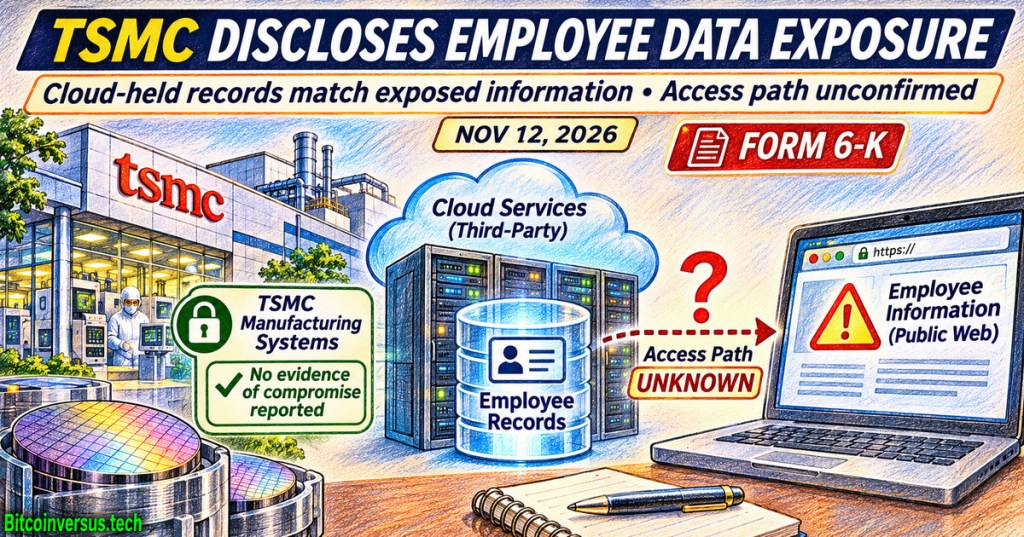
TSMC disclosed on November 12, 2026, that information concerning some current and former employees had appeared on an external website without authorization. The world’s leading contract chipmaker said the exposed information matched records held by an unnamed cloud service provider, while its investigation had found no evidence that TSMC’s own systems were compromised. The statement distinguishes an employee-privacy incident from a confirmed intrusion into semiconductor manufacturing infrastructure.
Video: Taiwan Public Television News, November 12, 2026 (Mandarin). Coverage of TSMC’s response and other recent Taiwanese data-security incidents. The company filing, rather than broadcast speculation, governs the findings reported below.
What the SEC filing actually establishes
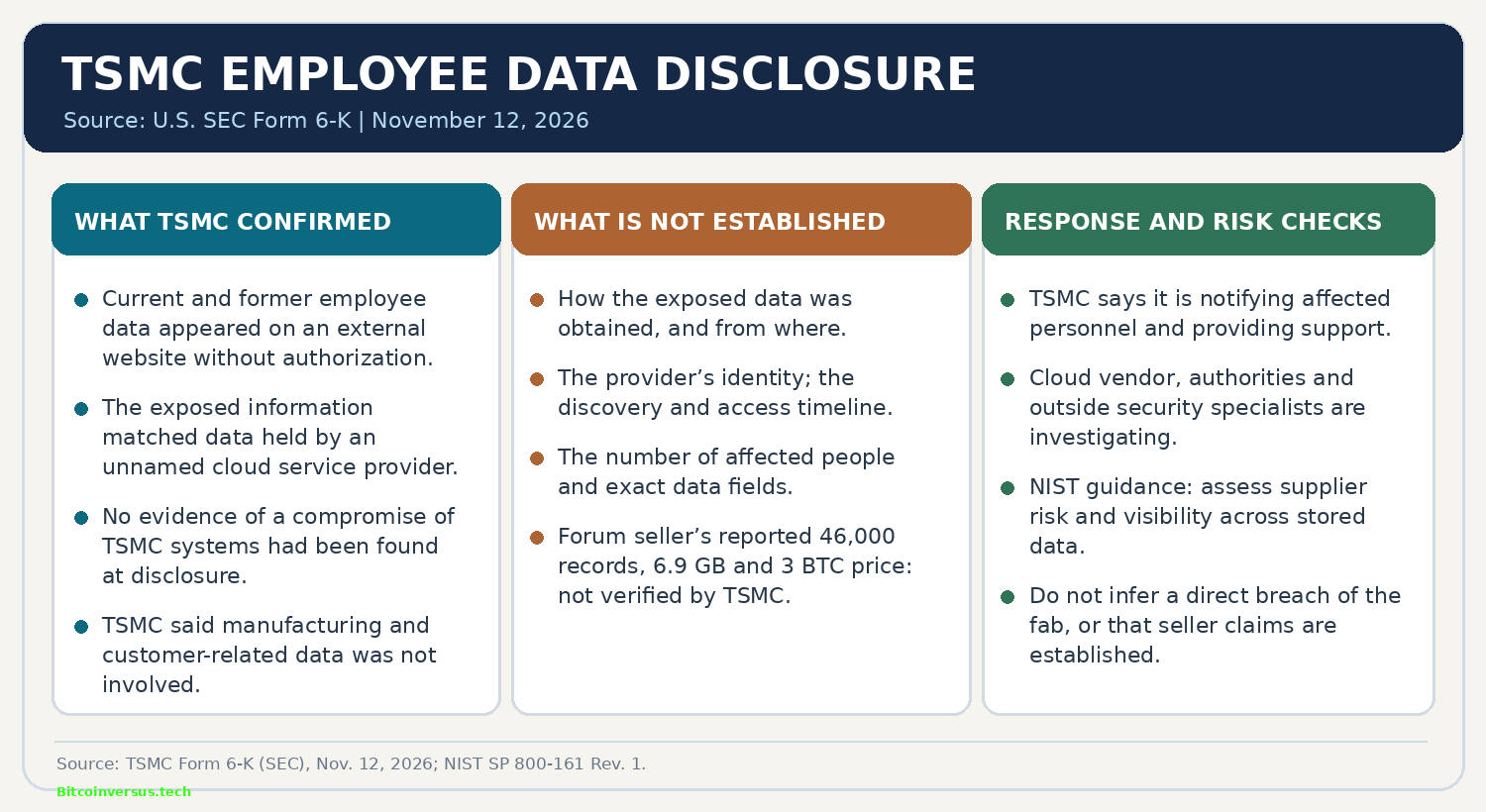
In a Form 6-K furnished to the U.S. Securities and Exchange Commission, TSMC said the exposed records matched information stored in a cloud provider’s services. It also said the information was unrelated to its operations or customer-related data. Chief Financial Officer Wendell Huang signed the November 12 filing. The document identifies neither the provider nor the technical route by which the records became publicly accessible.
TSMC says it is informing affected personnel and providing support. It has engaged the cloud vendor, relevant investigating authorities and an independent cybersecurity organization. The scope, timing and mechanism remain under investigation. For industrial context, BitcoinVersus.Tech’s coverage of TSMC’s October sales describes the company’s manufacturing scale; the employee-record disclosure is a separate event.
A 3-BTC offer remains an allegation
Taiwan’s Central News Agency and security outlet The Record report claims that a seller offered approximately 6.9 GB of information, described as roughly 46,000 employee records, for 3 bitcoin. Some coverage alleges personal contact, identification and bank details. Those figures and fields are seller claims reported by journalists, not a count or list authenticated by TSMC’s SEC filing. They do not prove the seller obtained the information from the named company’s own systems.
Cloud record matches do not identify an attacker
A matching dataset can establish that publicly exposed records correspond to information held in a provider’s environment. By itself, the match does not establish who copied them, which account or service was involved, whether a vendor was penetrated or whether another copy existed elsewhere. Those possibilities should remain hypotheses until investigators disclose evidence. Comparing the case with the recent GitHub-token investigation shows why access paths and exposed records must be distinguished before assigning responsibility.
Video: Formosa TV News, November 12, 2026 (Mandarin). A contemporary report on the alleged sale of employee data and TSMC’s early response. Numerical allegations in the broadcast are not treated as confirmed findings.
What suppliers and employers can learn
U.S. National Institute of Standards and Technology guidance on cybersecurity supply-chain risk management recommends identifying, assessing and mitigating vendor-linked risks. Its July 2026 due-diligence guide addresses supplier resilience, foundational practices and supply-chain tiers. Applied generally, those principles favor knowing which vendors retain employee records, who can access copies, how long records persist and how incident notices are coordinated. Such controls are recommendations, not claims about TSMC’s configuration.
For affected employees, an independently verified company notification is safer than following unsolicited messages promising a breach settlement or account reset. Where appropriate, monitor financial activity, strengthen authentication and contact the employer through established channels. BitcoinVersus.Tech’s multifactor-authentication primer explains one protective layer, though MFA cannot undo exposure of records already copied. The recent gateway-security report likewise illustrates why investigators must separate documented exploitation from unproven causes.
Bottom line: TSMC has acknowledged unauthorized exposure of employee data and a confirmed match to cloud-held records, but has not publicly established the attack path, victim count or the accuracy of a forum seller’s numbers. Continued updates should be judged against documented findings, not the volume of claims circulating online.
Sources and verification (November 15, 2026): TSMC Form 6-K filed November 12; Taiwan Central News Agency, November 12; The Record, November 13; NIST SP 800-161 Rev. 1 and SP 1326. Video segments offer contemporaneous context and may include additional unrelated incidents. The original illustration is schematic and does not assert a known attack path.


Leave a Reply