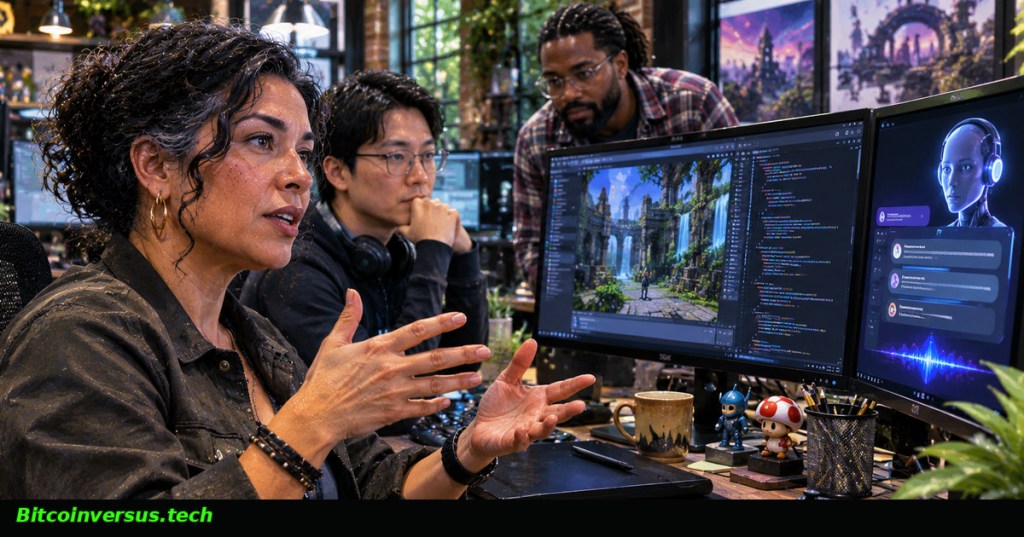
Generative AI is spreading through video game development without winning the industry’s confidence. A new GDC Festival of Gaming survey released November 12, 2026 finds that 40% of respondents use generative AI at work, while 55% believe it negatively affects gaming. More than 2,600 game-industry professionals participated. The findings reveal a divide between automating everyday work and trusting AI to produce the games people ultimately play.
The organizers’ published findings show adoption rising from 36% in the preceding survey to 40%. Negative sentiment moved from 54% to 55%; another 35% describe a mixed impact and 8% see positive effects. GDC released two editions during calendar 2026 while moving its recurring publication schedule from January to late in the year. The figures reflect different survey samples, not a controlled experiment tracking identical workers.
Game Developer’s November 12 discussion of the new GDC report, featuring GDC researcher Beth Elderkin and editor Imran Khan. Credit: Game Developer/YouTube, an original-source discussion of survey findings, layoffs and AI.
AI gets used for research long before final game assets
Among respondents already using AI, 57% use it daily. GDC’s survey describes support for research, brainstorming, repetitive administrative work, early prototyping and some programming assistance, alongside substantial opposition to generated final art and player-facing features. Its findings cannot be reduced to a vote for or against every AI application: an artist can oppose generated character art while accepting help with bug triage.
Adoption is also uneven. GDC reports that 70% of professionals at mobile-only studios and 58% working on free-to-play games use generative AI. A separate BitcoinVersus.Tech discussion of AI’s possible benefits in games examines workflow efficiencies, while the site’s SWE-Game benchmark coverage addresses the harder challenge of delivering genuinely playable results.

Layoffs add pressure, but correlation is not causation
The survey separately finds 34% of respondents were laid off within 24 months, including 39% of U.S. respondents. Among respondents who lost work, 54% remained unemployed and 27% had submitted 100 or more job applications. Those figures document hardship within the sample; they do not establish that AI caused the job losses.
GDC warns that workers affected by layoffs may have been more likely to participate. Its approximately 900 laid-off respondents are informative about their experiences, but 34% is not a verified layoff rate for the entire game industry. Financial pressures, project cancellations, studio consolidation and technology choices require separate evidence before assigning responsibility.
Engine figures show where production may shift
Among surveyed developers, 35% use Unreal Engine, down from 42% in the previous report; Unity registers 28%, compared with 30% previously. Proprietary engines rise from 19% to 23%. GDC reports that 11% of respondents working at indie studios use Godot, up from 7%. None of those survey shares measures total installed engine licenses or proves one engine displaced another.
Recent Unreal Engine 5.9 preview coverage explores AI tooling and web export; Godot 4.8 development reporting documents open-source improvements. Both platforms demonstrate why workflow choices involve more than whether a developer uses a chatbot.

PC remains the most commonly targeted upcoming release platform at 81% of surveyed developers. Meanwhile, 21% say they are already developing for the unreleased Steam Machine, and smaller groups report plans for future PlayStation and Xbox hardware. Intentions are not confirmed launch titles.
The strongest conclusion is narrower than either a coming AI takeover or a universal rejection: many workers use generative tools selectively while questioning their consequences for creative quality, employment and legal rights. GDC’s own sampling limitations make the survey a valuable industry snapshot, not a census or a forecast.
Sources and methodology
Primary sources: GDC, State of the Game Industry: November 2026; GDC’s November 12 announcement; Game Developer interview with GDC researcher Beth Elderkin; The Verge’s November 13 reporting. The report contains self-selected responses, including developers and other industry professionals; survey percentages are not independently reproduced population estimates.
Editor’s Note: GDC published the latest report November 12, 2026, after an earlier edition in January. All figures describe survey respondents, not verified counts across the entire game industry. The 1200 × 630 photorealistic featured cover is original conceptual art portraying fictional developers and a fictional software interface; no real respondents are represented. Both GDC event photographs are authentic, credited archival imagery. The November 12 video is a first-party discussion of the report hosted by Game Developer, a sibling GDC organization, not an independent audit. Iframe creation and actual visitor playback require separate tests.
Support BitcoinVersus.Tech
A voluntary 5,000-satoshi donation supports independent reporting on gaming technology and engineering. Scan the original BitcoinVersus.Tech QR using a compatible Bitcoin wallet on a second screen. On a phone, save the QR picture and import it through a wallet supporting saved-image scanning. Verify the recipient and intended payment amount before authorizing a transfer.

BitcoinVersus.Tech is volunteer-run and publishes independent technical journalism. Donations are optional, and Bitcoin payments are generally irreversible. Confirm recipient 3C9o19EH5HSiwEPyCTmEKzxhNCbo2X6TTb and 5,000 satoshis before sending. Survey reporting is informational and should not be interpreted as professional employment, legal, financial, or procurement advice.


Leave a Reply