
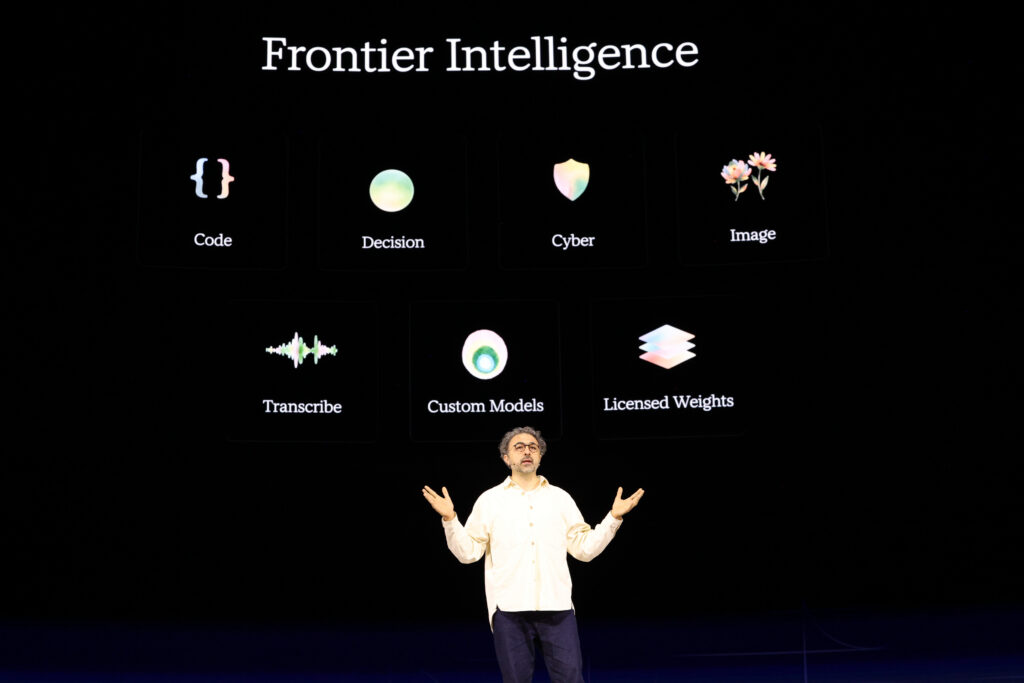
Microsoft introduced a new family of artificial intelligence models at its Ignite conference on November 17, 2026, positioning specialized coding and cybersecurity systems as lower-cost alternatives to larger general-purpose models. The announcement covers MAI Code 2, MAI Code 2 Flash and MAI Cyber 2 Flash, alongside image, speech and decision software. Microsoft’s official release describes a seven-model lineup, while Reuters reported that affordability and security are central to its strategy.
The products reach developers through GitHub Copilot, Microsoft Foundry and selected security services. Not every model has the same access level. Availability, benchmark methodology and operational safety matter as much as the headline performance comparisons.
Official archival source: Microsoft, Ignite opening keynote, November 17, 2026. The keynote presents the broader product strategy and original announcement; video is not a standalone model benchmark.
Code 2 targets real software engineering work
Microsoft reports MAI Code 2 reached 98% of GPT-6.1 Sol’s performance at roughly 40% of the price across four coding benchmarks: DeepSWE 1.1, Terminal Bench 2.1, SWE-Atlas and FrontierCode v1.1. Against Claude Opus 5.5, it claims 96% of performance at 5% of the cost. Those figures come from Microsoft’s own comparisons, not an independently replicated evaluation.
Microsoft AI, November 17, 2026. The company’s original announcement introduces its seven-model MAI portfolio.
MAI Code 2 supports complex edits, debugging and repository-wide tasks; Code 2 Flash prioritizes high-volume explanations, targeted changes and routine fixes. Both arrived in GitHub Copilot on launch day. Flash also entered a limited Microsoft Foundry preview. In its published model card, Microsoft says the hosted models can call tools within coding agents, but developers should maintain human oversight for consequential autonomous actions.
Cyber 2 Flash focuses on vulnerability discovery
The new security model targets finding, prioritizing and remediating software weaknesses. Microsoft claims MAI Cyber 2 Flash exceeded GPT-6 Astra’s quality on the CyberGymE2E benchmark while costing less than 2% as much per task. Cost per task includes model behavior and usage, rather than merely comparing advertised token prices. No general proof follows that either model will outperform rivals on every codebase.
Microsoft’s security announcement says its Perception platform is generally available and coordinates red-team simulations, blue-team detection and green-team remediation. A Recon Agent is generally available, while a Web App Pen Test Agent and additional MDASH scanning capabilities remain in preview. MDASH can analyze repositories up to 5 GB, according to Microsoft. Customers must distinguish features released today from those requiring enrollment.
Microsoft, November 17, 2026. Original company post describing Code 2, Code 2 Flash and Cyber 2 Flash.
Lower cost does not remove security risk
AI agents that inspect code and execute tools introduce fresh operational exposure. A false vulnerability finding can waste engineering time, while a mistaken automated fix can break production systems. Microsoft says governance, least-privilege permissions and independent verification must accompany continuous agent operation. Our earlier coverage of Windows agent sandboxing and a four-part cyber jailbreak risk framework explains why controls beyond model intelligence remain necessary.
The new offering also competes with other AI security approaches. BitcoinVersus.Tech examined Anthropic’s open-source bug scanner and controlled Firefox exploit research using GLM 5.3. Each illustrates a different part of the changing relationship between defensive testing, offensive capability and software maintenance.
What to watch after the announcement
Independent testing should determine whether lower operating costs hold across real repositories, cloud environments and varied failure rates. Microsoft also acknowledges its coding models are not yet optimized for fundamental scientific research or very long agent tasks. For enterprise buyers, total cost includes supervision, verification, computing, incident response and access controls, not only inference charges.
The immediate result is a broader menu of specialized models for common engineering work. Commercial adoption will depend on reliability, transparent benchmark comparisons and how safely organizations integrate agents into existing deployment pipelines.
Sources
- Microsoft AI, November 17 announcement and model comparison
- Microsoft Security, Perception and MDASH releases
- Microsoft Ignite keynote announcement
- Microsoft, MAI Code 2 model card
- Reuters, independent coverage, November 17
BitcoinVersus.Tech Editor’s Note
BitcoinVersus.Tech reports on Bitcoin, mining hardware, data centers, energy, semiconductors and emerging technology. Support independent reporting with Bitcoin: 3C9o19EH5HSiwEPyCTmEKzxhNCbo2X6TTb.
Financial disclaimer: The article is for informational and educational purposes only and is not financial, investment, legal or tax advice. Bitcoin, cryptocurrency mining and publicly traded securities can be volatile. Readers should conduct their own research before making financial decisions.
Related BitcoinVersus.Tech coverage: Microsoft agent sandboxing, cyber jailbreak risk framework, Anthropic bug scanner, Firefox exploit research.


Leave a Reply