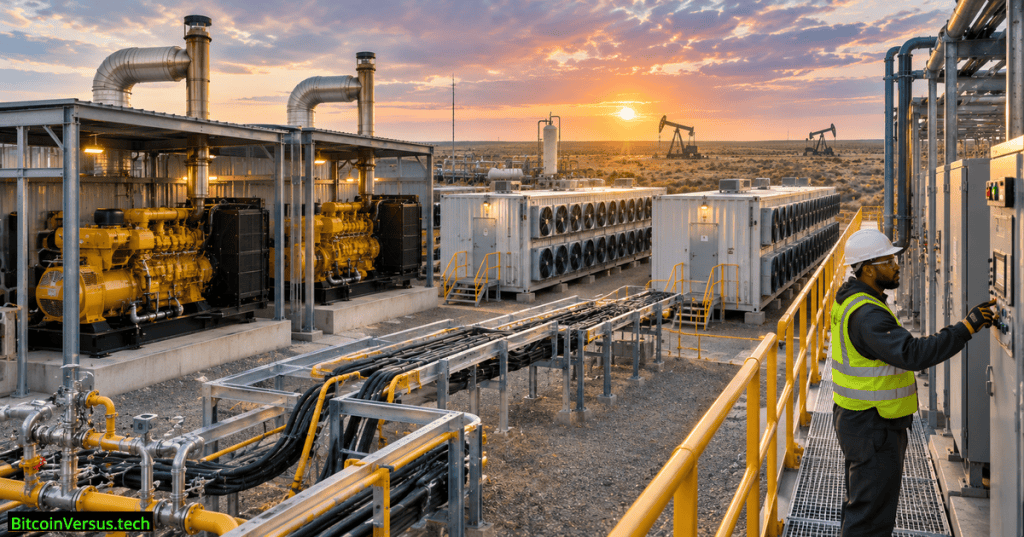
Sterling Digital says its gas-powered Bitcoin mining site in West Texas has operated continuously in its full commercial configuration since October 24, 2026. In a November 17 regulatory announcement, the company reported cumulative production exceeding two bitcoin and estimated that energy attributable to mining cost approximately $19,400 per BTC during the initial operating period. The figure is an early energy-cost estimate, not the total cost of producing a bitcoin or an audited profit margin.
Proactive interview with Sterling Digital CEO Stefan Michaelides, published in November 2025. The CEO explains the off-grid natural-gas strategy; archival background, not coverage of the November 2026 operational update.
From commissioning to continuous mining
The latest disclosure marks a step beyond Sterling’s first verified Bitcoin production in September. During commissioning, generators, electrical distribution, cooling and ASIC hardware were tested together. Sterling now says the integrated system converts locally sourced natural gas into electricity and continuously supports mining, but has not disclosed a detailed daily production log or an independently measured uptime percentage.
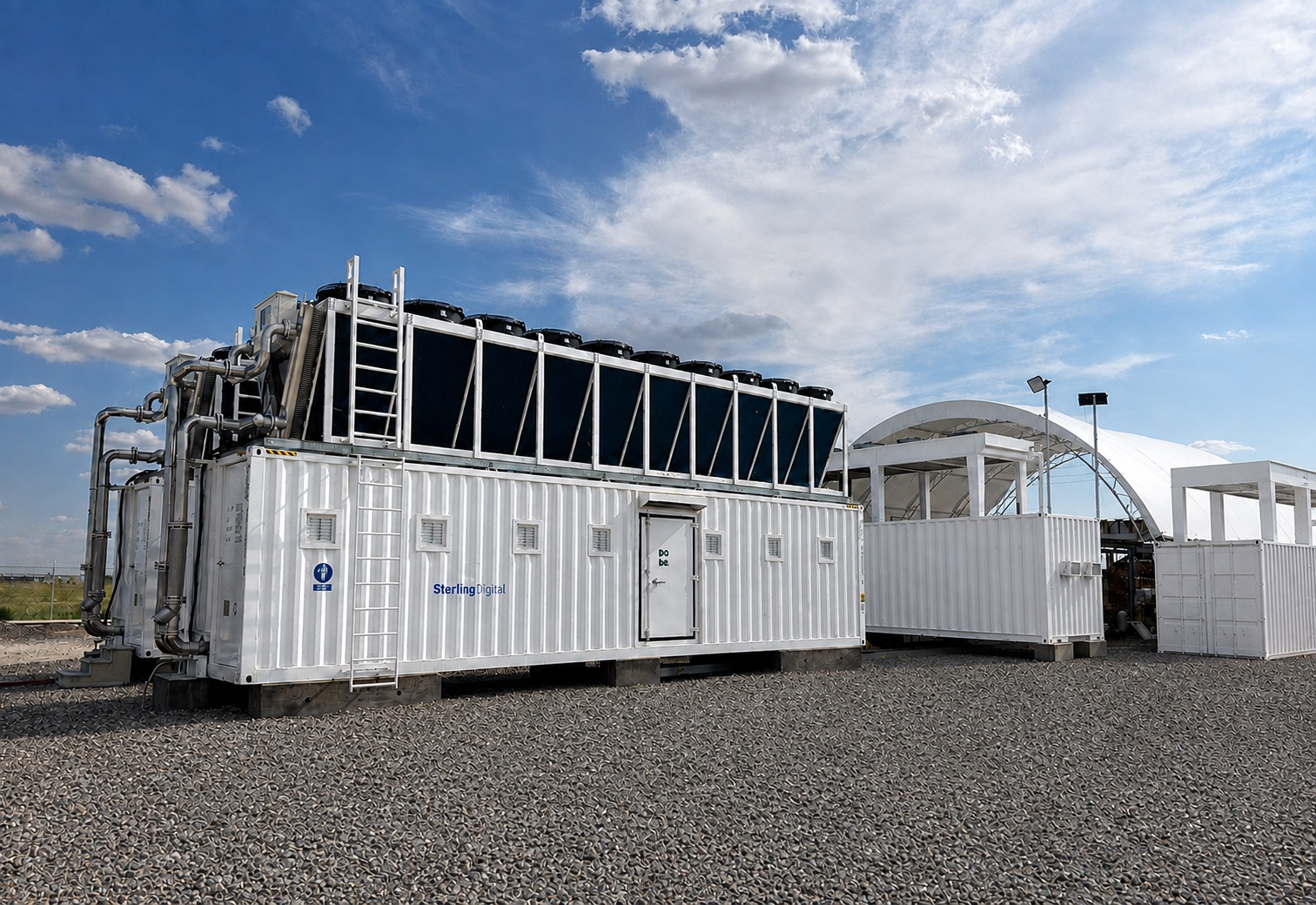
The company previously identified two Caterpillar generators rated at 2 MW each and a fleet of 420 mining servers with approximately 193,500 terahashes per second of stated computing capacity. That equals 193.5 petahashes per second, or 0.1935 exahashes per second. Those figures come from the September commissioning disclosure; the November release did not give a revised fleet-wide operating hashrate or power-meter reading. Rated generation, delivered electricity and accepted pool hashrate are distinct measurements.
Why $19,400 per BTC is not the full mining cost
Sterling describes $19,400 as an estimated energy cost attributable to producing one bitcoin. The release does not itemize generator maintenance, ASIC depreciation, employee expenses, insurance, site development, financing, pool fees or corporate overhead. Without the calculation period, fuel consumption, power output and exact BTC denominator, the estimate also cannot be converted reliably into an electricity tariff in cents per kilowatt-hour.
Bitcoin output varies with network difficulty, pool luck, mining uptime and the number of operational machines. A miner can maintain the same electricity spending while generating fewer coins after competition rises. BitcoinVersus.Tech recently covered a 9.13% difficulty adjustment, while its hashrate and hashprice guide explains why higher computing power alone does not guarantee greater revenue.
Official social-media feed: Sterling Digital on X. The timeline presents the company’s original posts about generators, commissioning and its West Texas strategy. It is an archival company feed, not independent verification of November production totals.
The economics of mining next to gas infrastructure
Sterling has described a five-year natural-gas supply agreement in Martin County tied to the WAHA gas market. Its maximum contracted supply is reported as up to 6,500 MMBtu daily, potentially supporting future expansion toward 25 MW. Neither number means a 25 MW mining plant is operating today. Site power depends on installed generator capacity, fuel delivery and operational derating.
Placing generation near a gas source can reduce fuel transportation constraints and avoid some grid charges. Yet combustion still emits carbon dioxide and nitrogen oxides, and methane leaks can offset environmental benefits. Redirecting gas from venting or flaring may improve a particular emissions comparison, but the conclusion requires measured baseline conditions, fuel leakage and generator efficiency. BitcoinVersus.Tech’s stranded-energy explainer describes the trade-offs.
SPACE DESIGN WAREHOUSE, May 2022: an independent walk-through of a separate flare-gas-powered mining farm in West Texas. Technical context only; it does not show Sterling Digital’s facility.
What the next report must establish
Sterling has now reported a date for full operations and an initial energy cost per coin. To assess economic sustainability, the next results need a defined production window, net megawatt-hours, realized hashrate, generator availability, fuel expenses and comprehensive production costs. A consistent month-over-month comparison would show whether the initial economics persist as equipment ages and mining difficulty changes.
The company joins other miners pursuing low-cost power, but comparisons require matching definitions. For example, BitcoinVersus.Tech’s Canaan power-cost report concerns a different fleet and accounting period. Sterling’s disclosure is meaningful evidence that its integrated gas-to-Bitcoin model is operating; proving durable margins requires more measurements.
Sources: Sterling Digital, November 17, 2026 regulatory announcement; September commissioning disclosure; Sterling Digital corporate site; U.S. EIA background on Bitcoin mining power.


Leave a Reply