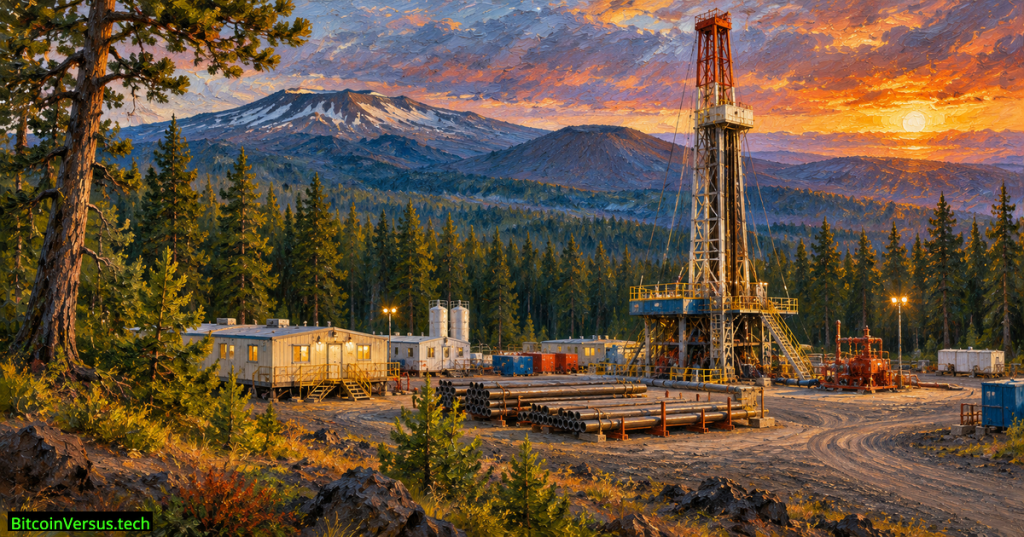
Google has agreed to purchase 50 megawatts of electricity from Quaise Energy’s planned Project Obsidian geothermal plant near Newberry Volcano in Central Oregon. Announced November 17, 2026, the power purchase agreement targets deliveries as early as 2030, with output intended to support Google’s data centers in The Dalles and the regional grid. The contract secures prospective electricity purchases; the 50 MW facility has not begun commercial generation.
Quaise describes Google as its first commercial customer. The project is intended to extract heat from exceptionally hot rock, making geothermal power available around the clock without burning fuel. Google’s agreement establishes market demand, although generation costs, drilling performance and construction schedules remain important uncertainties.
Quaise Energy, “From Lab to Field Testing of Millimeter Wave Drilling.” Official company video showing research and testing, not footage of a completed Project Obsidian power plant.
One contracted phase, larger ambitions
Quaise outlines a staged project, starting with 50 MW, followed by a proposed 250 MW phase and a longer-term ambition exceeding 1 gigawatt. Only the initial 50 MW purchase is covered by the announced Google agreement. At uninterrupted 50 MW output, theoretical annual generation would equal 50 × 8,760 hours, or 438 gigawatt-hours. Actual production will depend on availability, efficiency and plant operating conditions.
The Wall Street Journal reported a deal valuation exceeding $500 million, while the companies’ announcement did not disclose the electricity tariff or contract duration. Contract value should not be confused with an upfront Google investment or the plant’s construction budget.
Original source: Quaise Energy’s November 17 announcement on X identifying Google as its first customer and Project Obsidian as the contracted facility.
How superhot geothermal is supposed to work
Conventional geothermal plants commonly depend on naturally occurring underground reservoirs. Enhanced geothermal systems instead access heat from deep rock using engineered fluid circulation. Quaise aims to exploit temperatures around 300°C to 500°C, where sufficiently high heat flux could increase electricity output per well. Claims of up to ten times the output of traditional geothermal wells remain company projections, not measured commercial performance at Obsidian.
An important technical distinction separates the construction phases. According to Quaise’s primary announcement, the first phase will use conventional drilling equipment to reach superhot conditions. The proposed second phase would deploy millimeter-wave drilling, in which concentrated high-frequency energy heats and breaks down hard rock without a conventional mechanical cutting bit.
That approach could eventually reduce drill-bit wear in difficult formations. However, removing rock material, managing downhole temperatures, controlling energy consumption, protecting well integrity and maintaining dependable fluid circulation remain engineering challenges that field demonstrations alone have not resolved.
Quaise Energy, “Field Testing Our Millimeter Wave Technology for the First Time.” Official archival demonstration of drilling research, not proof of commercial millimeter-wave operation at Obsidian.
Transmission and local concerns
Oregon Public Broadcasting reports that Quaise will need approximately 10 miles of new transmission line to connect the site with a substation in La Pine. Electricity would then move through the wider grid toward The Dalles. A power purchase agreement does not itself deliver transmission capacity or secure every required approval.
Deschutes County Commissioner-elect Jamie Collins has called for clearer public consultation, including engagement with tribal nations, over the project’s use of public land and its effects on regional infrastructure. The developer projects 200 to 400 construction jobs and more than 50 permanent positions, but those numbers depend on successful development.
A significant contract, not yet a proven power station
The project joins a growing geothermal field already tracked by BitcoinVersus.Tech. Recent reporting covered Mazama’s superhot drilling trial, ARPA-E’s geothermal research funding, Fervo’s separate geothermal purchase agreements, and an explanation of power purchase agreements.
For Google, the 50 MW agreement could add firm, low-carbon energy to the region in the future. For Quaise, the next meaningful milestones are successful commercial wells, transmission approvals, financing and measured electricity delivery. Neither the contract’s scale nor a projected 2030 start proves that those hurdles have been cleared.
Sources: Quaise Energy, November 17, 2026; OPB, November 17; KTVZ community response; The Wall Street Journal.


Leave a Reply