ASML chief executive Christophe Fouquet is challenging the assumption that denying China access to Western semiconductor manufacturing equipment is always the best way to preserve a technological advantage. Speaking with Reed Albergotti on Semafor’s Future Proof, Fouquet advocated targeted restrictions on leading-edge equipment while maintaining permitted sales of older systems. His argument centers on preserving a technological “generation gap” rather than accelerating the emergence of a competing industrial ecosystem.
Why lithography is a strategic bottleneck
ASML manufactures lithography scanners, not finished AI processors. The Dutch company is the sole commercial supplier of extreme ultraviolet (EUV) lithography systems. Foundries use such equipment to pattern critical layers of advanced processors and memory devices. The technology helps enable higher transistor density, although chip performance and energy efficiency also depend on circuit design, manufacturing yield, packaging and memory architecture.
According to ASML’s optical technology documentation, EUV uses light with a wavelength of 13.5 nanometers, compared with 193 nanometers for argon-fluoride deep ultraviolet (DUV) systems. The wavelengths differ by a factor of approximately 14.3. That ratio is not a direct measure of transistor dimensions: numerical aperture, process chemistry and patterning methods also influence achievable resolution. Our coverage of Canon’s 193 nm scanner explains why mature lithography remains commercially valuable.
The economics of maintaining a generation gap
Fouquet’s position, reported by Semafor, is that access to older equipment gives Chinese customers an economic incentive to continue buying from established suppliers. A comprehensive cutoff could instead increase the expected return on domestic research, component manufacturing and equipment development. In May, Fouquet described permitted equipment shipments based on technology originally introduced in 2015.
The proposed strategy is not a guarantee of permanent Western leadership. Older machines can still support important manufacturing capabilities, including through multiple patterning, and policymakers may judge some of those capabilities relevant to national security. Export restrictions therefore require attention to individual equipment models, end users, servicing arrangements and actual manufacturing capabilities, not simply whether a machine carries a DUV or EUV label.
A live policy disagreement
On November 26, Reuters reported that the Netherlands intends to ask Washington not to enforce the proposed MATCH Act, which would pressure allied countries to align with tighter restrictions or risk unilateral American measures. The dispute illustrates how commercial interests, national security and allied sovereignty can diverge. ASML’s September 2024 statement and its 2025 annual filing document licensing obligations covering EUV and selected immersion DUV equipment. ASML also denied allegations of export-control noncompliance in June 2026.
The engineering race does not stop at the scanner
Expanding semiconductor capacity requires coordinated progress in optical components, light sources, precision motion, masks, metrology, materials and manufacturing expertise. The difficulty of scaling equipment production is part of the broader supply constraint discussed in our ASML AI demand report. Research into EUV stochastic defects and mask pellicles further illustrates why purchasing a scanner alone cannot reproduce an advanced fabrication process.
Ultimately, Fouquet is advocating a competitive strategy built on continued innovation and selective technological access. Its success would depend on whether the pace of Western engineering advances exceeds the pace at which Chinese manufacturers develop alternatives, and whether the resulting security risks remain acceptable to the governments responsible for licensing. The outcome remains uncertain; the strategic trade-off is already central to the global semiconductor industry.
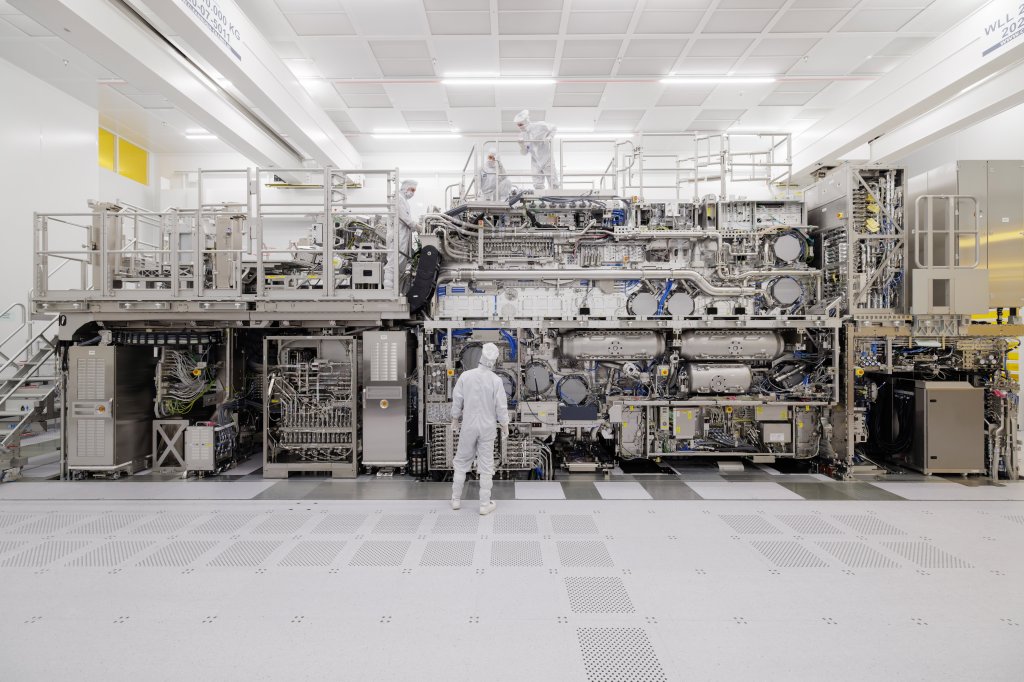
Featured image: ASML EXE 5200B cleanroom photograph, © ASML, from the BitcoinVersus.Tech media archive. The photograph depicts an EUV system, not equipment being shipped to China.
We volunteer daily to ensure the credibility of the information on this platform is Verifiably True. If you would like to support to help further secure the integrity of our research initiative, please scan the QR code below.



Leave a Reply