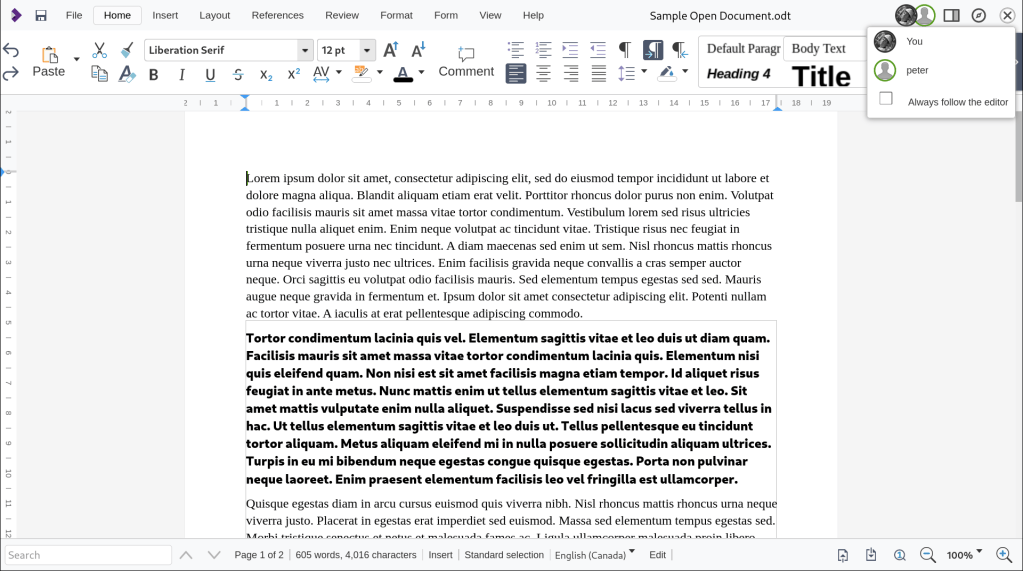
An open-source office server can conserve physical memory by deliberately reserving more space in its parent process. On November 24, 2026, Collabora Online developer Méven Car published benchmark results for an optimization that reduces unnecessary duplication of Linux memory pages. A blank text document consumed approximately 55% less memory after the change, while two more demanding document workloads produced smaller but substantial savings.
The results concern a server-side change to the development code, not a measured reduction in every user’s browser memory. The optimization was also covered by Phoronix on November 24.
Why a few bytes can cost an entire page
Collabora Online uses a parent process known as forkit to prepare shared office-suite resources before creating a separate worker process for each document. Linux can initially map the same physical memory into multiple processes after a fork. When a worker writes to a shared private mapping, the operating system creates a separate copy of the affected page. The mechanism is called copy-on-write.
Consider a conventional 4 KiB memory page containing mostly unchanged data and a small reusable heap region. An allocation of 32 bytes inside that region may trigger duplication of the entire 4,096-byte page. The page copy is 128 times the size of the allocation, although the actual process-wide overhead depends on the number of distinct pages modified.
The Collabora optimization changes the allocator’s starting conditions: the parent reserves unused regions before workers are created, encouraging document-specific allocations to land in new pages rather than modifying inherited ones. Packing new objects together can keep more existing physical pages shared across workers.
Measured memory consumption
The developer tested simulated editing sessions on a machine with four processor cores and 8 GB of memory, adding users in groups of ten. The published per-document measurements were:
| Workload (open documents) | Before (MB) | After (MB) | Reduction |
|---|---|---|---|
| Blank text (100) | 53.9 | 24.4 | 54.7% |
| Writer (70) | 73.6 | 47.8 | 35.1% |
| Impress (50) | 72.1 | 50.3 | 30.2% |
The parent preparation reportedly takes about 11 milliseconds at startup. The developer estimates savings of roughly 25 GB for a busy server handling a thousand concurrent users. That is an extrapolation, not a benchmark of a thousand simultaneous users. A deployment’s savings will depend on document complexity, distinct active documents, allocator behavior and memory pressure.
Why server capacity planners should care
Reducing the private memory required for each worker may increase the number of documents a server can handle before exhausting RAM. It does not guarantee a proportional increase in throughput: CPU utilization, storage latency and network demand can become limiting factors. Capacity testing should therefore measure actual worker memory, shared pages, response latency and concurrent sessions together.
Related BitcoinVersus.Tech coverage includes GPU memory visibility, shared-memory hardware, virtualization in Kubernetes and workload resource monitoring. Each illustrates how software architecture affects hardware utilization.
Administrators can follow the official stable release notes and qualify the optimization in a staging environment before treating the reported reductions as a production capacity assumption.
We volunteer daily to ensure the credibility of the information on this platform is Verifiably True. If you would like to support to help further secure the integrity of our research initiative, please scan the QR code below.



Leave a Reply