Suppliers selling computing and connectivity infrastructure to telecommunications companies are expanding beyond the traditional mobile network equipment market. On November 17, 2026, MTN Consulting released its second-quarter vendor study, estimating quarterly telecom network infrastructure revenue at $63.7 billion, up 15.3% from the equivalent quarter of 2025. The research follows 137 vendors, including businesses subsequently acquired.
Annualized vendor revenue reached $233.3 billion, an increase of 12%. Meanwhile, telecom operators’ quarterly capital expenditure reached $73 billion, up 7.2%. The figures represent different economic measures and should not be subtracted to estimate spending on artificial intelligence. They nevertheless illustrate the changing composition of telecom infrastructure demand.
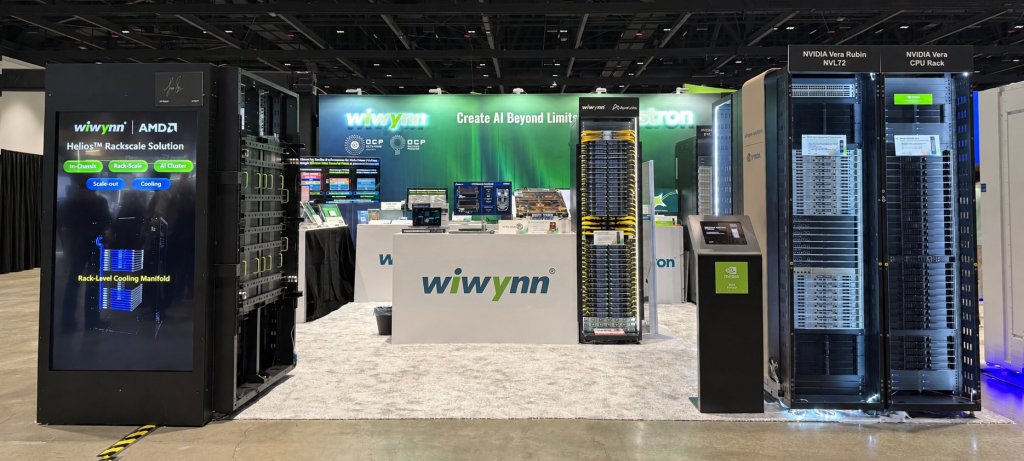
Featured photograph: Wiwynn’s rack-scale AI hardware exhibit at the October 2026 OCP Global Summit. The company’s official event recap includes technical video presentations on computing, power, cooling and interconnects. Video playback could not be independently tested.
SmartChart #13: Comparing vendor growth
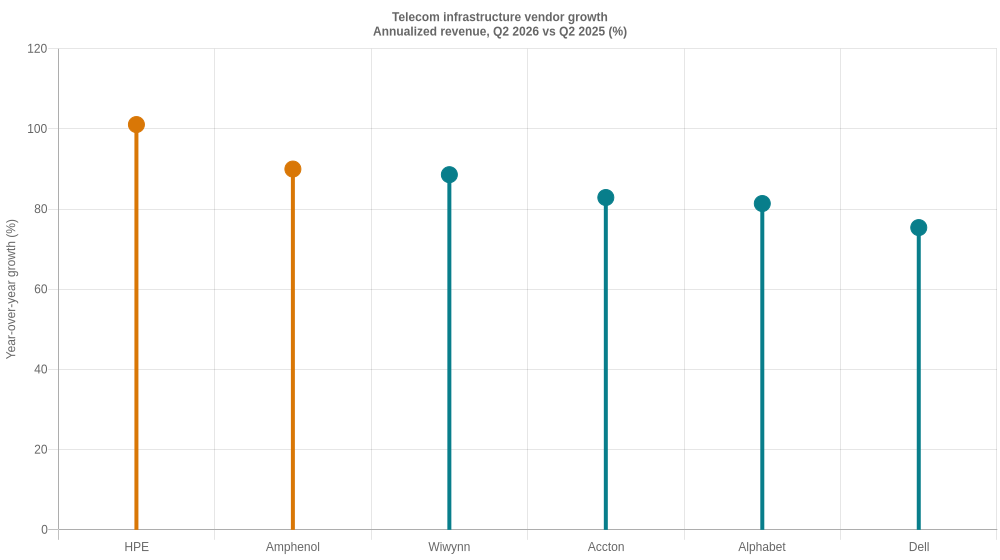
MTN distinguishes the effects of mergers from underlying expansion. HPE’s 101.1% annualized telecom infrastructure revenue increase incorporates Juniper, while Amphenol’s 90% increase includes the acquired CommScope connectivity business. Among the named suppliers expanding organically, Wiwynn recorded 88.6%, Accton 82.9%, Alphabet 81.4% and Dell Technologies 75.4%. The percentages measure the change in estimated annualized revenue from telecom customers, not each company’s total corporate sales.
The lollipop format gives every supplier a common zero baseline while keeping the six observations readable. Separating the acquisition-influenced values from organic growth prevents the two acquisition-related figures from being interpreted as equivalent measures of underlying demand. The public report summary does not provide an acquisition-adjusted growth rate for HPE or Amphenol.
Why the hardware mix is changing
AI infrastructure requires networking across accelerator servers, storage and management systems. Large distributed training jobs exchange intermediate results across multiple processors, making link bandwidth, congestion management and latency consequential to utilization. Optical transport connects facilities over longer distances, while switching hardware handles traffic within and between racks. The engineering problem extends beyond adding more radios or increasing mobile subscriber capacity.
At the 2026 OCP Global Summit, Wiwynn presented rack-scale systems and supporting infrastructure. Such equipment must integrate electrical distribution, high-speed links and thermal management. Related engineering developments include Semtech’s signal-integrity sales growth, near-package optical production, Eliyan’s optical chiplet platform and optical module component development.

The traditional leaders still matter
Huawei remained the largest supplier in MTN’s tracked market at 17.6% of annualized revenue. Ericsson and Nokia followed at 9.5% and 7.6%, respectively. Together they accounted for 34.7%, down 0.8 percentage points from the year-earlier period. Their established positions coexist with faster growth at selected server, cloud and connectivity suppliers.
The estimates do not establish that AI alone caused every increase. Acquisitions, customer mix, product pricing and timing can all affect the reported totals. A separate November 19 Dell’Oro Group update also identified improvement in radio access networking, a narrower market with a different measurement boundary. The next test is whether infrastructure suppliers sustain growth as operators deploy more computing capacity, fiber and high-speed networking.
We volunteer daily to ensure the credibility of the information on this platform is Verifiably True. If you would like to support to help further secure the integrity of our research initiative, please scan the QR code below.



Leave a Reply