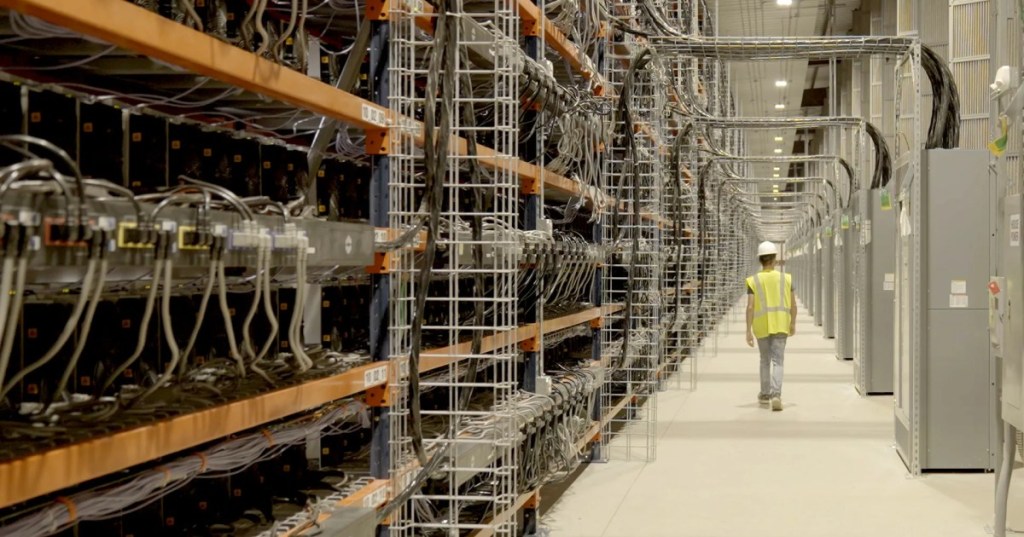
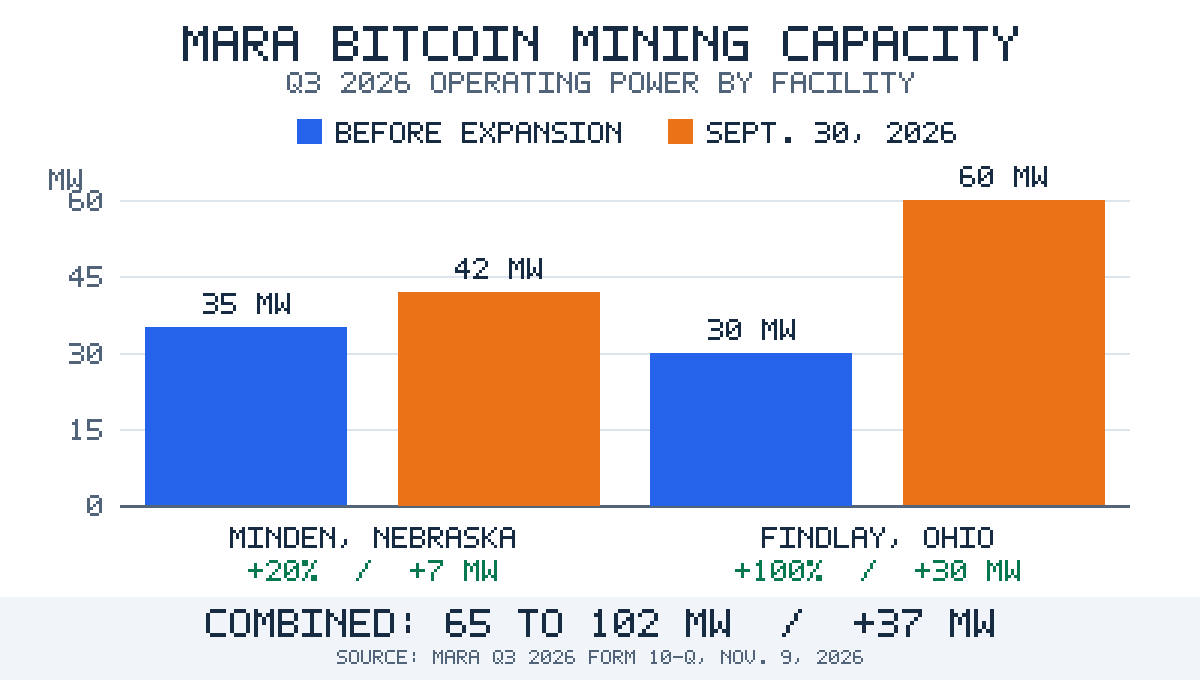
MARA Holdings increased operational power capacity at two American Bitcoin mining facilities during the third quarter of 2026, according to its November 9 quarterly SEC filing. Its recently acquired Central Nebraska facility rose from 35 to 42 megawatts (MW), while its Central Ohio operation increased from 30 to 60 MW. Together, the two expansions represent 37 MW of additional operational capacity compared with their previous reported levels. The disclosure describes Q3 progress, not a November commissioning event.
Nebraska: completing the Meerkat expansion
MARA acquired the Nebraska data center from Mining of the West on January 21 for approximately $25.2 million, including transaction costs. The company portfolio identifies its Minden site as a seven-acre, grid-connected 42 MW facility. Its 7 MW increase represents 20% growth from the original operational rating. The acquisition consideration equates to approximately $600,000 per MW of nameplate capacity, an asset-purchase ratio rather than the cost of constructing a new mining facility.
The November earnings presentation provides an important regional distinction: Central Nebraska had 134 MW operational against 142 MW of total capacity as of September 30. Although the new site reached its stated nameplate rating, the combined regional portfolio was not operating at its full total capacity. MARA’s separate Kearney site has been discussed in our Project Horizon coverage. The two locations should not be confused.
Ohio: converting electrical headroom into operating capacity
MARA’s Central Ohio facility doubled its operational capacity during Q3. The portfolio identifies Findlay as a grid-connected location with 60 MW currently available and a potential path to 150 MW. The September 30 earnings deck likewise distinguishes 60 MW operational from 150 MW total. That leaves 90 MW of reported headroom, not an assurance of near-term mining or AI deployment.
Energizing industrial computing loads requires coordinated utility service, transformers, switchgear, circuit protection, distribution and heat rejection. A facility’s gross power capacity includes more than the ASICs themselves. If the additional 37 MW were devoted entirely to miners rated at an illustrative 15 J/TH, the theoretical increase would be approximately 2.47 EH/s. At continuous full load, 37 MW would consume 888 MWh per day. Real performance depends on auxiliary consumption, installed equipment and curtailment; the calculation is not a measured site result.
Power availability is not Bitcoin production
MARA reported 71.2 EH/s of energized fleet hashrate at quarter end, a theoretical manufacturer-rated measure rather than sustained live throughput, as explained in our Q3 fleet analysis. The Long Ridge transaction represents a different Ohio infrastructure initiative. Likewise, Bitdeer’s Massillon expansion illustrates a separate operator’s capacity milestone.
Minden and Findlay demonstrate how existing electrical assets can support staged expansion without equating all announced capacity with productive load. Future disclosures should identify site-level operating hashrate, utilization and actual electricity consumption, especially as MARA evaluates alternative computing workloads. Source: MARA Q3 earnings presentation, page 13.
We volunteer daily to ensure the credibility of the information on this platform is Verifiably True. If you would like to support to help further secure the integrity of our research initiative, please scan the QR code below.

For mobile scanning, open the article on another display and scan the QR code with a Bitcoin wallet. The voluntary donation amount is 5,000 sats. Verify the receiving address 3C9o19EH5HSiwEPyCTmEKzxhNCbo2X6TTb before sending.
BitcoinVersus.tech is not a financial advisor. This media platform reports on financial subjects purely for informational purposes.


Leave a Reply