XPENG says its automated humanoid manufacturing line is designed to complete an IRON robot every 2.5 minutes at full capacity. The November 25 AI Day disclosure establishes a new production target following the company’s earlier production-line milestone. Hardware mass production is planned for January 2027, with retail training scheduled for the first quarter.
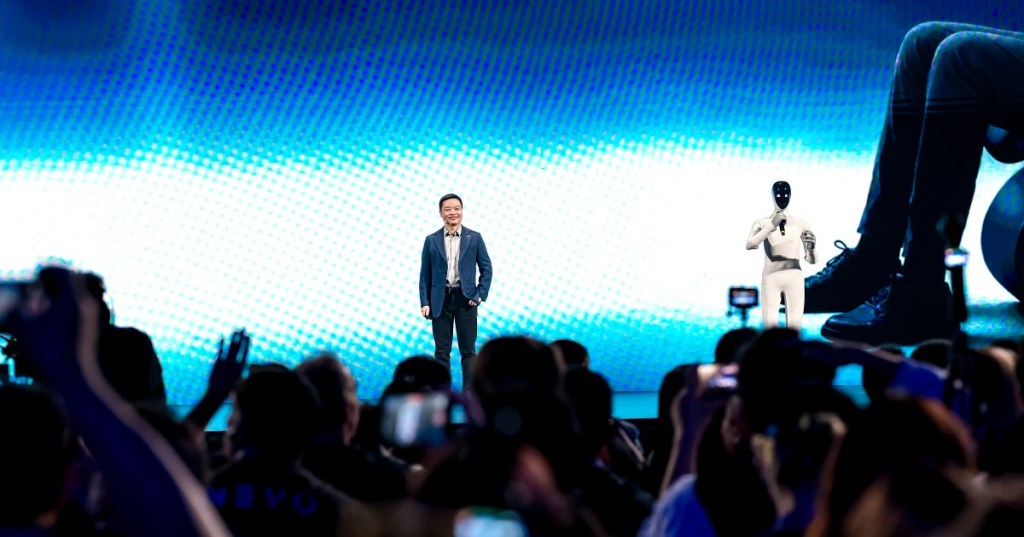
Featured photograph: XPENG IRON at AI Day 2026, credit XPENG via GlobeNewswire.
A factory designed around a production interval
An interval of 150 seconds corresponds to 24 completed robots per hour at the stated design rate. Continuous operation for eight hours would yield 192 robots; uninterrupted operation for an entire 24-hour day would yield 576. Neither calculation represents actual output. Maintenance, component availability, staffing, rework, quality-control failures and commissioning will affect realized throughput.
XPENG reports more than 600 AI-assisted inspection points and over 1,000 qualification tests for components and finished robots. Such procedures matter because humanoid systems combine multiple mechanically loaded joints, sensors, batteries, power electronics and safety-critical controllers. A robot can pass a demonstration while still presenting unacceptable failure rates in sustained commercial service.

From perception to motion
The company describes a three-layer control architecture: high-level reasoning, real-time perception and decision-making, and direct physical execution. IRON reportedly has 76 degrees of freedom, more than 1,500 tactile sensing points and three Turing processors with a combined claimed 2,250 TOPS of effective computing performance. TOPS is a workload-dependent measure and should not be interpreted as a guarantee of task reliability.
The layers have different timing requirements. A language-oriented planner may take longer to determine a goal, whereas a balance or torque controller must react rapidly to changes in forces and body position. Separating them allows engineers to enforce hardware constraints even when higher-level software encounters uncertainty.
A measurable commercial milestone
The first retail deployments are intended to test customer reception and product guidance before broader applications. Production targets become meaningful when accompanied by actual deliveries, sustained availability, intervention frequency, repair cost and task completion data. A high-rate factory can reduce manufacturing bottlenecks, but the economic value of each robot ultimately depends on useful work performed safely over its service life.
Sources and related coverage
XPENG AI Day announcement | XPENG manufacturing release
China Post Tests 45 Humanoid Robots in a High-Speed Parcel Sorting Hub | Volvo Trains Wheeled Humanoid Robots for Factory Production in 2027 | Bigwave’s Walking Humanoid Integrates With an Automotive Production Line | GigaDevice’s 750 MHz Industrial Processor Family Puts EtherCAT Inside Robot Joints
We volunteer daily to ensure the credibility of the information on this platform is Verifiably True. If you would like to support to help further secure the integrity of our research initiative, please scan the QR code below.

For mobile scanning, open the article on another display and scan the QR code with a Bitcoin wallet. The voluntary donation amount is 5,000 sats. Verify the receiving address 3C9o19EH5HSiwEPyCTmEKzxhNCbo2X6TTb before sending.
BitcoinVersus.tech is not a financial advisor. This media platform reports on financial subjects purely for informational purposes.


Leave a Reply