
GigaDevice is organizing its high-performance industrial microcontrollers around a shared silicon architecture, with specialized versions for robot joints, factory automation and embedded displays. The company announced the GD32H7 portfolio at electronica in Munich on November 10, 2026, and All About Circuits reported on the exhibition on November 25. Full sample availability is targeted for January 2027, followed by planned mass production in April.
The announcement consolidates previously introduced variants rather than establishing a new processor architecture or a completed fabrication milestone. The common design uses a 32-bit Arm Cortex-M7 CPU, with versions operating at 600 MHz and 750 MHz. GigaDevice reports a maximum CoreMark score of 3,736 for the portfolio, not for every individual model.
A 9 mm chip for robotic joints
The GD32H77R robot-joint variant combines a 600 MHz CPU with an EtherCAT controller and two integrated Ethernet physical-layer transceivers. Its 169-ball package occupies a nominal 81 square millimeters. Dedicated position-sensor interfaces and hardware mathematical functions support servo control. GigaDevice claims transmission latency below 50 nanoseconds, a component-level figure that should not be confused with the complete time required to measure a joint and update its motor current.
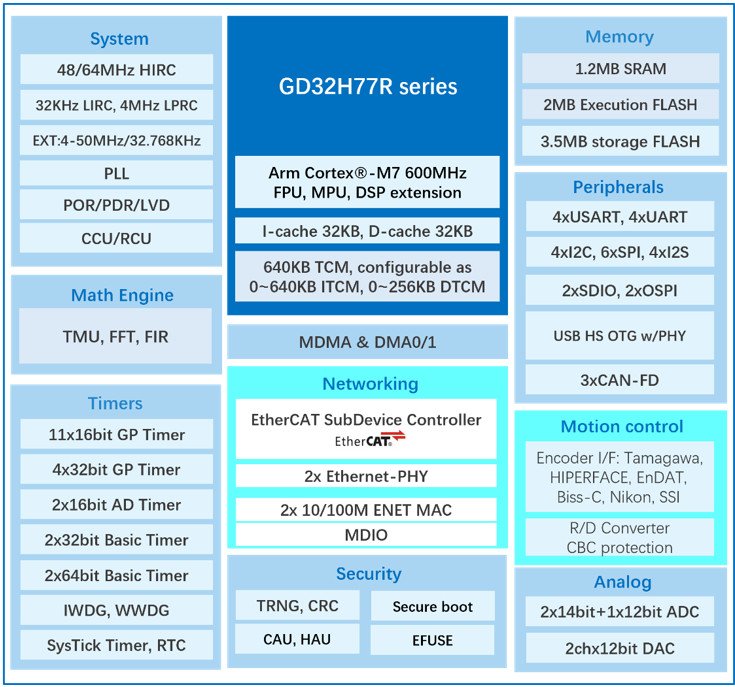
A servo controller must repeatedly measure current or position, calculate an error and update its output. Moving trigonometric operations and signal filtering into dedicated circuits can relieve the CPU of repetitive arithmetic. Integrating network transceivers can also remove external components from a joint-control board, although connectors, magnetics and other supporting circuitry may still be required.
Comparable approaches appear in our coverage of MIPS robot-joint controllers and high-frequency GaN motor drives. The motor’s electrical characteristics and control-loop requirements ultimately determine whether integration delivers measurable system improvements.
Why deterministic memory matters
A processor clock measures timing, not completed instructions or guaranteed response time. A real-time system must also limit unpredictable delays when fetching code and data. The GD32H7 design includes 640 KB of tightly coupled memory, providing a direct CPU memory path for time-sensitive instructions and working data.
Storage specifications deserve particular attention. The November portfolio release describes 2 MB of execution flash and 8 MB of storage flash, but the GD32H77R product selector lists 5,632 KB of total flash for its joint-control part. The architecture diagram separates that into 2 MB of execution flash and 3.5 MB of storage flash. Engineers should select memory capacity using the exact part number rather than a family-wide headline.
One architecture across industrial equipment
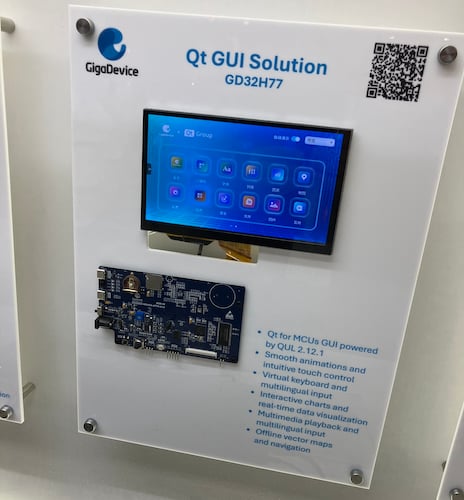
Display-oriented variants provide dedicated graphics hardware and display interfaces, while automation variants emphasize analog measurement or synchronized motion. Shared development tools can reduce the amount of firmware that needs to be rewritten when different devices within a factory use related processors. Our earlier articles on GigaDevice’s LVGL integration and STMicroelectronics’ industrial MCU illustrate complementary strategies for embedded computing.
GigaDevice reports functional-safety certification for the portfolio and includes hardware cryptography. Neither a certified component nor secure-boot support automatically makes an entire robot safe or secure. Board-level timing, thermal measurements, fault behavior and independently reproduced benchmarks remain important validation milestones ahead of production.
Sources: GigaDevice, November 10, 2026; All About Circuits, November 25, 2026; China Hot Tech, November 10, 2026; GD32H77R product specifications. Featured illustration: GigaDevice.
We volunteer daily to ensure the credibility of the information on this platform is Verifiably True. If you would like to support to help further secure the integrity of our research initiative, please scan the QR code below.



Leave a Reply