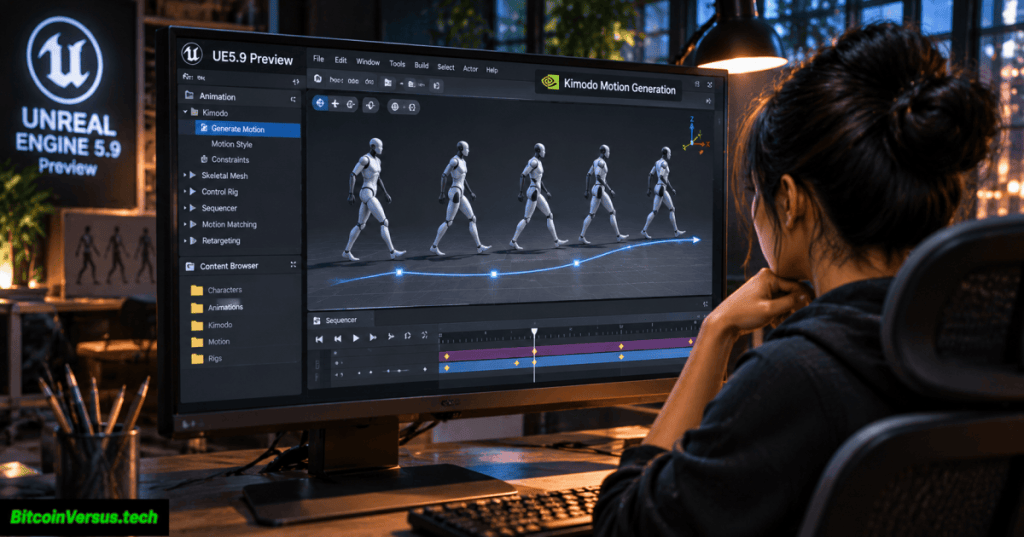
NVIDIA announced on November 24, 2026, that its Kimodo motion-generation model has become the first model integrated into the guided animation framework of Unreal Engine 5.9 Preview. The developer announcement describes a workflow in which animators specify how a digital character should move by combining written descriptions, drawn trajectories and selected poses within Unreal’s Sequencer timeline. Rather than generating an entire game, the system addresses the narrower problem of constructing character animation.
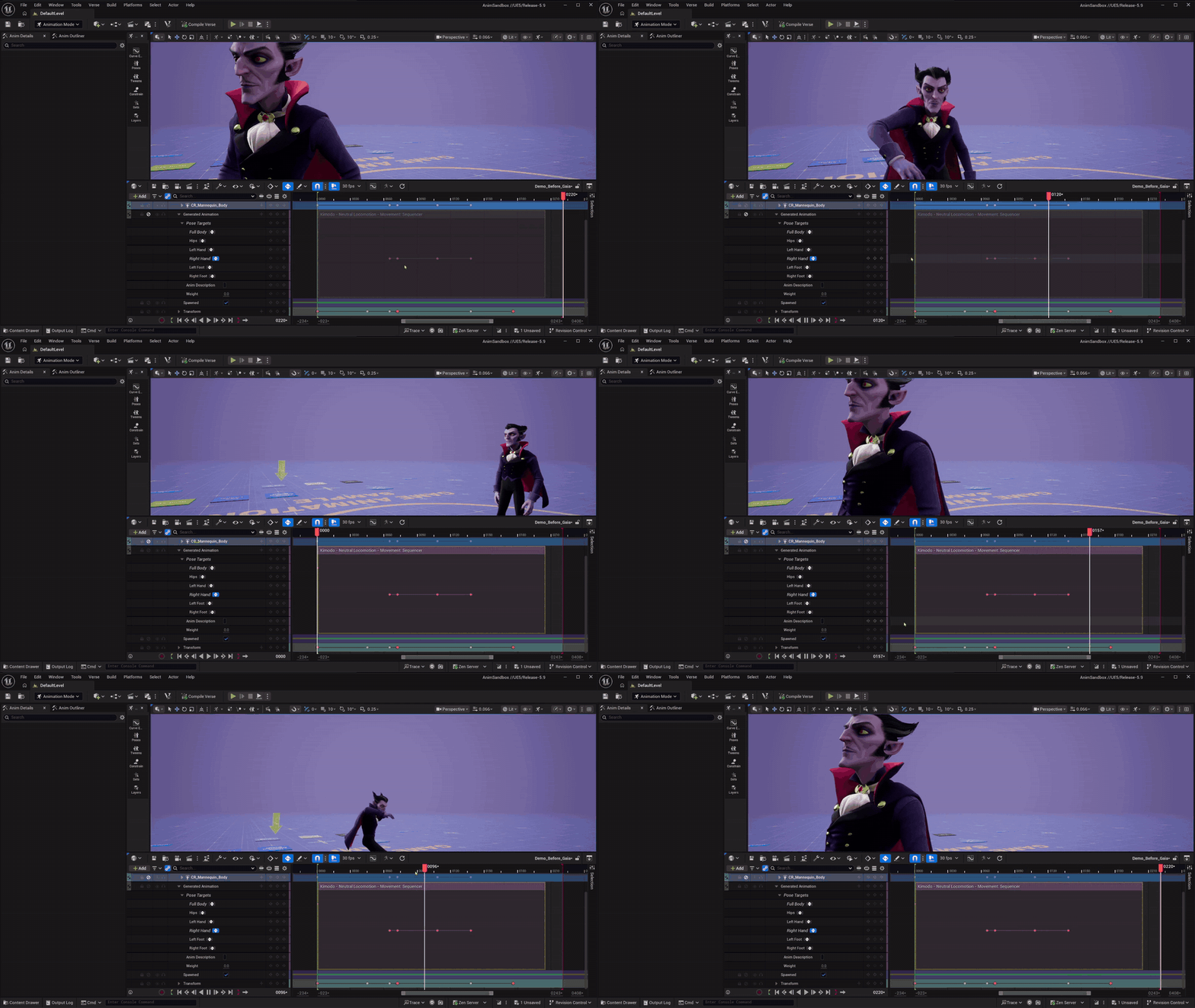
From key poses to continuous movement
A three-dimensional character typically consists of a visible mesh and an underlying skeleton. Rotation and translation of the skeleton’s joints deform the mesh, producing movement. Artists traditionally define important poses at selected frames and refine the transitions between them. Motion capture offers another approach by recording an actor’s movement, but captured sequences may require substantial adjustment to fit a different character or environment.
A path specifies where the character should travel, whereas a pose specifies the arrangement of its limbs at a particular moment. Neither instruction alone determines every intermediate joint angle. A character walking around a corner, for example, must coordinate foot placement, body orientation and arm movement while maintaining a plausible gait. Kimodo attempts to infer the missing motion from learned examples. The animator retains control over the requested trajectory and important poses rather than accepting an entirely unconstrained sequence.
How the motion diffusion model works
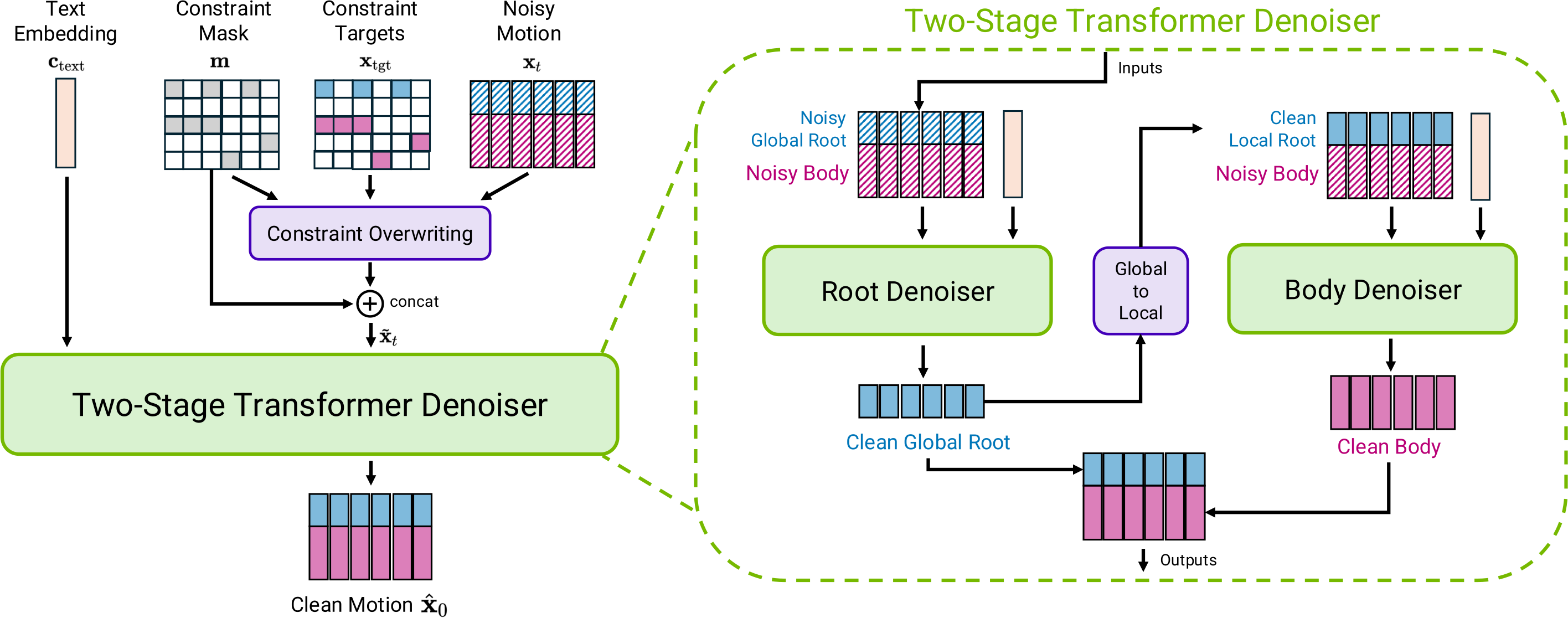
The underlying NVIDIA research describes a diffusion model trained on approximately 700 hours of optical motion-capture recordings. Generation begins with a noisy motion representation and progressively refines it. Two successive transformer components separate global character movement from local skeletal movement. The resulting representation enables constraints on the position and orientation of selected joints, including hands and feet.
The public Kimodo repository provides model variants for human and robot skeletons, along with an evaluation framework. Its documentation estimates approximately 17 GB of video memory for fully GPU-based generation in the standalone implementation. Moving text encoding to the CPU reduces the stated requirement to less than 3 GB at a speed cost. Those figures should not be interpreted as verified hardware requirements for the Unreal integration. The repository also documents an October 15 model revision correcting a training and evaluation data overlap in an earlier version.
What remains for game developers to validate
The integration complements other recent game-development advances, including Unreal Engine’s experimental browser workflows, Unity’s development automation and Godot’s engine improvements. Meanwhile, Cornell’s acoustic motion-tracking research illustrates a separate challenge: reconstructing actual human movement rather than synthesizing new motion.
Generated animations still require inspection for foot sliding, environmental intersections, contact timing and continuity between clips. A kinematic model is not a guarantee of physically valid movement. The November integration remains part of a preview release, and NVIDIA has not established an independently measured reduction in animation production time. The next useful milestone will be production comparisons measuring editing effort, motion quality and consistency across different characters and scenes.
We volunteer daily to ensure the credibility of the information on this platform is Verifiably True. If you would like to support to help further secure the integrity of our research initiative, please scan the QR code below.

BitcoinVersus.tech is not a financial advisor. This media platform reports on financial subjects purely for informational purposes.


Leave a Reply