
Cornell University researchers have demonstrated a way to estimate full-body movement using the speaker and microphone already installed in a smartwatch. Called EchoMotion, the system reconstructs the positions of 12 body joints using reflected ultrasonic signals and a compact machine-learning model. The university announced the findings on November 11, 2026, following presentation of the research at UbiComp/ISWC in October. The system remains a research demonstration rather than an available consumer fitness application.
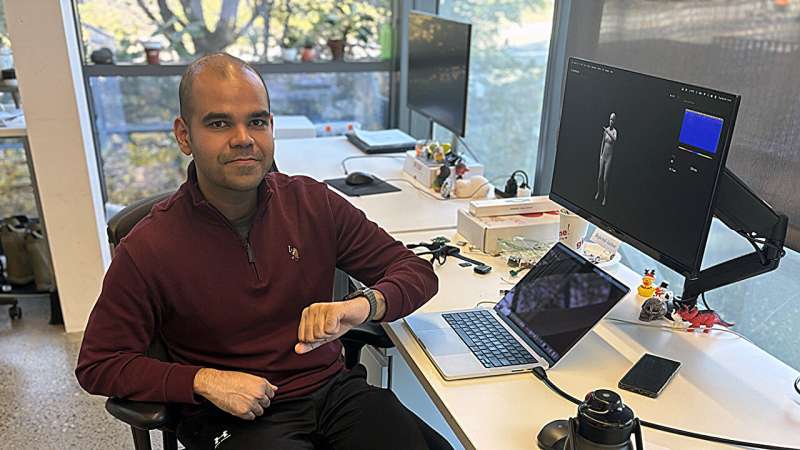
How a smartwatch can sense distant joints
Conventional smartwatch motion sensing depends heavily on inertial measurement. An accelerometer measures specific force, while a gyroscope measures angular velocity. Both instruments provide information about the watch itself. Inferring a knee angle or the position of an ankle from wrist motion alone is considerably more difficult because different body configurations can produce similar wrist trajectories.
EchoMotion introduces another source of information. Its speaker transmits sound at ultrasonic frequencies, and its microphone receives reflections from surrounding surfaces, including the wearer’s body. Moving limbs change the acoustic propagation paths. A trained model interprets the resulting signal patterns to estimate body geometry. Unlike optical motion capture, the operating system does not require a camera pointed at the wearer. Related sensing approaches include Doppler radar and camera-based sports measurement and machine-learning-assisted optical touch sensing.
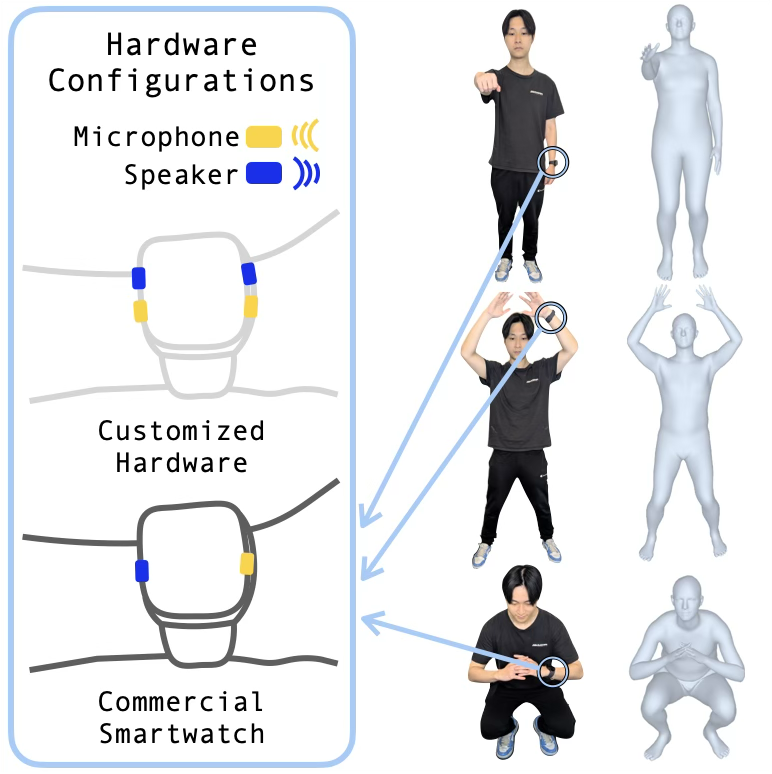
Measuring accuracy and power consumption
The researchers’ published abstract reports mean per-joint position errors of 5.36 cm for a custom prototype, 5.99 cm for a commercial smartwatch evaluation and 6.41 cm in a study outside controlled laboratory conditions. The respective groups included 10, 15 and 10 participants. Mean position error describes the average spatial discrepancy between estimated and reference joint locations; it does not imply that every joint stays within that distance. The study is published in Proceedings of the ACM on Interactive, Mobile, Wearable and Ubiquitous Technologies.
According to Cornell, the acoustic sensing prototype required approximately 12 mW. A separate 30-minute Galaxy Watch 6 session consumed 5–6% of its battery. The two measurements describe different system boundaries: sensing power alone cannot establish the complete application’s energy consumption. Digital Trends reports that the researchers also demonstrated exercise classification. Small embedded models are an important development direction, as illustrated by Arm’s vector-processing microcontroller architecture.
The next challenge: crowded environments
Acoustic sensing also introduces a distinct challenge: reflections from another person can resemble signals associated with the wearer. Cornell observed reduced performance in a hallway containing other people. Larger and more diverse validation studies would help establish reliability across body types, clothing, watch placement and crowded environments. Potential applications include exercise feedback and avatar control alongside lightweight augmented-reality eyewear. Clinical rehabilitation would require additional validation. EchoMotion demonstrates how existing consumer hardware can acquire a new sensing capability through software without adding dedicated motion-capture equipment.
We volunteer daily to ensure the credibility of the information on this platform is Verifiably True. If you would like to support to help further secure the integrity of our research initiative, please scan the QR code below.

BitcoinVersus.tech is not a financial advisor. This media platform reports on financial subjects purely for informational purposes.


Leave a Reply