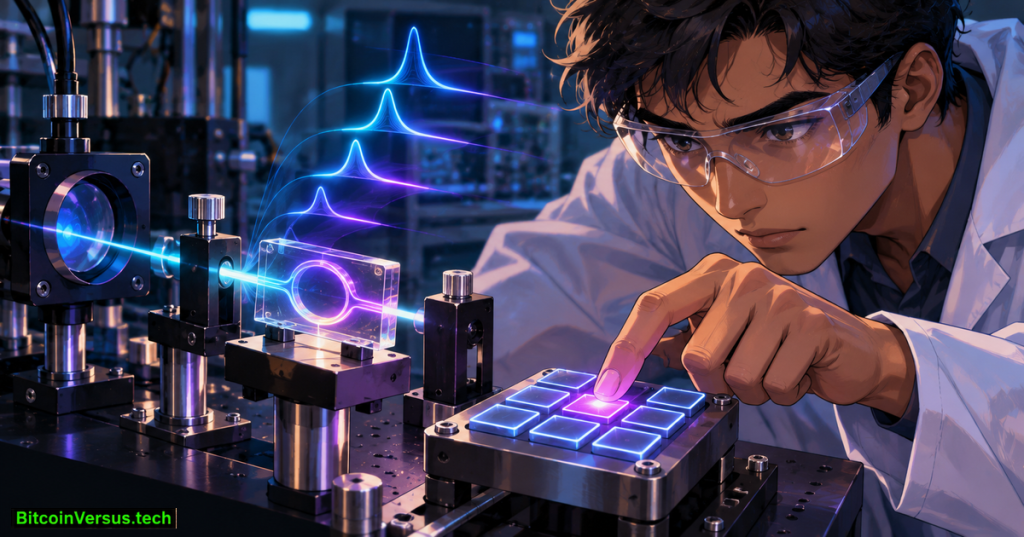
What if one microscopic optical sensor could tell which of nine buttons was pressed and how far the surface moved? Engineers at Washington University in St. Louis have demonstrated that idea using a light-trapping device and machine learning. The researchers described their results in a November 20, 2026 university announcement, following publication of the peer-reviewed study in Laser & Photonics Reviews on September 14. The achievement concerns a controlled test platform, not a commercial keyboard or a validated security product.
The engineering trick is to extract several independent measurements from one physical sensor instead of installing a separate sensing element beneath every key. A single multimode optical microresonator recorded complex responses to touch, and trained software decoded those responses into both contact location and surface displacement.

How light becomes a touch measurement
A microresonator keeps light circulating through tightly confined optical paths. Only specific resonance conditions produce strong responses, somewhat like particular notes resonating inside a musical instrument. Different optical modes concentrate their sensing sensitivity in different places. When the device is disturbed, each mode changes in a characteristic way.
Instead of measuring one frequency shift and stopping there, the team collected several mode responses as an information-rich fingerprint. Researchers call the combined signal a hyper-information barcode. Machine-learning models learned the relationship between known touches and the resulting optical signatures, then estimated more than one changing parameter from the same device.
The optical hardware performs the sensing; the AI translates its complicated output. Neither function eliminates the need for a light source, readout electronics, training data or calibration. The distinction matters when comparing a compact sensing element with the size and energy requirements of a complete product.
One device, nine test locations
The research team tested a small keyboard-like structure with nine distinct touch locations. The optical data distinguished where the surface was pressed and how far it displaced. The published study also reports resilience when signals are down-sampled or made noisier, addressing a practical concern for any sensor deployed beyond a carefully controlled lab.
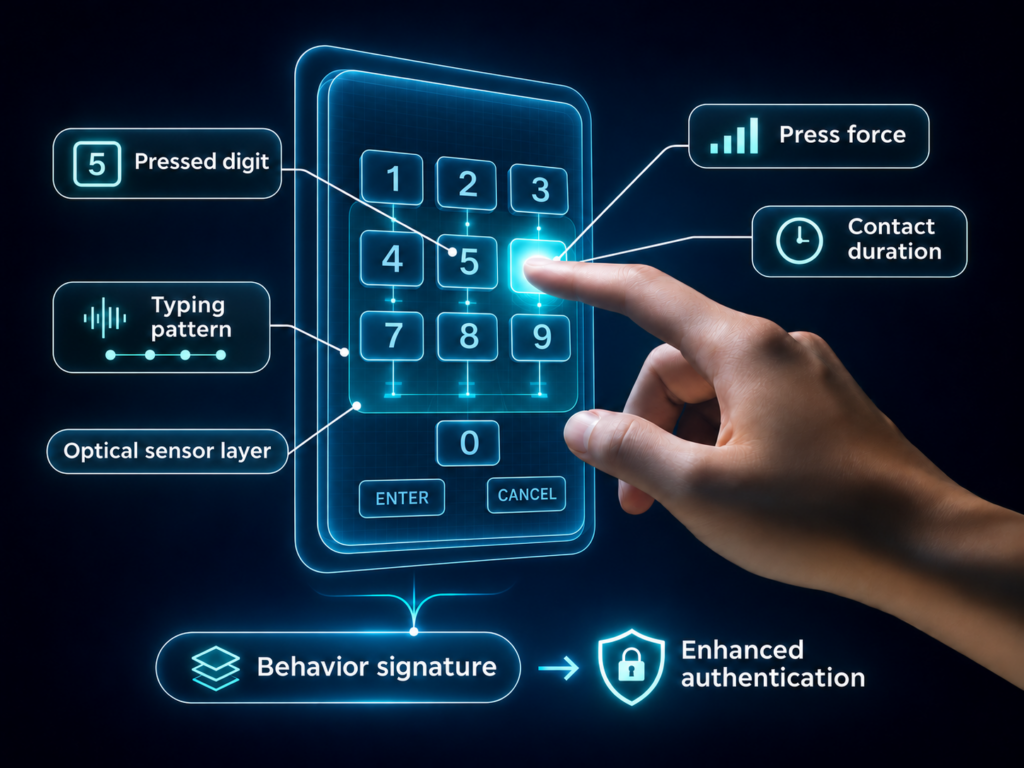
The test does not mean a production keyboard’s entire sensing system has already shrunk to one passive chip. Nor should movement distance be treated as a direct, calibrated force measurement in newtons. The university presents pressure-sensitive typing and more sophisticated input authentication as future possibilities, not demonstrated products.
Where the technology could matter
Robotic fingertips might eventually extract contact position and deformation without packing separate transducers into every surface. That direction complements BitcoinVersus.Tech reporting on wearable nanomesh motion sensors and graphene-assisted optical brain-signal readout, although those devices measure different physical effects.
Another possibility is enhanced device authentication based on how someone types, including timing and contact changes alongside a passcode. Such behavioral biometrics would require rigorous testing for reliability, spoofing risk, accessibility and user privacy. A keyboard proof of concept cannot, by itself, substantiate stronger authentication against real attackers.
Optical sensing also connects with other work in photon-driven circuit research and the use of electrical fields to power batteryless temperature measurements. Those systems rely on different physics, but all seek greater functionality from smaller hardware.
What still needs verification
Washington University did not announce a shipping product, large-scale field deployment or independently verified consumer-device power savings. Practical evaluation must establish sensitivity across manufacturing variation, stability under temperature changes, long-term calibration, and performance under repeated physical wear. The study’s authors also disclose equity interests held by Lan Yang and Chenyang Lu in DeepSight Technology; the research paper notes the potential conflict.
Sources: Washington University news release, November 20, 2026; Liao and colleagues, Laser & Photonics Reviews, originally published September 14, 2026; Tech Xplore coverage.
We volunteer daily to ensure the credibility of the information on this platform is Verifiably True. If you would like to support to help further secure the integrity of our research initiative, please scan the QR code below.

BitcoinVersus.tech is not a financial advisor. This media platform reports on financial subjects purely for informational purposes.


Leave a Reply