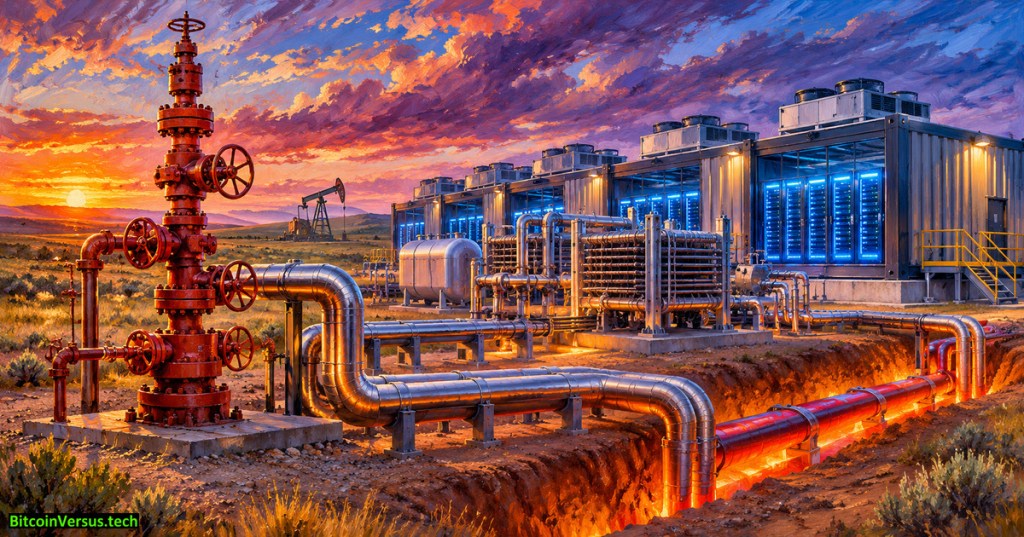
GEIOS GEOFLEX and Aiden Digital Labs announced on November 19, 2026 that they are preparing to test a radical engineering proposal: turn an idle oil or gas well into a local geothermal power source for an autonomous AI data center. They call the project the Dark Token Factory. Its first physical compute pilot is targeted for early 2027, not already in commercial operation.
The partners say an AI facility design is complete, test-module fabrication has begun, and prospective host wells are being screened. GEIOS reports laboratory validation of its geothermal technology and system-level field trials at three projects, two involving existing wells. Those claimed trials are not evidence that a geothermal-powered data center has yet been commissioned. The companies have not identified the first compute site or published independently verified electrical-generation results.
Aiden Digital Labs webinar on subsurface sensing and AI-driven geological assessment, filmed before the pilot announcement. Context, not footage of a Dark Token Factory View on YouTube.
A geothermal power plant built around an old well
The proposed design re-enters an existing well and extracts subsurface heat through GEIOS’s proprietary sealed-loop architecture. A heat-driven generator would supply regulated direct-current electricity, buffered by batteries, to modular GPU or TPU servers. GEIOS also proposes immersion cooling and thermally driven equipment intended to limit freshwater consumption.
Avoiding a grid connection could bypass a major data-center bottleneck, but heat is not the same as electric power. The system must turn underground thermal energy into usable electricity while accounting for pumps, conversion losses, cooling, controls and networking. Continuous production requires credible temperature, well-integrity and sustainable heat-transfer measurements.
The promised scale is much bigger than the pilot
GEIOS describes eventual pads providing 10–20 MW and robotically serviced sealed buildings, including automated exchanges of eight-GPU server sleds. A development timeline of roughly 10–14 months per node remains a company target. The first pilot instead aims for a 168-hour continuous AI-token production test, equal to seven days. No verified pilot power rating, delivered token throughput, annual uptime or electricity cost accompanied the release.
Seven days of sustained compute would establish a useful engineering milestone, not prove years of commercial reliability. Further work must establish generator output, thermal decline, battery cycling, fluid compatibility, cooling efficiency, and safe operation of an aging well.
U.S. Department of Energy’s Energy 101 geothermal explainer, showing the physics behind converting subsurface heat into electricity. General background, not a GEIOS endorsement View on YouTube.
Are the tokens cryptocurrency?
Despite its name, the Dark Token Factory is described as producing AI inference and compute tokens through an OpenAI-compatible interface, with per-batch energy and water records. GEIOS also proposes selling capacity as Green Premium Tokens. Its announcement does not establish that the pilot will mine Bitcoin, operate validators, issue a cryptocurrency or use a blockchain token. That distinction matters when comparing AI services with proof-of-work mining.
Why Bitcoin miners should follow the experiment
Bitcoin miners contend with similar power, land, equipment and cooling constraints, although flexible ASIC loads can generally shut down more readily than high-availability AI hosting. Compare Google’s 50 MW geothermal agreement, Sage’s enhanced-geothermal work in Nevada, Mazama’s superhot drilling demonstration, and Nocera’s planned gas-powered AI campus. Our ASIC-versus-cloud infrastructure analysis explains the differences.
The engineering results still missing
The essential measurements are net sustained kilowatts per well, thermal-to-electric efficiency, parasitic demand, well integrity, methane leakage, capital cost, cooling water use and actual AI throughput. Until independently measured operating data appear, the proposed 10–20 MW scale, grid-free reliability and low-water claims are engineering goals rather than demonstrated commercial performance.
Sources: GEIOS/Aiden press release, November 19, 2026; GEIOS GEOFLEX architecture overview; U.S. Department of Energy geothermal primer. The oil-painted featured cover is an original editorial illustration, not a photograph of a completed facility.
We volunteer daily to ensure the credibility of the information on this platform is Verifiably True. If you would like to support to help further secure the integrity of our research initiative, please scan the QR code below.

Educational reporting only. Not investment advice.


Leave a Reply