Nocera disclosed November 23, 2026 a binding letter of intent to invest approximately US$22 million in BitRock, a Calgary-based developer planning a natural-gas-powered artificial-intelligence data center near Hanna, Alberta. The proposal covers a 10 MW first phase of critical IT load, assembled from four 2.5 MW prefabricated modules. No construction completion, live AI fleet, or funded transaction was announced.
The agreement was signed November 19 and would give Nocera around 44% ownership at a $50 million post-money valuation. Its investment proceeds would be restricted to the first phase. However, a binding letter of intent is not a closed acquisition: funding requires due diligence, definitive documents and regulatory approvals, and Nocera states it has not secured all necessary financing.
VoltaGrid engineering video, January 2026, explaining natural-gas-powered data center microgrids. Independent background; not footage of BitRock or its Alberta site Open on YouTube.
Why bring a generator to the data center?
BitRock’s plan would use generation equipment it says it owns rather than wait for a large utility connection. The developer also claims to hold required generation, supply and usage permits, but Nocera expressly says those representations have not been independently verified. Gas delivery, plant operation, environmental compliance and reliable generator capacity would still need confirmation before commissioning.
The Alberta Electric System Operator reports that its interim 1,200 MW large-load connection allowance has already been allocated. Alberta’s data center electricity policy encourages developers to provide their own generation. That explains the commercial appeal of a behind-the-meter strategy, but does not exempt a project from local approvals or utility and gas-system requirements.
Ten IT megawatts are not ten facility megawatts
BitRock targets a power usage effectiveness (PUE) of 1.225 with N+1 redundancy, UPS protection and cold-climate cooling. At a steady 10 MW of IT demand, a realized PUE of 1.225 would imply roughly 12.25 MW of whole-facility electrical demand, including around 2.25 MW for cooling and supporting infrastructure. Those figures are calculations from a design target, not measured equipment performance.
N+1 describes a spare-capacity design objective, not an independently demonstrated reliability record. Engineers must establish real equipment ratings, fuel resilience, generator switching, UPS ride-through, controls integration and maintenance bypasses. AI GPU racks can produce rapid load changes, making frequency control and cooling response more important than a simple electricity nameplate.
July 2026 interview with METIS Power CEO Pooya Kabiri about behind-the-meter power, load transients, air permitting and microgrids. General engineering context, not a BitRock project demonstration Open on YouTube.
A 200 MW vision, but only 10 MW in the transaction
BitRock describes approximately 37 acres near Hanna and a possible 200 MW buildout in increments of 10 MW. The $22 million proposed investment is dedicated solely to the first 10 MW; additional buildings, power plants and financing have not been committed. Potential colocation customers reportedly have memoranda of understanding, not disclosed binding service leases.
The proposed capital works out to $2.2 million per initial IT megawatt, a transaction-to-capacity ratio rather than a complete construction-cost benchmark. Server GPUs, networking equipment and tenant deployments are not included in Nocera’s intended ownership of the colocation infrastructure. The LOI remains effective for 60 days, with a possible 30-day extension by agreement.
A parallel path to Bitcoin mining infrastructure
Industrial Bitcoin mines and modular AI campuses compete for many of the same scarce inputs: land, transformers, transmission access, gas generation, cooling and operational expertise. Yet Bitcoin ASICs can often curtail load rapidly, while AI colocation clients generally demand stronger uptime commitments. Compare Bitdeer’s 101 MW Alberta gas-power mining project, Cipher’s planned gas pipelines for AI infrastructure, Bitdeer’s Norwegian mining-to-AI conversion and Soluna’s AI build beside an operating Texas Bitcoin mine. BitRock itself is an AI project; no Bitcoin mining operation at its proposed site has been established.
What to verify next
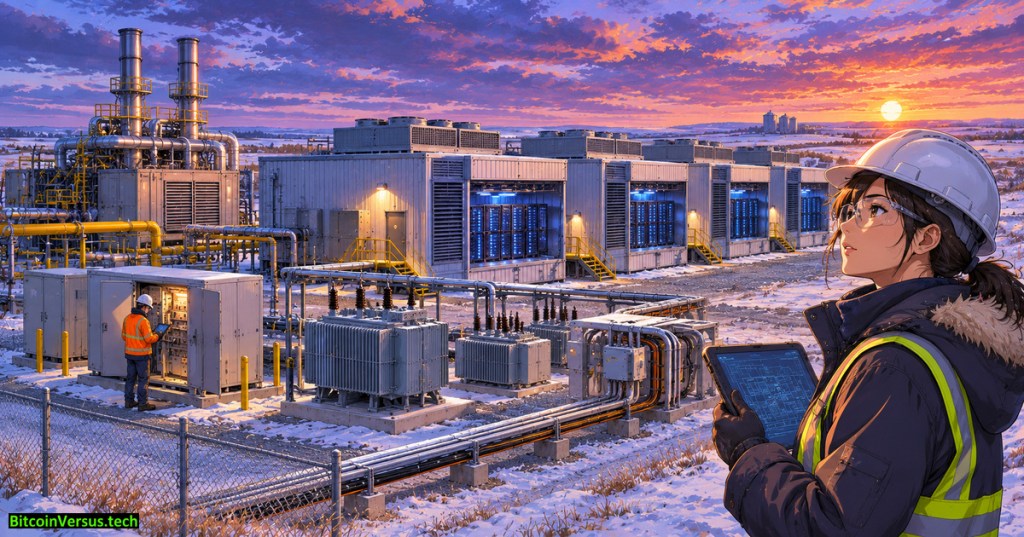
The important next milestones are completed financing, executed investment documents, verified permits and site control, construction activity, signed colocation leases, fuel arrangements, and independent electrical and cooling commissioning. The SEC filing and company announcement support the announced proposal, but neither proves an energized, revenue-producing campus. The featured image is a custom editorial illustration, not documentary site photography.
We volunteer daily to ensure the credibility of the information on this platform is Verifiably True. If you would like to support to help further secure the integrity of our research initiative, please scan the QR code below.

For information and education only; not investment advice.


Leave a Reply