Utexo postponed its planned November 28 public rollout of USDT on Bitcoin, citing the need to coordinate wallet and exchange integrations. Its November 27 announcement, corroborated by The Crypto Times, provided no replacement date. The decision changes the timetable described in our October coverage of USDT and RGB. Early-access testing remains open, according to the company.
The difference between testing and deployment
On October 22, Utexo announced access to a sandbox where approved professional operators could practice minting, transferring and redeeming bridged USDT on Bitcoin Signet. Signet is a test network; successful transactions there do not demonstrate that the same service is available to paying customers on mainnet. Utexo says the postponement allows partner applications to be ready when public access begins.
How the stablecoin crosses networks
According to the Utexo Mint product description, its mechanism locks existing stablecoin collateral and creates corresponding RGB units on Bitcoin. Redemption reverses the process through burning and releasing funds. Utexo describes its backing as USDT0 locked on Arbitrum and advertises a 0.1% transfer fee, excluding source-network charges. A hypothetical $10,000 transfer would therefore incur $10 in the advertised fee before additional costs. The advertised tariff and backing model are company statements, not independently measured production results. Our Tether reserve coverage concerns a different layer of financial backing.
RGB uses client-side validation: parties exchange the relevant asset history privately and verify it against commitments anchored to Bitcoin transactions. Bitcoin consensus secures the underlying spending rules, but full nodes do not independently certify the dollar backing of every RGB token. The bridge therefore introduces separate operational, collateral and redemption risks. Privacy mechanisms also do not eliminate an issuer’s compliance controls.
Protocol development continues separately
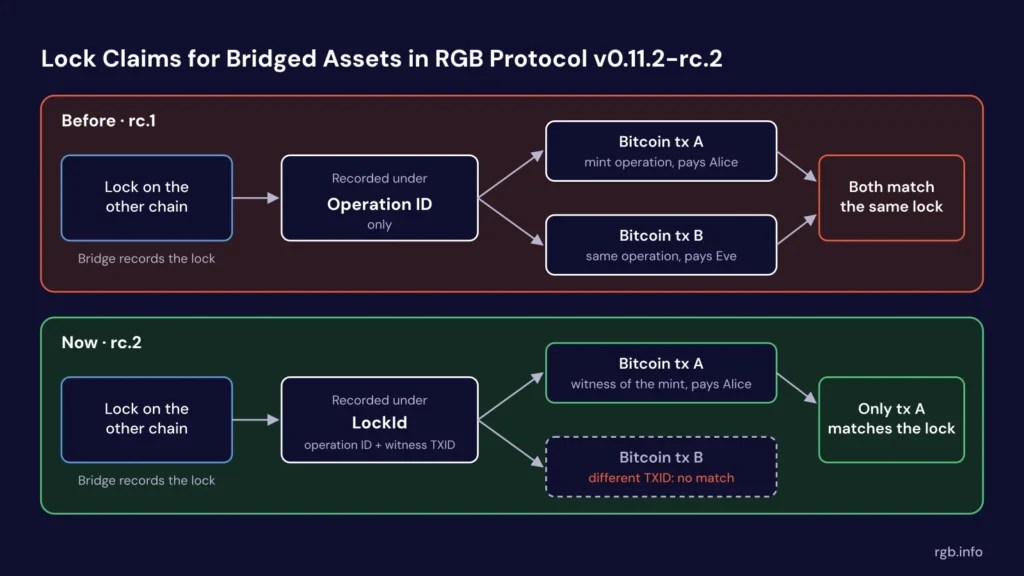
On November 23, RGB developers described version 0.11.2-rc.2, a testing release whose revised bridge claims bind a lock to a particular Bitcoin witness transaction. The change illustrates why cross-network asset issuance requires careful validation. The developers identify 0.11.1 as stable and mark the new bridged-asset schema as not production-ready. Neither Utexo nor RGB attributed the launch delay to the release candidate; the two developments must not be conflated.
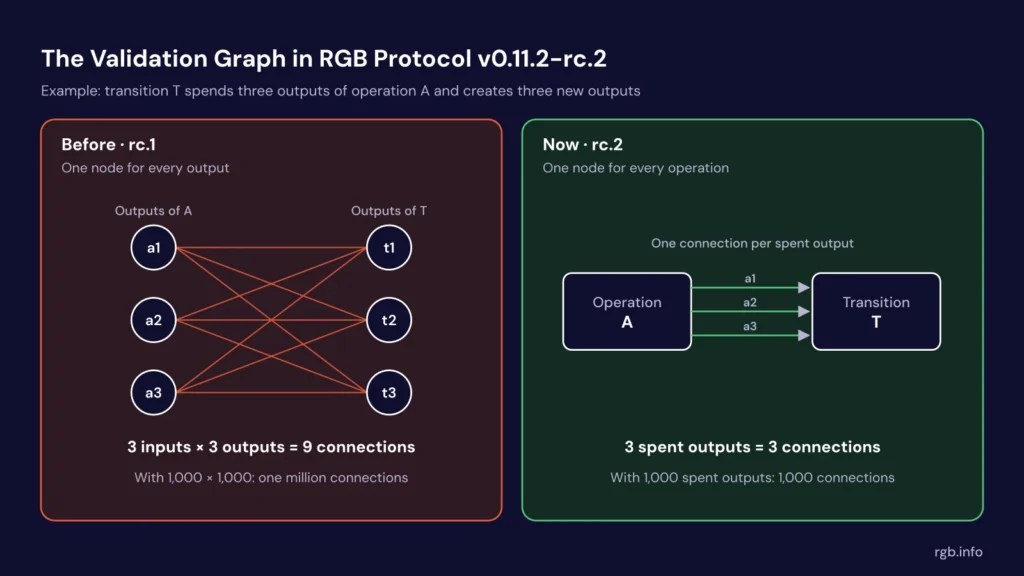
The same developer update describes a lighter validation graph that represents operations and spent outputs without generating every possible input-output connection. The architectural goal is to reduce memory pressure when validating asset history. It is not a measured throughput improvement for the Utexo service.
What remains before public access
The October plan placed Lightning integration in a second phase targeted for the first quarter of 2027. The November delay leaves the first phase without a confirmed date; the later phase should be treated as a previous target, not a renewed commitment. Our WhiteBIT Lightning coverage illustrates existing Bitcoin payment integration, which is distinct from a bridged stablecoin. Likewise, other Bitcoin privacy research addresses different protocol mechanisms.
A meaningful launch milestone would include confirmed mainnet access through named partners, documented redemption procedures, and independently reviewable evidence of reserves and security. Until those conditions are demonstrated, the project remains a proposed commercial rollout with ongoing testing. Featured artwork: Utexo’s October 22 press announcement.
We volunteer daily to ensure the credibility of the information on our platform is Verifiably True. If you would like to support to help further secure the integrity of our research initiative, please scan the QR code below.



Leave a Reply