
BNB Chain published its New L1 litepaper on November 26, 2026, describing a separate blockchain intended for latency-sensitive trading, payments and automated financial applications. The proposed network retains BNB as its native asset and complements BNB Smart Chain rather than replacing it. Earlier tokenized securities activity on BNB Chain illustrates a potential market for the additional infrastructure.
20 ms feedback is not final settlement
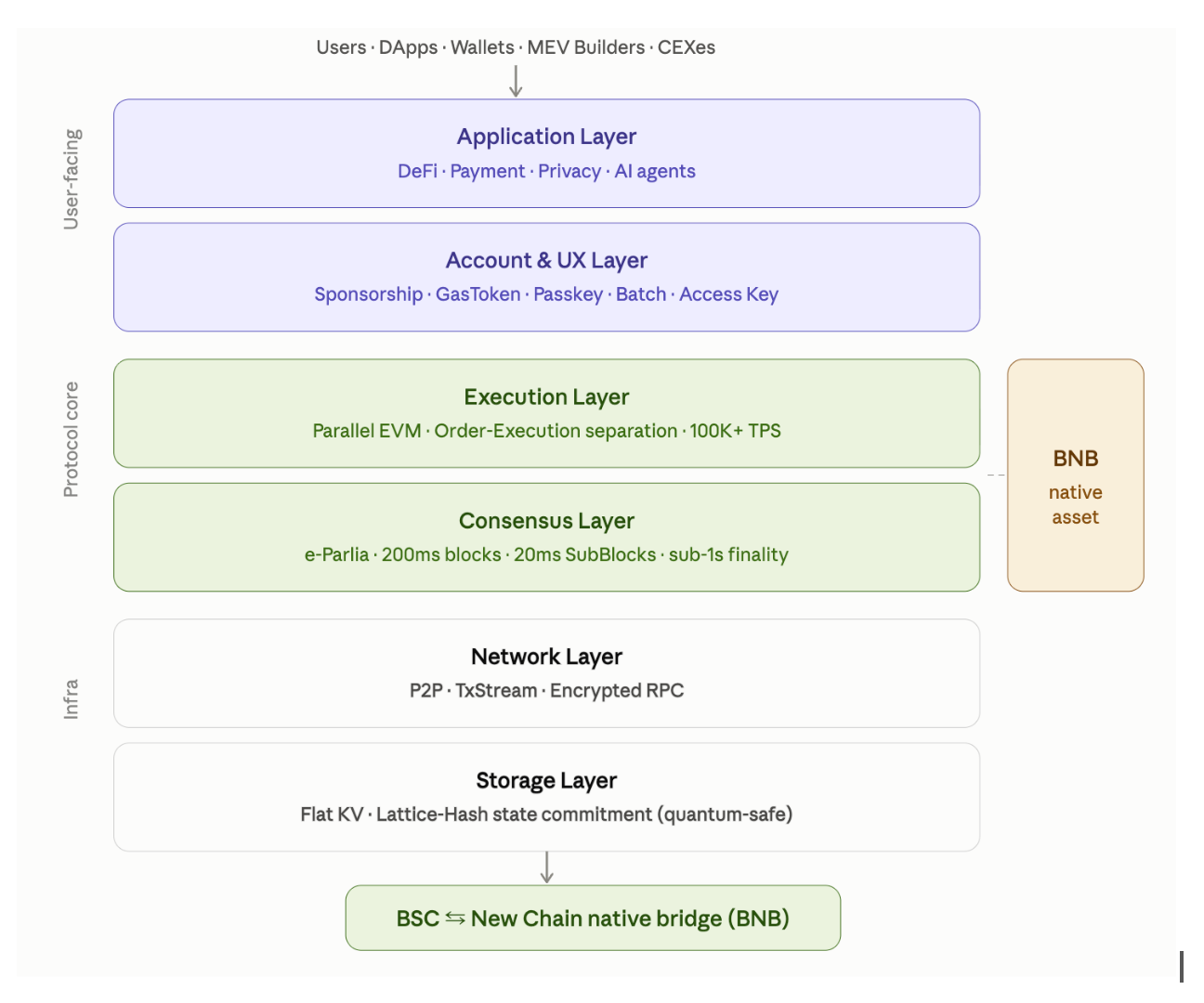
The technical overview specifies a target block interval of 200 milliseconds, equivalent to five blocks per second if maintained. Smaller transaction batches provide preliminary placement signals at approximately 20 milliseconds. The preliminary signal is revocable; it cannot establish that a trade has executed or that a payment is irreversible. The proposed consensus mechanism targets ordering finality in under one second, while execution finality requires a later finalized commitment to the execution result.
A transaction may therefore be ordered before its outcome is known. For a trading application, early feedback could help update interface state without displaying a payment as settled. Exchanges and merchants should wait for successful execution and confirm finality before releasing assets or delivering irreversible services. The distinction also matters for tokenized securities, where transfer-agent infrastructure must reconcile ownership records reliably.
Reserved transaction capacity
Conventional transaction queues allow unrelated activity to compete for limited space. New L1 introduces Multi-Lane, which allocates part of the block gas budget to designated contract addresses. For example, a hypothetical 15% reservation protects that portion of capacity when eligible traffic exists. Other transactions can use unclaimed capacity. The reservation does not guarantee inclusion for an individual transaction; competing transactions within the same lane can still face delays.
Because ordering precedes execution, lane accounting uses declared gas limits rather than measured execution consumption. Overestimating gas can therefore reduce usable throughput and increase expense. Governance controls lane allocation, introducing operational questions about resource distribution and configuration changes.
Payment authorization and privacy
The proposed native account-abstraction system allows batched calls, passkey signatures, restricted delegated keys and sponsored fees. An automated trading service could receive limited authority rather than unrestricted control over an account. A sponsor can pay the BNB network fee even when the user does not hold BNB; the fee itself does not disappear. Comparable efforts to extend smart-account functionality include Stellar’s Bell upgrade.
The privacy proposal includes shielded settlement for supported assets, with limits on what public interactions conceal. The developer FAQ explicitly warns that the shielded pool circuits have not been audited and should not be used with real funds. Privacy at the transaction layer also does not automatically protect network metadata or every application interaction.
Public testnet and mainnet are still ahead
The network currently operates as a development environment. Its planning targets are a public testnet in the first quarter of 2027 and mainnet in the second half of 2027, subject to readiness. Cointelegraph’s November 26 report corroborates that timeline. The proposal competes in a sector where settlement mechanisms such as Solana’s delivery-versus-payment program already address institutional transaction requirements. Independent testing under sustained load, security reviews and reliable recovery behavior will matter more than nominal block timing alone.
The featured cover is an original conceptual illustration, not a photograph of deployed infrastructure. The linked archival video is provided for context; third-party playback was not independently tested.
We volunteer daily to ensure the credibility of the information on our platform is Verifiably True. If you would like to support to help further secure the integrity of our research initiative, please scan the QR code below.



Leave a Reply