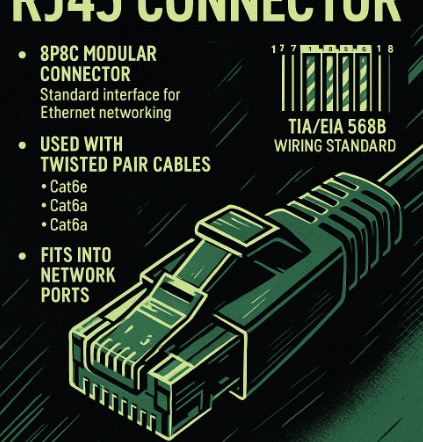
The RJ45 connector is the industry-standard interface used to terminate twisted-pair Ethernet cables for wired networking.
Formally known as an 8P8C (eight positions, eight contacts) modular connector, RJ45 is used to connect devices such as computers, routers, switches, and patch panels in both residential and enterprise environments.
It supports network standards like 10BASE-T, 100BASE-TX, 1000BASE-T, and even 10GBASE-T, depending on the cable category and signal quality. The RJ45’s clear plastic housing typically features a locking clip and color-coded pinouts following TIA/EIA-568A or 568B wiring standards.
RJ45 connectors are terminated on Cat5e, Cat6, or Cat6a twisted-pair cables, each suited for specific bandwidth and distance requirements. Proper crimping with a cable tester ensures solid connectivity and minimizes signal degradation.
Unlike coaxial or fiber optic connectors, RJ45 is prized for its balance of speed, simplicity, and cost-effectiveness. While wireless technology continues to grow,
RJ45-based connections remain crucial for environments requiring high reliability, low latency, and network security, such as in data centers, VoIP systems, and financial networks.
BitcoinVersus.Tech Editor’s Note:
We volunteer daily to ensure the credibility of the information on this platform is Verifiably True. If you would like to support to help further secure the integrity of our research initiatives, please donate here
BitcoinVersus.tech is not a financial advisor. This media platform reports on financial subjects purely for informational purposes.


Leave a Reply