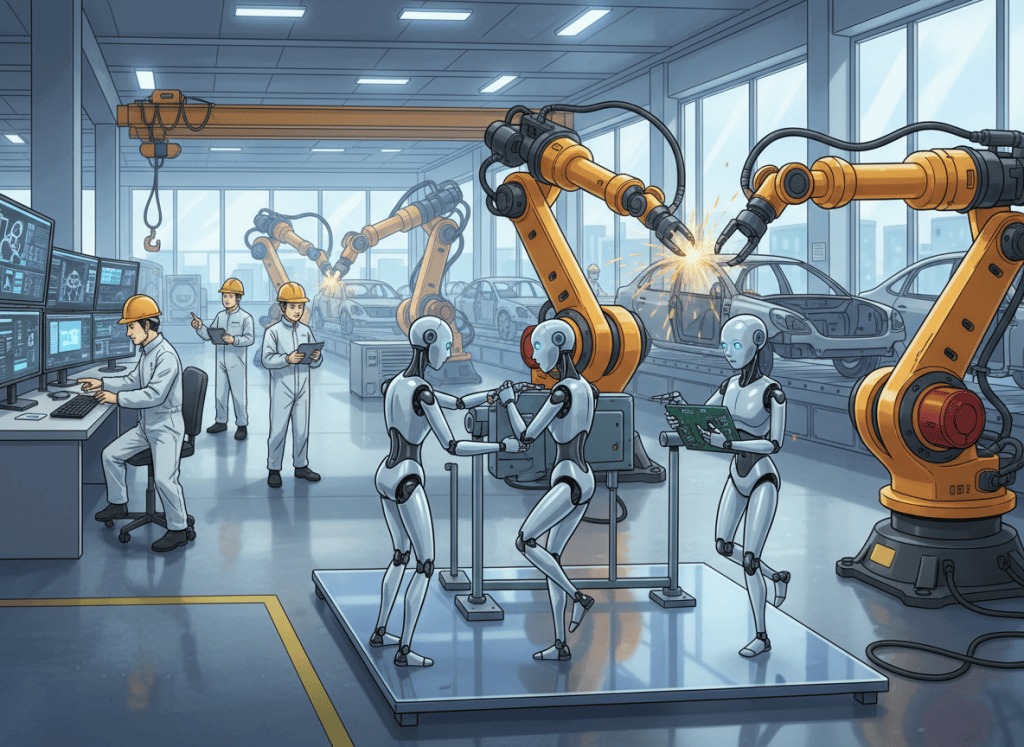
About 7,000 humanoid robots were sold worldwide in 2025 for industrial and professional service applications, according to data compiled by the International Federation of Robotics. The figure provides an early industry benchmark for a robotics category attracting major investment while remaining small compared with established automation markets. Sources: Reuters and International Federation of Robotics.
The IFR defines a humanoid robot as a machine with a human like appearance that can operate autonomously in environments designed for people. Legs are not required under the definition. The new sales tally covers industrial and professional service machines while excluding consumer and military humanoids, and medical robots are classified separately. Source: Reuters reporting on IFR methodology.
Humanoid sales remain small beside conventional robotics. IFR data show roughly 542,000 industrial robots were installed worldwide in 2024, while about 199,000 professional service robots were sold for applications including transportation, hospitality and cleaning. The comparison means the 2025 humanoid total was only a small fraction of either established category, even before newer 2025 industrial and service robot totals are released. Sources: IFR World Robotics data and Reuters.
Many humanoid robots sold during 2025 were not yet performing routine productive labor. IFR Secretary General Susanne Bieller told Reuters that research institutions and companies bought many units to generate data for improving artificial intelligence models. Automotive manufacturers are among the early industrial adopters, but current factory pilots often involve only single digit or low double digit numbers of robots. Source: Reuters interview with the International Federation of Robotics.
The data highlight a major distinction between technical demonstrations and commercial deployment. Humanoid robots have demonstrated increasingly sophisticated locomotion and manipulation, but factory use requires repeatability, safety, uptime, integration with production systems and an economic advantage over conventional automation. Established industrial robot arms already perform high volume tasks with mature engineering and service ecosystems, giving humanoid platforms a demanding benchmark for productive manufacturing work. Sources: IFR humanoid robotics research and Reuters.
Forecasts nevertheless anticipate substantial growth. Reuters reported that Bank of America Global Research estimates about 90,000 humanoid robots could ship in 2026 and 1.2 million units in 2030. Forecasts are not measured sales, and the IFR figure establishes a much smaller observed baseline of approximately 7,000 industrial and professional service humanoids sold in 2025. Future growth will depend on whether research platforms and pilot deployments develop into repeatable commercial applications. Source: Reuters.
BitcoinVersus.Tech Editor’s Note:
We volunteer daily to ensure the credibility of the information on this platform is Verifiably True. If you would like to support to help further secure the integrity of our research initiatives, please donate here: 3C9o19EH5HSiwEPyCTmEKzxhNCbo2X6TTb
BitcoinVersus.tech is not a financial advisor. This media platform reports on financial subjects purely for informational purposes.


Leave a Reply