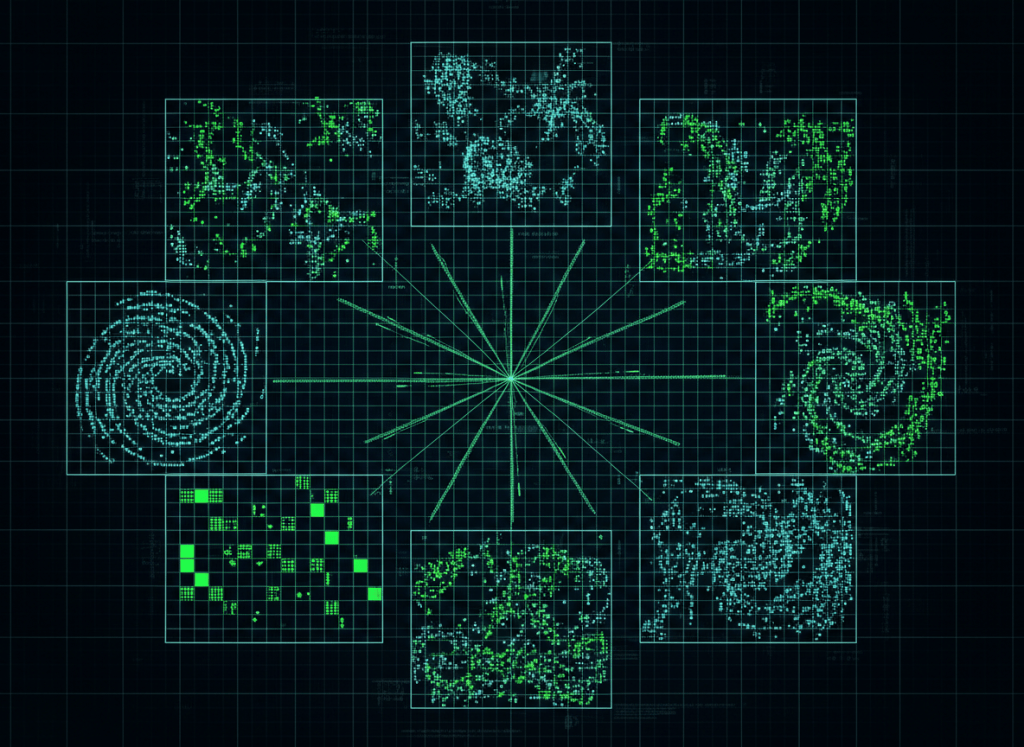
A June video from creator Carykh has pushed Conway’s Game of Life back into online discussion by exploring a much larger family of cellular automata rather than treating John Conway’s famous rule as an isolated mathematical curiosity. The video, titled The Conway Multiverse, was published in late June 2026 and has drawn a large audience for an unusually technical computer science subject. Sources: PreserveTube channel archive and Communitrics video statistics.
Conway’s Game of Life is a cellular automaton built on a two dimensional grid. Every cell is either alive or dead, and a small set of local rules determines whether cells survive, die or appear during the next generation. Repeated application of those rules can produce still lifes, oscillators, moving structures such as gliders and far more complicated behavior. The striking result is that a simple deterministic rule can generate patterns that look organized, unpredictable or computationally purposeful without a central controller. Source: LifeWiki overview of Conway’s Game of Life.
The multiverse idea expands the experiment by changing the rules themselves. Conway’s familiar Life rule is commonly written B3/S23, meaning a dead cell is born with exactly three live neighbors while a live cell survives with two or three. Other combinations of birth and survival conditions create different Life like cellular automata. Some rapidly collapse into empty grids, some explode into noise, and others support persistent structures, movement and complex interactions. Sources: LifeWiki cellular automaton reference and Physical Review E.
Scientific research has examined where Conway’s Life sits inside the broader rule space. A 2014 study in Physical Review E analyzed 6,144 outer totalistic cellular automata and compared mean field predictions with behavior on square lattices. Researchers Sandro Reia and Osame Kinouchi argued that Life is better characterized as a quasicritical nucleation process near a transition where empty regions invade active ones. Their analysis described Life as operating near a border of extinction rather than simply a border of chaos. Sources: Physical Review E and PubMed.
Interest generated by Carykh’s exploration reached the established Game of Life community almost immediately. A ConwayLife forum discussion on June 25 noted that the video covered Life like rules, ConwayLife and Catagolue, a distributed database used to catalogue objects found in cellular automata. Community members anticipated an influx of newcomers interested in exploring the larger rule space. Source: ConwayLife community discussion.
The underlying lesson extends beyond a single recreational mathematics experiment. Cellular automata demonstrate how local rules can create large scale behavior without global instructions, making them useful conceptual tools in computer science, complexity research and mathematical physics. Conway’s rule became famous because complex structures emerge from remarkable simplicity. Exploring neighboring rules shows that Life belongs to a much broader computational landscape where tiny changes in local logic can produce radically different artificial worlds. Sources: OpenAlex research record and Physical Review E.
BitcoinVersus.Tech Editor’s Note:
We volunteer daily to ensure the credibility of the information on this platform is Verifiably True. If you would like to support to help further secure the integrity of our research initiatives, please donate here: 3C9o19EH5HSiwEPyCTmEKzxhNCbo2X6TTb
BitcoinVersus.tech is not a financial advisor. This media platform reports on financial subjects purely for informational purposes.


Leave a Reply