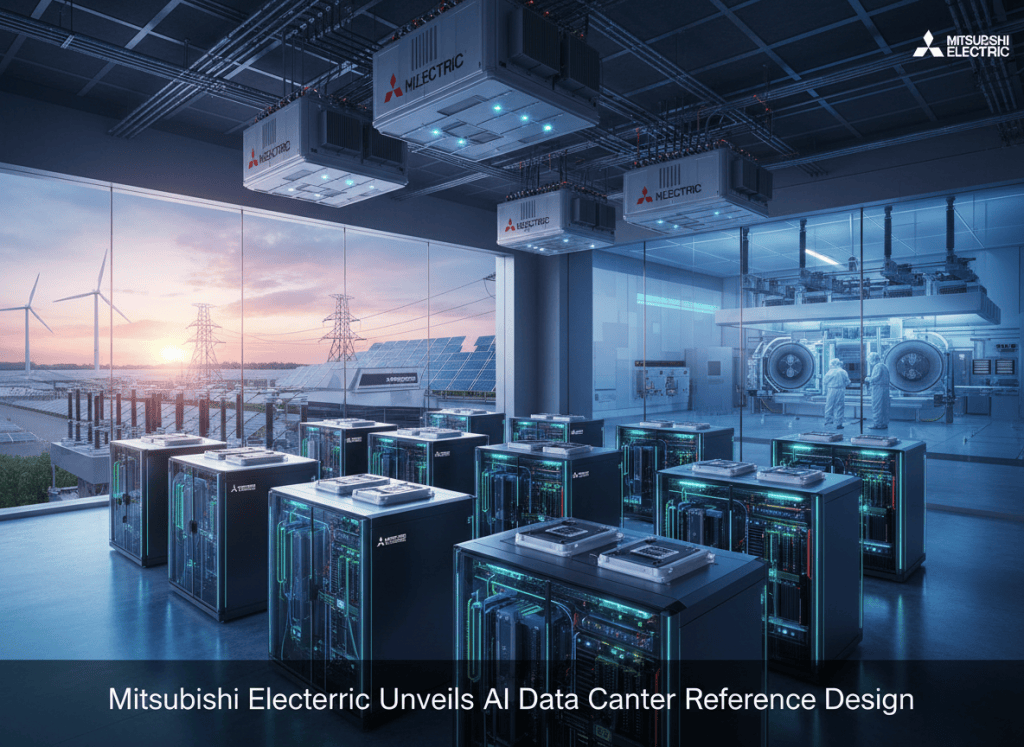
Mitsubishi Electric has released new Chip-to-Grid DSX reference designs for next-generation AI data centers, tying power generation, energy storage, distribution and cooling directly to NVIDIA Vera Rubin infrastructure.
The architecture was announced September 24 by Mitsubishi Electric and its U.S. subsidiary Mitsubishi Electric Power Products. The company says the designs are intended to support NVIDIA Vera Rubin NVL72 and future AI infrastructure while scaling toward gigawatt-class data centers.
From the grid to the chip
The important part of the announcement is the scope. Mitsubishi Electric is not treating the GPU rack as an isolated machine. Its Chip-to-Grid DSX design coordinates the electrical and thermal systems that surround the compute hardware.
The reference architecture includes on-site power generation and battery energy storage systems. Mitsubishi says a facility can reduce its normal dependence on the utility grid and transition to autonomous microgrid operation during a grid failure.
Inside the facility, the design supports both conventional 415/480 VAC distribution and emerging 800 VDC power distribution. That higher-voltage DC architecture is becoming increasingly important as rack-scale AI systems push electrical density far beyond conventional server deployments.
Cooling becomes part of the architecture
Mitsubishi Electric also combines direct liquid cooling for high-density chips with air cooling for other components. The dual-loop approach reflects a broader shift in AI infrastructure: cooling can no longer be designed after the compute equipment is selected. Power, thermal management and compute density increasingly have to be engineered as one system.
That approach lines up with NVIDIA DSX, which provides generation-specific AI-factory reference architectures spanning compute and facility infrastructure. NVIDIA describes Vera Rubin NVL72 as a rack-scale system integrating 72 Rubin GPUs and 36 Vera CPUs.
Why 800 VDC matters
Moving more electrical power through a data center raises the importance of conductor losses, conversion stages, switchgear, protection and physical distribution. An 800 VDC architecture is designed to move large amounts of power more efficiently to dense AI equipment while reducing some of the complexity associated with repeated power conversion.
For operators familiar with Bitcoin mining, the engineering direction is recognizable. Mining campuses have long treated megawatts, transformers, substations, cooling and machine efficiency as core operating variables. AI data centers are moving toward similarly power-centric infrastructure, although their compute, networking and redundancy requirements are substantially different.
Gigawatt-scale computing changes data-center design
Mitsubishi Electric says the reference designs are intended to remain scalable as facilities move toward gigawatt-class power demand. At that level, the data center increasingly behaves like a major industrial power system with its own generation, storage, microgrid controls, high-voltage distribution and specialized cooling.
The announcement adds another major industrial supplier to the push toward integrated AI-factory infrastructure. NVIDIA’s own Vera Rubin platform treats the data center as a larger unit of compute, linking processors, networking, storage, power and cooling into a coordinated system.
Sources: Mitsubishi Electric, September 24, 2026; NVIDIA DSX documentation; NVIDIA Vera Rubin platform.
BitcoinVersus.Tech Editor’s Note:
We volunteer daily to ensure the credibility of the information on this platform is Verifiably True. If you would like to support to help further secure the integrity of our research initiatives, please donate here: 3C9o19EH5HSiwEPyCTmEKzxhNCbo2X6TTb


Leave a Reply