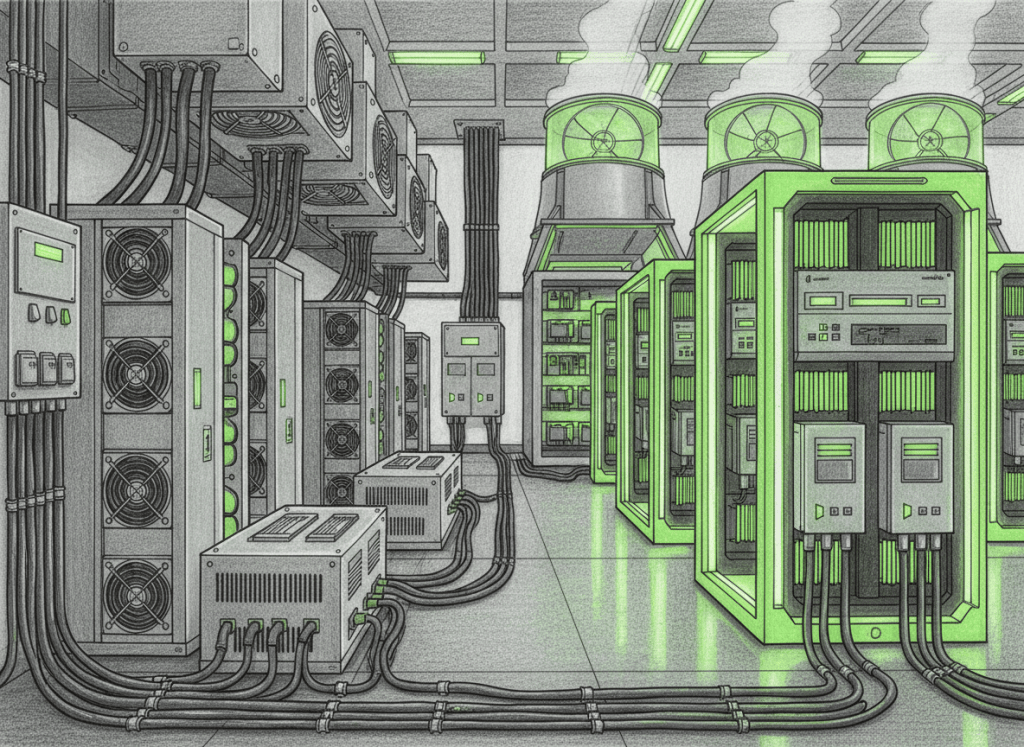
The Antminer S19 became the defining Bitcoin mining machine of the post-2020 cycle because it was more than a specification sheet. It became a fleet standard. Operators bought it by the thousands, hosting sites learned its electrical and thermal profile, repair shops learned its boards and power supplies, firmware matured, and used units circulated across the industry.
By 2026, a similar pattern is developing around Bitmain’s S21 family. The most defensible way to say it is simple: the S19 remains the installed-base king, but the S21 increasingly looks like the machine customers are choosing to replace it.
Demand is the real S19 comparison
The strongest argument is not that every miner has already replaced its S19s. They have not. It is that customer demand, institutional procurement and modern fleet composition are increasingly clustering around S21-generation equipment.
A OneMiners report from Mining Disrupt, based on an interview with ASIC distributor Lead Miner Limited, described the Antminer S21 series as the conference’s No. 1 in-demand miner and the most popular ASIC among customers there. That is distributor and conference evidence rather than a census of worldwide sales, but it is a useful direct signal of what buyers were asking for.
BITMAIN itself reported customer interest in the S21 almost immediately after launch. In its coverage of the Australian Crypto Convention, the manufacturer said customers were satisfied with the S21’s hashrate and energy efficiency and were looking forward to additional products. The S21 family has since expanded across air, hydro and immersion configurations.
The fleet data show the same transition
Public-company disclosures give the demand argument a second statistical leg. As of June 30, 2026, TeraWulf disclosed 53,700 miners at its Lake Mariner Bitcoin mining facilities. Its fleet included 8,300 S21 units and 27,500 S21 Pro units. That is 35,800 S21-family machines, or approximately 66.7% of the disclosed fleet. TeraWulf reported average fleet efficiency of 17.6 J/TH.
That does not mean two-thirds of the global Bitcoin mining fleet consists of S21s. Public miners are generally more aggressive about fleet upgrades than the entire installed base. What it does demonstrate is that a large modern industrial operation can already be predominantly S21-generation.
Why customers moved from S19 to S21
BITMAIN’s original S19 specification lists 95 TH/s at 3,250 watts and 34 J/TH. The original S21 is rated at 200 TH/s, 3,500 watts and 17.5 J/TH.
| Metric | S19 | S21 | Change |
|---|---|---|---|
| Hashrate | 95 TH/s | 200 TH/s | +110.5% |
| Wall power | 3.25 kW | 3.50 kW | +7.7% |
| Efficiency | 34 J/TH | 17.5 J/TH | 48.5% lower J/TH |
| Hashrate per MW* | ~29.2 PH/s | ~57.1 PH/s | ~95.7% higher |
For roughly 7.7% more machine-level electrical demand, the S21 provides more than twice the nominal hashrate of the original S19. A hypothetical 10 MW machine allocation therefore moves from about 292 PH/s with original S19s to roughly 571 PH/s with original S21s, before accounting for facility overhead.
That density matters because the scarce asset in industrial Bitcoin mining is often not the ASIC itself. It is energized megawatts: the utility allocation, transformers, switchgear, conductors, cooling and physical site capacity required to run a fleet. The S21 lets a miner extract substantially more SHA-256 compute from the same basic electrical envelope.
S21 is becoming a platform, not one miner
The S19’s longevity came partly from becoming a family: S19, S19 Pro, S19j Pro, S19 XP, S19k Pro and numerous hydro variants. The S21 is following the same pattern through S21, S21 Pro, S21+, S21 XP and multiple liquid-cooled configurations.
This is important when measuring popularity. Customers do not necessarily standardize on one exact hashrate bin. They standardize around a hardware generation, its service ecosystem and the economics it offers.
That is why the phrase “the S21 is the new S19” is becoming statistically justifiable. It should not be interpreted as a claim that S21 machines already outnumber every S19 worldwide. The available data support a narrower and more useful conclusion: the S21 family is becoming a major default choice for customers buying, expanding or modernizing industrial Bitcoin mining fleets.
The S19 is still everywhere. The buying cycle has moved on.
The S19’s enormous installed base means it will remain visible for years, especially at sites with sufficiently low power costs. But installed base and current demand are different measurements.
The S19 tells us what miners bought during the previous fleet cycle. Increasing S21 deployment tells us where a significant part of the replacement and expansion market has moved.
That is ultimately what made the S19 legendary in the first place. It became the machine everyone knew. The S21 increasingly looks like its successor.
BITMAIN’s official X account provides the manufacturer’s continuing ANTMINER product and fleet-hardware updates: @BITMAINtech.
BitcoinVersus.Tech Editor’s Note:
The phrase “S21 is the new S19” describes fleet-generation and customer-demand trends. It is not a claim that S21-series machines constitute a majority of the entire Bitcoin network or worldwide installed ASIC base.
Support BitcoinVersus.tech with Bitcoin: 3C9o19EH5HSiwEPyCTmEKzxhNCbo2X6TTb
Follow BitcoinVersus.tech on X: https://x.com/BitcoinVersus
BitcoinVersus.tech is not a financial advisor. This media platform reports on financial subjects purely for informational purposes.


Leave a Reply