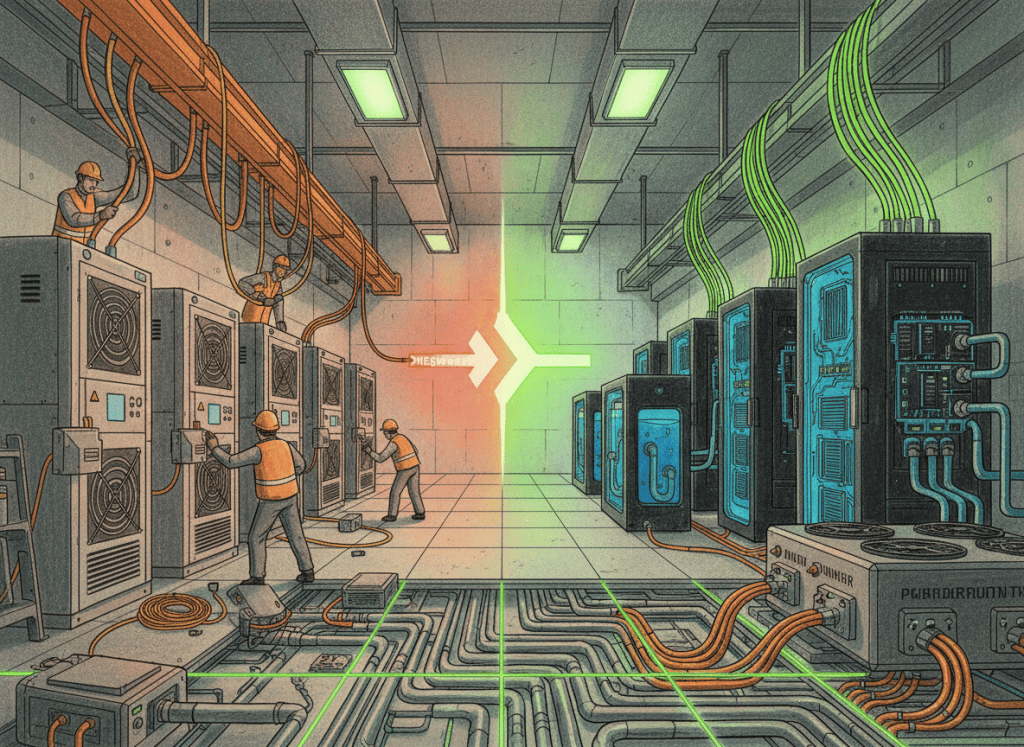
Some of the largest publicly traded Bitcoin miners are no longer treating artificial intelligence as a side business. They are physically reallocating energized megawatts, retiring ASIC hardware and converting mining campuses into high-density AI and HPC data centers.
A new CoinShares Q2 2026 Bitcoin mining report puts numbers behind that transition. The report estimates the listed mining sector’s weighted-average ex-tax cash cost at about $75,500 per BTC during Q2 and says at least 35 EH/s is scheduled to leave the listed-miner cohort as several operators reduce or exit self-mining.
IREN’s AI revenue overtakes Bitcoin mining
IREN provides one of the clearest examples. Its June-quarter results show AI Cloud Services revenue of $70.5 million, exceeding Bitcoin mining revenue of $66.7 million for the first time.
The transition is also visible on the balance sheet. IREN recorded a $450.4 million non-cash impairment in the June quarter, primarily related to decommissioning Bitcoin mining hardware as sites are converted for AI Cloud growth. It also recorded a $102.1 million reduction in the fair value of assets held for sale and $25.1 million in disposal losses.
CoinShares says IREN expects its transition from mining to AI to be substantially complete by December 31, 2026.
TeraWulf is converting mining infrastructure too
TeraWulf is moving in the same direction. Its Q2 SEC filing records impairment charges related to shutting down mining infrastructure and ceasing associated Bitcoin mining operations to support its transition to HPC. CoinShares reports that two miner buildings at Lake Mariner were retired during the first half of 2026.
CoinShares calculates that HPC lease revenue represented about 71% of TeraWulf’s $44.8 million quarterly revenue. The company mined 179 BTC during Q2, according to its regulatory disclosures.
The scarce asset is increasingly the energized site
This shift explains why Bitcoin mining infrastructure has become strategically valuable to AI developers. A miner may already control land, utility interconnection, substations, transformers, switchgear, fiber access and large blocks of energized capacity. Those assets can take years to reproduce from a greenfield site.
CoinShares estimates that U.S. interconnection queues total roughly 2,600 GW and says data centers account for 87% of ERCOT’s roughly 410 GW large-load queue. In that environment, an existing mining campus with hundreds of energized megawatts can be worth more as a compute platform than the ASICs sitting inside it.
Not every major miner is abandoning SHA-256
The transition is not universal. Bitdeer continues investing heavily in Bitcoin mining hardware and recently announced a Nevada SEALMINER manufacturing facility. CoinShares also identifies operators including MARA, Riot, HIVE and Bitdeer as having retained greater flexibility to continue investing in mining.
That creates two increasingly distinct strategies among major public miners. One group is using its grid connections and data-center campuses to chase AI/HPC economics. Another is continuing to improve SHA-256 efficiency with newer ASIC generations, cheaper energy and larger mining fleets.
Bitcoin ASICs are competing with GPUs for megawatts
At the facility level, this is now a competition over the same fundamental resource: delivered electrical power. Bitcoin ASICs convert megawatts into SHA-256 hashes. AI accelerators convert megawatts into training and inference compute. The economics of each workload determine which machines occupy the building.
CoinShares estimates annualized AI profit at roughly $1.5 million per MW compared with about $0.5 million per MW for Bitcoin mining under the market conditions analyzed in its report. Those are estimates rather than guaranteed returns, and a sustained rise in Bitcoin price or hashprice could change the comparison substantially.
The larger trend is already visible in physical infrastructure. Bitcoin mining helped build a generation of large, power-dense computing campuses. Some of those same substations, transformers and megawatts are now becoming the foundation for the AI buildout.
BitcoinVersus.Tech Editor’s Note:
Support BitcoinVersus.tech with Bitcoin: 3C9o19EH5HSiwEPyCTmEKzxhNCbo2X6TTb
Follow BitcoinVersus.tech on X: https://x.com/BitcoinVersus
BitcoinVersus.tech is not a financial advisor. This media platform reports on financial subjects purely for informational purposes.


Leave a comment