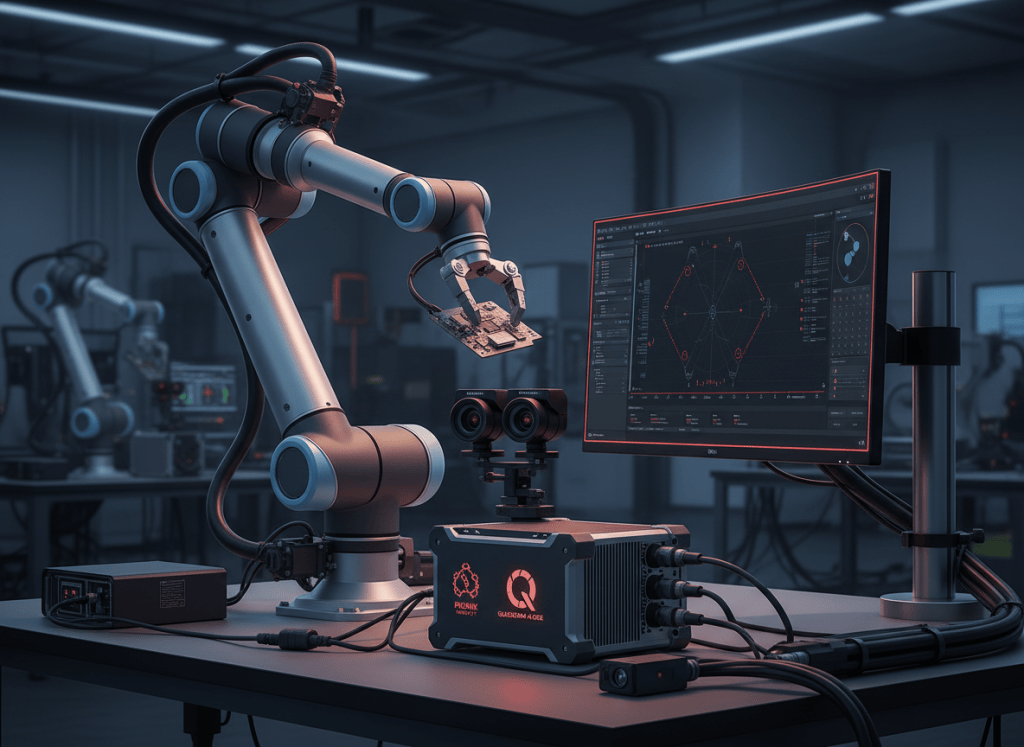
Qualcomm is moving deeper into physical AI with an agreement to acquire PickNik Robotics, the longtime steward of MoveIt, one of the most widely used open-source frameworks for robot manipulation and motion planning.
In a move centered on the software layer that turns computing into physical motion, Qualcomm says MoveIt is expected to integrate more closely with its Dragonwing robotics platforms while remaining open-source, community-driven and supported across third-party hardware. PickNik founder Dave Coleman separately described the next chapter as a hardware-and-software co-design problem for AI models that must run on robots in real time and within tight power budgets.
MoveIt Connects AI Models to Robot Motion
MoveIt is built on ROS and provides tools for motion planning, manipulation, perception, kinematics and collision-aware control. That makes the acquisition different from simply buying another processor company. Qualcomm already has the compute, connectivity and edge-AI side of the stack. PickNik adds software that helps a robot decide how to move an arm, avoid an obstacle, reach an object and execute a manipulation task.
BitcoinVersus.tech recently covered NVIDIA Isaac ROS 5.0 bringing AI agents into robotics workflows, EdgeCortix building high-performance silicon for physical AI, and Amazon’s tactile Vulcan warehouse robot. Together, those developments show physical AI becoming a full-stack engineering problem spanning processors, sensors, perception, networking, planning and electromechanical control.
Open Source Is the Important Part
Qualcomm says MoveIt 1 and MoveIt 2 will remain open-source under their existing licenses and that hardware-agnostic support will continue. That commitment matters because MoveIt’s value comes partly from a broad robotics community rather than from one processor vendor. PickNik says more than 560 people have contributed code across the project, which spans dozens of repositories and thousands of forks.
The strategy also parallels other open development efforts BitcoinVersus.tech has followed, including open-source AI-agent frameworks and the increasingly important relationship between specialized hardware and the software controlling it. In robotics, openness can be especially valuable because developers must support many combinations of arms, grippers, cameras, sensors and compute platforms.
Dragonwing and Arduino Could Expand the Developer Base
Qualcomm plans tighter MoveIt and MoveIt Pro integration with Dragonwing robotics platforms, including a path from vision-language and vision-language-action models into planning, manipulation and real-time control. The company also specifically named Arduino VENTUNO Q boards as an early integration target.
That could make advanced manipulation tooling accessible across a wider range of robots, from research arms and warehouse automation to industrial machines and emerging humanoid systems. BitcoinVersus.tech has previously examined how dexterous robotic hands combine sensing, actuation and AI and how autonomous industrial robots turn perception into physical action.
What Happens Next
Financial terms were not disclosed, and the transaction remains subject to customary closing conditions. That means the most important near-term questions are technical rather than financial: how quickly optimized Dragonwing support reaches developers, whether MoveIt remains equally useful across competing hardware, and whether tighter hardware-software integration measurably reduces the time required to move a robot from prototype to reliable production deployment.
For Qualcomm, PickNik adds an established robotics software community to a growing physical-AI hardware portfolio. For MoveIt developers, the key test will be whether the additional resources accelerate development without compromising the open, hardware-independent ecosystem that made the framework valuable in the first place.
BitcoinVersus.Tech Editor’s Note: We volunteer daily to help ensure the credibility of information on this platform is verifiably true. This article is independent editorial coverage based on public company statements and technical documentation. BitcoinVersus.tech is not a financial advisor. Financial and technology subjects are reported for informational purposes only.
Follow BitcoinVersus.Tech through our continuing technology coverage.


Leave a comment