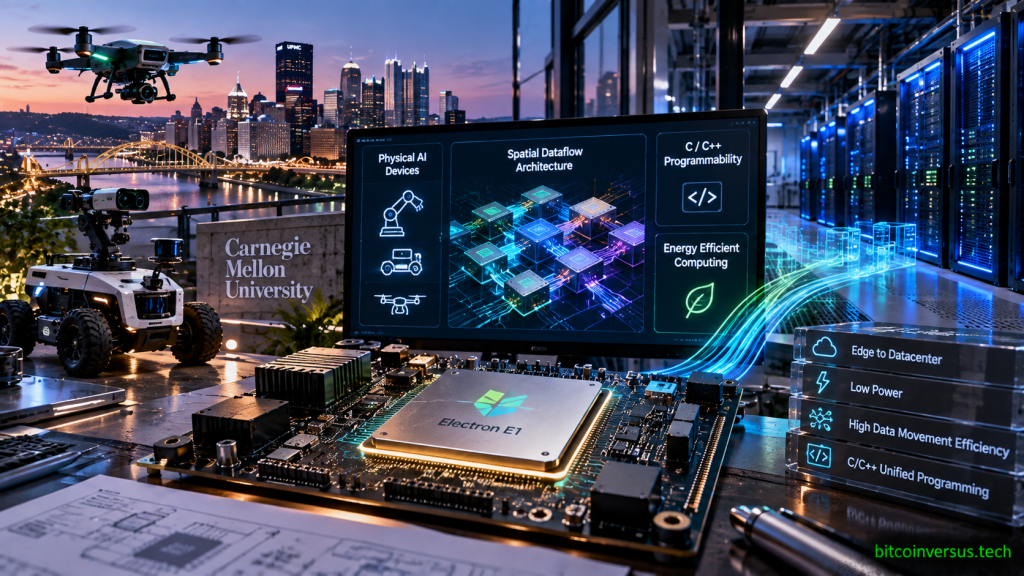
Efficient Computer has raised $97 million to push its unconventional dataflow processor architecture from battery-constrained robots and embedded systems toward the data center, while its first Electron E1 chips move into volume production.
The company said on September 29 that the Series B values Efficient Computer at $650 million and brings total capital raised to $173 million. TQ Ventures led the round, joined by Eclipse, Union Square Ventures, Giant Ventures, Triatomic Capital, TO Capital, TF Capital, Mana Ventures, Toyota Ventures, Overmatch and Borderless.
The funding is intended to increase Electron E1 shipments and extend Efficient’s Fabric architecture toward data-center-class performance. Efficient says that future work is targeting more than a 10× reduction in energy consumption compared with systems built today, a forward-looking company claim rather than an independently demonstrated data-center benchmark.
Reuters reporting confirmed the $97 million round and $650 million valuation, while noting that Efficient’s first shipping chips target drones and small robots even as the company works toward larger data-center processors.
Electron E1 replaces instruction flow with spatial dataflow
Electron E1 is not simply another low-power CPU. Efficient’s Fabric architecture maps an application’s dataflow across a tiled grid of compute nodes. Instead of repeatedly fetching and decoding instructions through a conventional processor front end, the compiler distributes operations across the chip so data can move between the nodes that need it.
That architecture is aimed at reducing energy spent moving instructions and data rather than performing useful computation. Efficient also pairs the hardware with its effcc compiler so developers can use C and C++ instead of programming a specialized accelerator from scratch.
The following official Efficient Computer walkthrough shows the Electron E1 evaluation kit and the development workflow developers use to bring software onto the processor.
The immediate market is physical AI
The first commercial target is not a hyperscale GPU cluster. Electron E1 is aimed at physical AI and embedded workloads where every watt affects battery life, cooling, weight or mission duration. Efficient lists autonomy, critical-infrastructure observability, space and defense, and wearable devices among its target applications.
That puts Electron E1 in a rapidly growing class of processors trying to move more intelligence onto the device. BitcoinVersus.Tech recently examined Ambarella’s X7 physical-AI processor operating in a 2-to-5-watt envelope, another example of compute moving into power-constrained machines rather than remaining exclusively in the cloud.
The lead investor highlighted the difference between demonstrating an architecture and shipping it. In a specific post announcing the round, TQ Ventures said Efficient had taped out four times in under three years and was already shipping Electron E1 in volume.
TQ Ventures followed the announcement with the Reuters coverage of the financing and Efficient’s broader attempt to make dataflow computing commercially programmable.
General-purpose efficiency is the harder claim
Specialized accelerators can be extremely efficient when the workload matches the hardware. The challenge is retaining that efficiency across irregular software that does not map cleanly onto a narrow accelerator.
Efficient is positioning Fabric as a general-purpose answer to that problem. The company says Electron E1 can support heterogeneous application code while avoiding much of the energy overhead associated with conventional instruction-centric execution. Its public efficiency figures, including claims of 10-to-100× improvements for some general-purpose workloads, remain company claims and will ultimately need workload-specific independent benchmarking.
Electronic Design’s interview with Efficient Computer CEO Brandon Lucia provides a technical explanation of the programmable dataflow approach and why the company believes compiler and architecture design have to be developed together.
The data-center roadmap changes the scale of the problem
Moving Fabric into a data center would require a different class of system engineering. Higher aggregate throughput brings memory bandwidth, packaging, interconnect, software maturity, reliability and cooling into the design problem. A processor that saves energy on computation still has to fit inside a complete server architecture.
BitcoinVersus.Tech’s coverage of MIPS and Xcelsa optimizing RISC-V custom silicon showed another route toward workload-specific compute without abandoning programmable processor architecture. Efficient is taking a more fundamental path by changing how general-purpose computation itself is scheduled across the chip.
The energy argument becomes more important as AI infrastructure scales. Our recent report on Analog Devices’ $1.35 billion Alif Semiconductor acquisition similarly reflects growing demand for efficient edge intelligence, where power budgets can matter as much as peak compute performance.
Efficient’s new financing therefore funds two distinct execution tests. The first is commercial: ramp Electron E1 shipments into real physical-AI products. The second is architectural: prove that the same Fabric concept can scale far enough upward to matter in data centers without losing the efficiency advantage that defines the design.
If it succeeds, the interesting result will not be another accelerator optimized for one neural-network primitive. It will be evidence that a spatial-dataflow machine can remain programmable enough for broad software while cutting the energy tax imposed by conventional execution. The $97 million round gives Efficient Computer more runway to find out.
BitcoinVersus.Tech
Advertisement: Follow BitcoinVersus.Tech for independent coverage of Bitcoin mining, ASIC hardware, semiconductors, AI infrastructure, robotics, data centers and energy.
BitcoinVersus.Tech Editor’s Note:
We volunteer daily to ensure the credibility of the information on this platform is Verifiably True. If you would like to support to help further secure the integrity of our research initiatives, please donate here: 3C9o19EH5HSiwEPyCTmEKzxhNCbo2X6TTb
BitcoinVersus.tech is not a financial advisor. This media platform reports on financial subjects purely for informational purposes.


Leave a Reply