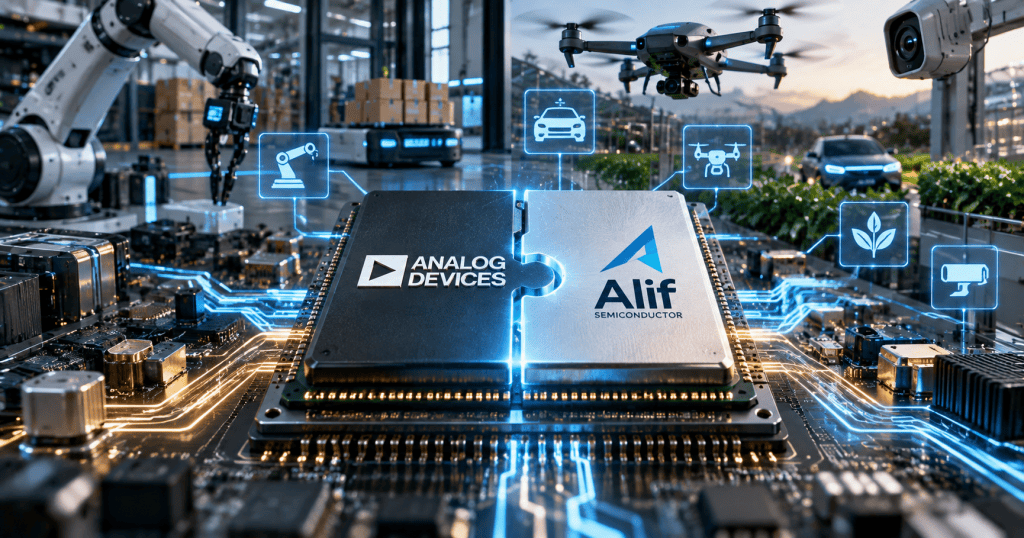
Analog Devices is making a $1.35 billion cash bet that the next major phase of artificial intelligence will happen closer to sensors, machines and physical systems rather than only inside giant data centers.
Under the company’s definitive agreement, Analog Devices, or ADI, plans to acquire Alif Semiconductor for $1.35 billion upfront in cash, with as much as $200 million of additional contingent consideration. The companies expect the transaction to close before the end of 2026, subject to customary conditions.
The deal is less about adding another conventional microcontroller line and more about putting AI inference, sensing and control into the same low-power systems that interact directly with the physical world.
ADI calls the target “Physical Intelligence”
Analog Devices says AI is moving into environments where systems must interpret motion, sound, vibration, radio signals and other real-world inputs locally. That requires low latency, tight power budgets, dependable security and enough on-device compute to make decisions without continuously sending data back to a cloud service.
Alif’s contribution is a family of power-efficient microcontrollers and fusion processors built around heterogeneous computing. Its chips combine CPU resources, integrated neural processing units, graphics acceleration, connectivity and security so embedded systems can run AI workloads directly at the edge.
That architecture fits into a broader shift toward Arm-based heterogeneous computing, where different processing blocks handle different workloads instead of forcing one general-purpose core to do everything.
ADI summarized the strategy in its public announcement on X, describing the acquisition as a way to add an AI-native processing platform for next-generation physical systems.
Alif brings AI processors that are already shipping
Alif is not a pre-product research company. ADI says Alif silicon is already shipping in production and has design wins across consumer and industrial customers. The company’s portfolio scales from single-core devices to multicore systems with integrated NPUs and graphics acceleration.
That matters because physical AI is increasingly defined by what can run under constrained power and memory budgets. A factory sensor, mobile robot, camera or wearable system cannot assume it has the cooling, power delivery or network connection of a data-center accelerator.
The engineering direction is closely related to the physical-AI transition BitcoinVersus.tech recently examined in AMD’s move from cloud AI toward robotics. In both cases, the key problem is pushing useful intelligence into systems that have to sense, decide and act in real time.
Analog expertise meets embedded AI
ADI already has deep positions in sensing, signal processing, power management, connectivity and industrial electronics. Alif adds a more aggressive digital AI layer. The combined idea is straightforward: collect physical signals, process them locally, run inference on the device and turn the result into an immediate action.
Independent reporting on the transaction confirms the acquisition is intended to expand ADI’s on-device capabilities as AI workloads move into physical systems. Reuters also noted that Alif develops low-power processors that combine AI compute, sensor data, connectivity and security for consumer and industrial applications.
The edge-AI stack is becoming more specialized
The acquisition also reflects a semiconductor industry that is becoming more specialized by workload. AI systems now mix general CPUs, NPUs, signal processors, graphics engines, memory controllers, security blocks and application-specific logic.
BitcoinVersus.tech has seen the same trend in custom RISC-V silicon development, where system designers are increasingly combining specialized compute with domain-specific architectures instead of relying on one monolithic processor design.
Why the acquisition matters
The strategic value is not only raw AI performance. ADI is buying an embedded-compute platform that can sit next to the sensors, power systems and analog interfaces the company already sells. That creates a path toward more complete systems for robotics, industrial automation, energy infrastructure, medical devices, wearables and intelligent machines.
Alif also gives ADI a way to compete deeper inside the digital portion of the edge-AI stack without abandoning the analog and mixed-signal strengths that built the company. If the integration works as intended, customers could source more of the sensing-to-decision chain from one supplier.
The larger shift is that AI hardware is no longer defined only by the biggest accelerator in the data center. More of the next wave will be measured by how efficiently intelligence can be placed inside the machines that actually touch the physical world.
BitcoinVersus.Tech
Advertisement
BitcoinVersus.Tech Editor’s Note:
We volunteer daily to ensure the credibility of the information on this platform is Verifiably True. If you would like to support to help further secure the integrity of our research initiatives, please donate here: 3C9o19EH5HSiwEPyCTmEKzxhNCbo2X6TTb
BitcoinVersus.tech is not a financial advisor. This media platform reports on financial subjects purely for informational purposes.


Leave a Reply