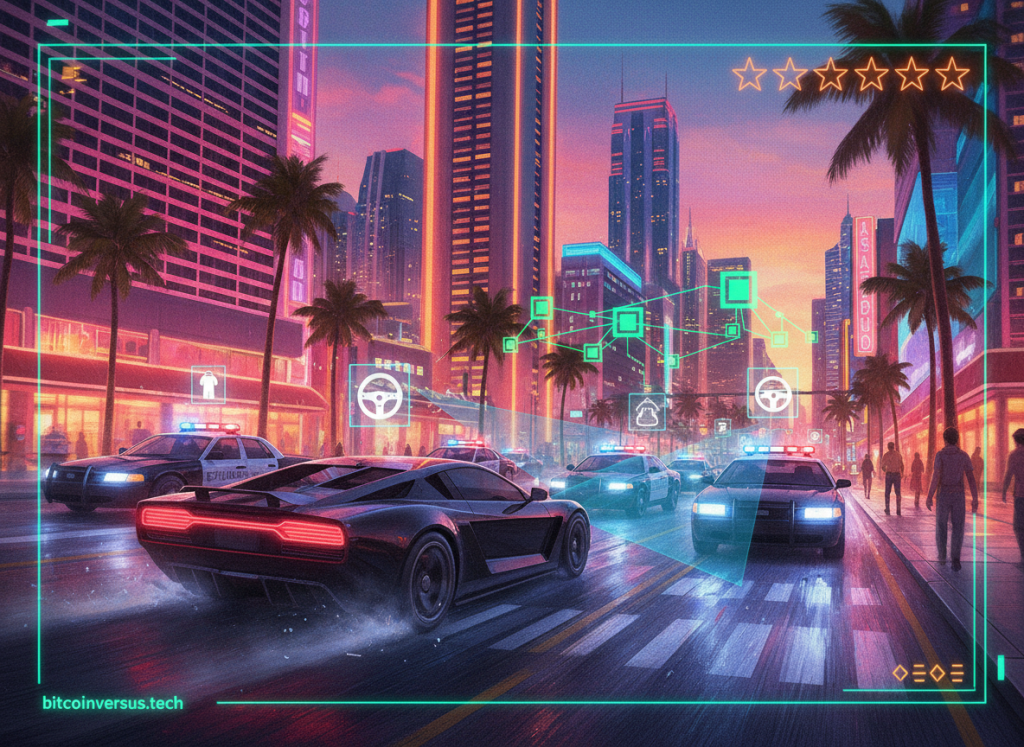
Grand Theft Auto VI’s latest gameplay footage is interesting for more than graphics. It shows Rockstar moving toward a wanted system where police react to information about the player instead of feeling like a single global switch.
Rockstar says its 26-minute Extended Look was captured entirely from in-game PlayStation 5 footage. The presentation shows Jason and Lucia moving through pursuits, disguise changes, combat and character switching ahead of the November 19 launch.
Rockstar first promoted the showcase through this official X post.
The police appear to work from information
PC Gamer’s gameplay breakdown notes that police may receive a description of the player, the vehicle, clothing and whether Jason and Lucia are traveling together. The footage also shows six wanted-star slots, while disguises and gear can be changed on the fly.
That makes the system look less like one global wanted variable and more like several linked gameplay states. Rockstar has not published GTA VI source code, so the exact architecture is unknown. From a programming perspective, however, the visible behavior can be read as an event-driven chain: an incident occurs, information is recorded, a suspect state is created, and the player changes that state through movement, appearance or vehicle choices.
A state-machine way to read the gameplay
One way to model a system like this is with states such as unidentified, partially identified, actively pursued and lost. Each state can carry attributes such as face known, clothing known, vehicle known and whether the two protagonists were seen together.
That does not mean Rockstar literally uses one simple state machine. Large commercial engines combine perception, mission scripting, animation, traffic, navigation, combat logic, world streaming and save-state systems. The important point is that GTA VI exposes more relationships between those systems to the player.
BitcoinVersus.tech has explored the coding side of this franchise before through Grand Theft Auto III reverse engineering in C++. That older work is useful context because open-world gameplay is fundamentally a synchronization problem: many independent systems must agree about what is happening at the same moment.
Disguises become gameplay data
If changing a hat, mask, glasses or clothing can change what police know about the player, cosmetic objects stop being purely visual inventory. They also become inputs to gameplay logic.
A clothing component might normally answer a rendering question: what mesh and material should appear? In a reactive wanted system it may also affect another question: what description should the world retain about the character?
This cross-system design is why modern engines are difficult to build. Open-source projects such as Crown Engine 0.65 expose how much infrastructure sits behind scenes and game logic, while Microsoft’s Xbox multiplayer sample for Godot shows another side of the same challenge: game state must move reliably between systems without becoming inconsistent.
Character switching raises the synchronization problem
The Extended Look also shows Jason and Lucia switching during action without a loading screen. The engine has to preserve nearby NPC behavior, animation, mission scripting, camera state and inventory while control moves between protagonists.
When the wanted system also tracks whether the pair were seen together, character switching becomes part of the same simulation. The game cannot treat “the player” as a single anonymous object. It has to reason about two protagonists, their current appearance, their vehicles and the information the world has collected.
The coding story is the interaction between systems
GTA VI’s technical leap may not be one spectacular algorithm. The stronger signal is how many systems appear to feed one another. Clothing can matter to identification. Vehicle choice can matter to pursuit. Character switching can matter to what police know. Combat, navigation and longer-term behavior systems can all contribute to the same open world.
That is what makes the footage useful as a programming story. The visible improvement is not only higher-resolution assets. It is a denser network of game-state variables, rules and reactions. If Rockstar can keep those systems synchronized at open-world scale, GTA VI should feel less scripted even though the experience is still built from carefully designed code, states and events.
BitcoinVersus.Tech
Advertisement
Editor’s Note
We volunteer daily to ensure the credibility of the information on this platform is Verifiably True. If you would like to support to help further secure the integrity of our research initiatives, please donate here: 3C9o19EH5HSiwEPyCTmEKzxhNCbo2X6TTb
BitcoinVersus.tech is not a financial advisor. This media platform reports on financial subjects purely for informational purposes.


Leave a comment