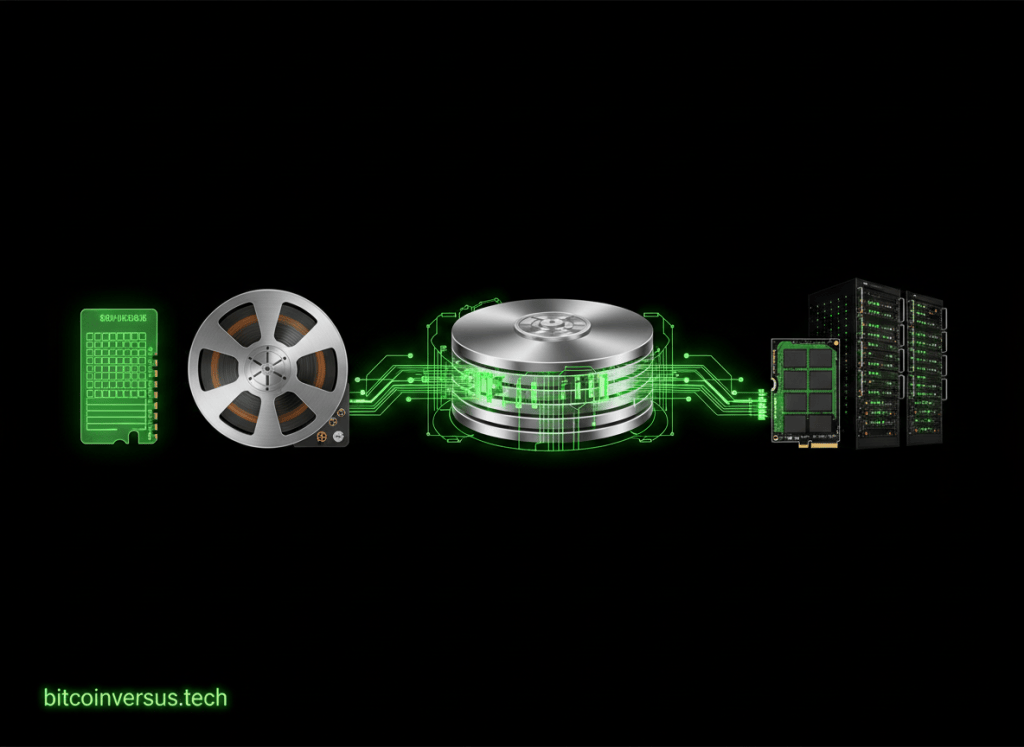
A September 22 video from The Night Shift Professor traces computer storage from punched cards and magnetic tape to hard drives, flash memory and SSDs. The history lands at a timely moment: AI is making storage capacity, data readiness and retrieval speed critical infrastructure again.
The shift is easy to miss because storage usually sits behind the processor. CPUs and GPUs perform the visible computation, but every program, model, file and dataset depends on somewhere persistent to live. In a September 28 post, Seagate said AI is creating new demands on enterprise infrastructure and making data readiness and storage increasingly important to AI success.
Storage began as physical encoding
Early information systems stored data by changing physical media. Holes punched into cards represented characters and instructions that machines could read. IBM’s history of the punched card notes that its 80-column format could hold roughly 80 bytes and that large programs or datasets required entire stacks of cards.
The limitation was obvious: capacity scaled with paper. More information meant more cards, more floor space, more handling and more chances for physical damage or ordering mistakes.
That physicality helps explain why later storage technologies felt revolutionary. Magnetic tape could pack far more information into much less space, while magnetic disks added something tape could not provide efficiently: fast random access.
RAMAC changed storage from sequential to random access
The hard disk changed the model again. Instead of reading a long sequence until the desired record appeared, a disk could move a read/write head to a particular location.
The Computer History Museum documents IBM’s 1956 Model 350 RAMAC as the first commercial hard disk drive. Its 50 spinning 24-inch disks stored about 3.75 MB and the complete unit weighed more than a ton.
That capacity looks tiny now, but random access was the conceptual breakthrough. Modern hard drives and SSDs are dramatically smaller and faster, yet both still solve the same user problem: retrieve a specific block of data without stepping through everything stored before it.
BitcoinVersus.tech’s SSD vs HDD comparison shows how that evolution split into two dominant technologies: mechanical disks optimized for inexpensive capacity and solid-state storage optimized for latency, shock resistance and parallel access.
Flash removed the moving parts
Solid-state storage removed spinning platters and moving heads from the data path. Instead, flash memory stores information electrically inside semiconductor cells. That change improved access latency, reduced mechanical failure points and allowed storage devices to become much smaller.
The operating system still has to discover and organize those devices. BitcoinVersus.tech’s recent Linux lsblk lesson shows the modern software view: disks, partitions and removable media appear as block devices that the OS can enumerate, mount and manage.
Even external storage follows the same abstraction. A USB drive, portable SSD or external hard disk presents a block device to the host while hiding most of its controller logic, flash translation or mechanical details behind a standard interface.
BitcoinVersus.tech’s external-storage guide covers that practical endpoint: the physical medium changes, but the user increasingly interacts with storage as a portable, addressable service rather than a mechanism.
AI makes storage a throughput problem again
AI changes the storage discussion because modern models do not only need capacity. Training pipelines repeatedly stream enormous datasets. Checkpoints must be written and loaded. Inference systems need model weights and retrieval data available with predictable latency. A fast accelerator can still sit idle if storage cannot feed it quickly enough.
The storage story is really about hiding complexity
The long arc from punched cards to SSDs is not only about fitting more bits into less space. Each generation hides more physical complexity from the software and the user.
A punched-card operator could see every record as a physical object. A hard-drive user could not see which platter held a file. An SSD user usually cannot know which flash cell holds a block because the controller constantly remaps data for wear leveling and reliability.
Modern cloud and AI systems push that abstraction further. Applications often interact with object stores, distributed file systems or databases without knowing which rack, drive or flash package physically contains the data.
The result is a strange continuity. Computing began with information represented as visible holes in cardboard. Today, exabytes of data move through storage systems that hide nearly every physical detail. The medium changed completely, but the engineering objective stayed the same: preserve information, find it quickly and move it to computation when needed.
BitcoinVersus.Tech
Advertisement
BitcoinVersus.Tech Editor’s Note:
We volunteer daily to ensure the credibility of the information on this platform is Verifiably True. If you would like to support to help further secure the integrity of our research initiatives, please donate here: 3C9o19EH5HSiwEPyCTmEKzxhNCbo2X6TTb
BitcoinVersus.tech is not a financial advisor. This media platform reports on financial subjects purely for informational purposes.


Leave a Reply