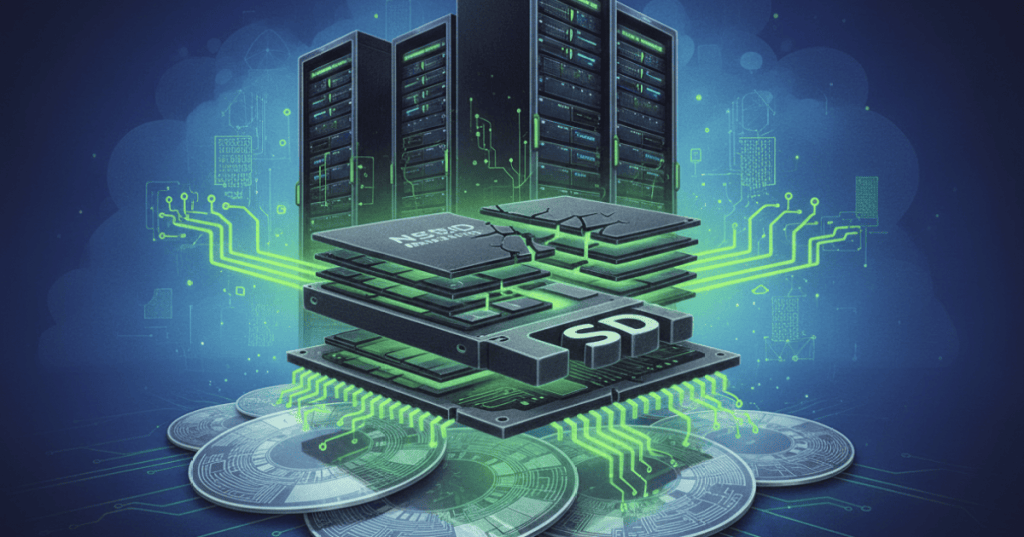
Kioxia is pushing the long E1.L “ruler” SSD back into the center of hyperscale storage design with the new LD4 Series, a QLC NAND drive family built for dense 1U servers and read-heavy data-center workloads.
Kioxia announced the LD4 on October 9, saying it is the company’s first E1.L SSD built with generation-8 BiCS FLASH QLC memory. The drives are sampling now in 15.36 TB and 30.72 TB capacities, while Kioxia says the architecture has been validated for capacities as high as 122.88 TB.
That distinction matters: 122.88 TB is the validated ceiling of the design announced today, not yet a shipping LD4 SKU. StorageReview likewise notes that the current samples top out at 30.72 TB.
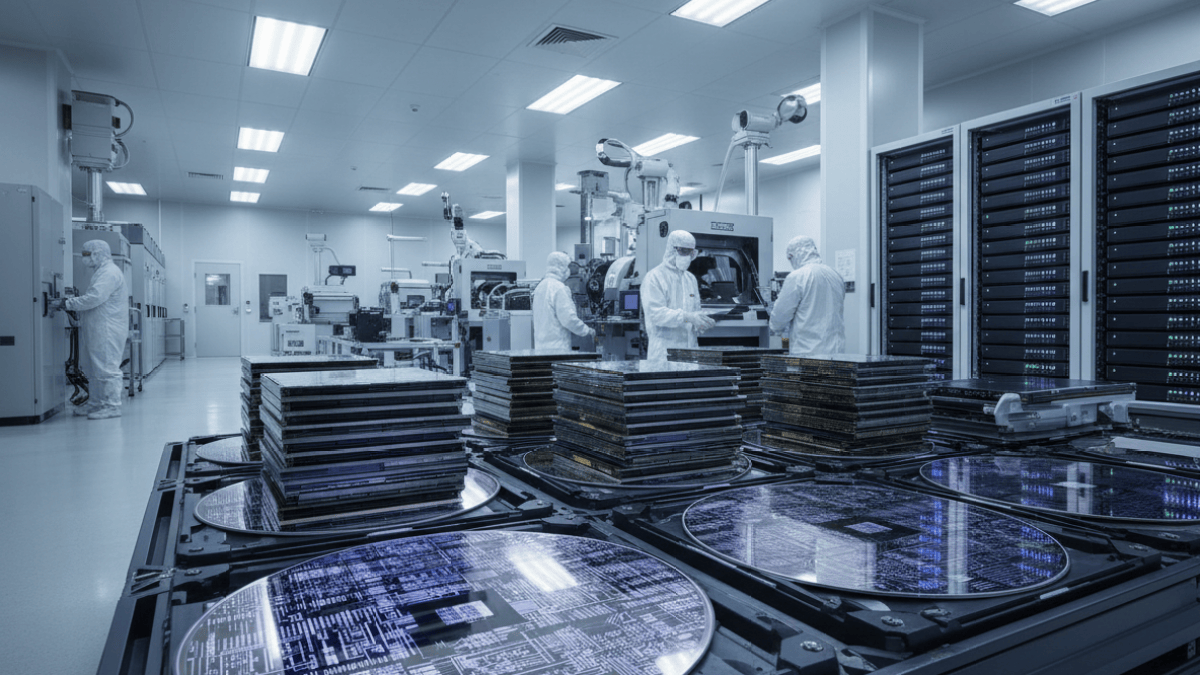
Why E1.L Exists
E1.L is part of the Enterprise and Datacenter Standard Form Factor family. Unlike the familiar consumer M.2 stick, E1.L is a much longer device designed around server density, airflow, serviceability, and the physical realities of rack-scale storage.
The goal is simple: place more flash capacity into a 1U chassis without turning drive replacement and cooling into an afterthought. That builds directly on the concepts in BitcoinVersus.Tech’s NVMe vs. SATA SSD guide, where interface speed and physical form factor were treated as separate design choices.
QLC Trades Write Endurance for Density
The LD4 uses QLC NAND, which stores four bits per memory cell. Packing more bits into each cell raises capacity and can reduce cost per stored terabyte, but QLC generally gives up endurance and sustained write performance compared with TLC designs. That is why Kioxia is positioning LD4 for read-intensive environments rather than write-heavy transactional workloads.
For readers who want the component-level picture, BitcoinVersus.Tech’s What’s Inside an SSD? explains how NAND, controllers, firmware, and cache behavior fit together.
The Interface Is PCIe 5.0, But the Lane Rate Needs a Footnote
Kioxia lists the LD4 as PCIe 5.0 compliant with an x4 connection, while specifying operation up to 16 GT/s per lane. That lane rate corresponds to the throughput class normally associated with PCIe Gen4 signaling, even though the device is designed within a PCIe 5.0 ecosystem and supports NVMe 2.0e plus the OCP Datacenter NVMe SSD Specification 2.6.
That makes LD4 less about chasing benchmark headlines and more about fitting a very large amount of flash behind a standardized hyperscale interface. BitcoinVersus.Tech’s older PCI Express overview explains why lane count and per-lane signaling rate both matter when interpreting interface claims.
Why 122.88 TB in One Device Matters
High-capacity SSDs reduce the number of physical devices required to reach a target storage pool. That can mean fewer connectors, fewer drive slots, fewer controllers, fewer service points, and less board area per petabyte. In hyperscale systems, those physical savings can matter almost as much as raw throughput.
The same trend explains why modern AI infrastructure increasingly treats storage as part of the compute architecture rather than a separate back-room tier. BitcoinVersus.Tech recently traced that shift in From Punch Cards to AI: How Computer Storage Became Critical Infrastructure.
AI Storage Is Becoming a Rack-Density Problem
AI clusters generate enormous data sets, checkpoints, embeddings, logs, model artifacts, and object-store traffic. GPUs may dominate attention, but the rack still has finite space, finite power, and finite cooling capacity. Dense flash can reduce the number of chassis needed to hold a given data set and can keep more data physically close to compute.
Kioxia is also part of the broader semiconductor push to improve how memory and storage scale for AI. BitcoinVersus.Tech covered that direction in September when Applied Materials and Kioxia brought AI-memory R&D into the EPIC Center.
What to Watch Next
- 122.88 TB timing: Kioxia has validated the architecture, but has not announced when that capacity becomes a commercial LD4 SKU.
- Performance: detailed throughput, IOPS, latency, and endurance figures will determine where LD4 fits versus competing QLC drives.
- Thermals: extreme flash density inside 1U systems pushes cooling and airflow design higher on the priority list.
- OCP adoption: the LD4 will be shown at the 2026 OCP Global Summit in San Jose from October 12–15.
- TCO: hyperscalers will care about watts per terabyte, rack units per petabyte, endurance, and service costs—not just maximum capacity.
Bottom Line
Kioxia’s LD4 is a storage-density play. The current 15.36 TB and 30.72 TB samples are not record-breaking by themselves, but the validated 122.88 TB architecture shows where E1.L is headed: fewer devices, more terabytes per rack, and storage systems designed around the same physical-density pressures already reshaping AI compute.
Editor’s Note: Product specifications can change before mass production. The 122.88 TB figure refers to Kioxia’s validated LD4 architecture; the announced sampling capacities are 15.36 TB and 30.72 TB.
BitcoinVersus.Tech is not a financial advisor. This media platform reports on financial and technology subjects for informational purposes.


Leave a Reply