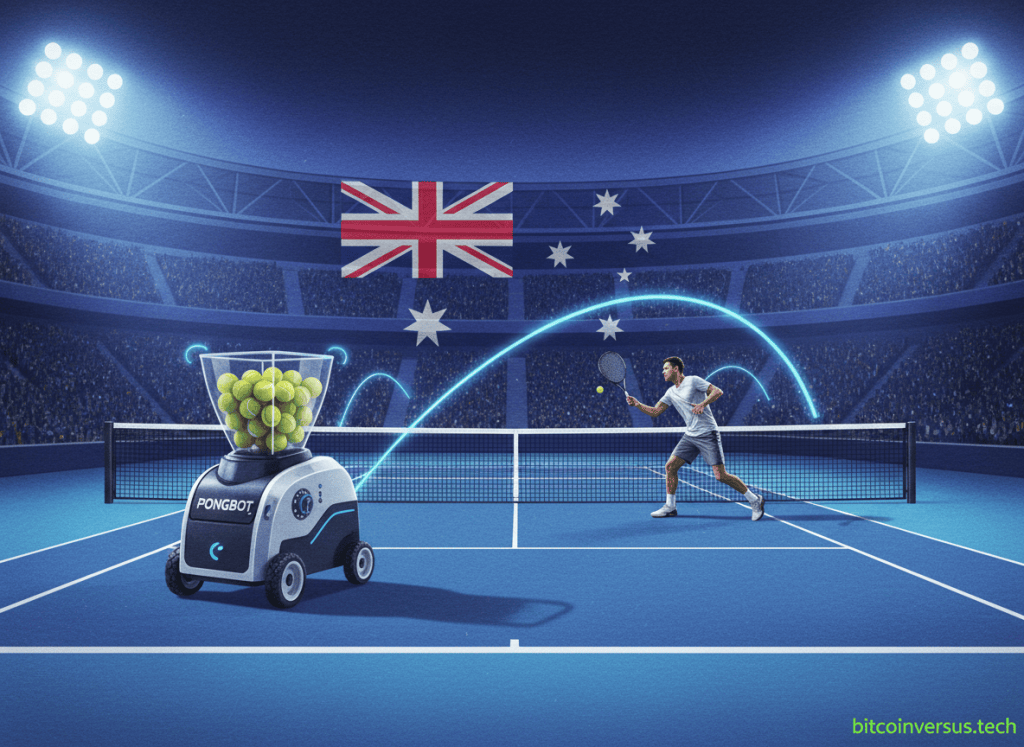
The Australian Open is bringing artificial intelligence deeper into tennis training. Tennis Australia has named Pongbot the Official Ball Machine of the Australian Open and the Official Ball Machine Supplier of its National Tennis Academy, putting an AI-focused training platform alongside one of the sport’s biggest events.
According to the Australian Open announcement, the multi-year partnership begins with AO27. Pongbot, founded in 2019, develops intelligent tennis-training systems that combine repeatable ball delivery with tracking, data collection and performance analysis.
The announcement also circulated through a specific public post on X, giving the partnership a timely social signal beyond the tournament’s own channels.
From programmed feeds to an AI training loop
A conventional tennis ball machine is mostly a repetition tool. It can send balls to preset locations at selected speeds and spins. The more interesting sports-science question is what happens when the machine can also participate in a feedback loop: observing player position, varying patterns, collecting training data and helping structure drills around performance.
That direction fits a wider shift already visible across sports. BitcoinVersus.tech previously examined robotic racquet-sports training, where sensing and real-time adaptation make the machine part of the practice environment rather than simply a launcher.
Why the Australian Open partnership matters
Tennis Australia says the technology will support both high-performance training and broader participation. The National Tennis Academy connection is especially important because it creates a setting where coaches and developing players can use the equipment repeatedly rather than treating it as a one-off tournament attraction.
Independent reporting from The Australian says the rollout will also include fan-facing AI challenges around the Grand Slam, bringing the same underlying training concept into a public demonstration environment.
That puts the technology at the intersection of elite development, consumer sports hardware and live-event experience. It is similar to the way AI is changing sports officiating: the most consequential systems are not useful because the label says “AI,” but because sensing, computation and software can make a previously subjective or repetitive task more measurable.
The sports-science value is in the data
For coaches, consistency is valuable because it makes comparison possible. A player can repeat a drill against a controlled sequence, then compare movement, timing, placement and response across sessions. If the machine also changes feeds based on the player’s position or selected training objective, practice begins to resemble a controlled experiment.
That is the same principle behind modern tracking systems in other sports. Baseball’s public Statcast tools, for example, increasingly translate physical events into measurable probabilities and outcomes, as seen in BitcoinVersus.tech’s look at first-base receiving analytics. Tennis training is moving in the same general direction: more sensors, more repeatable data and more opportunities to connect a physical movement with an objective result.
AI will not replace the coach
The strongest use case is assistance, not replacement. A machine can repeat a difficult pattern hundreds of times and record what happened. A coach still decides why a drill matters, what technical change is appropriate and how a player should adapt when competition becomes unpredictable.
The Australian Open partnership is therefore less about a robot “playing tennis” and more about intelligent practice infrastructure becoming normal enough to sit inside a Grand Slam ecosystem. AO27 will give tennis a high-profile test of how well that hardware-and-data model translates from product demonstrations into serious development and everyday training.
BitcoinVersus.Tech
Advertisement
Editor’s Note
We volunteer daily to ensure the credibility of the information on this platform is Verifiably True. If you would like to support to help further secure the integrity of our research initiatives, please donate here: 3C9o19EH5HSiwEPyCTmEKzxhNCbo2X6TTb
BitcoinVersus.tech is not a financial advisor. This media platform reports on financial subjects purely for informational purposes.


Leave a Reply