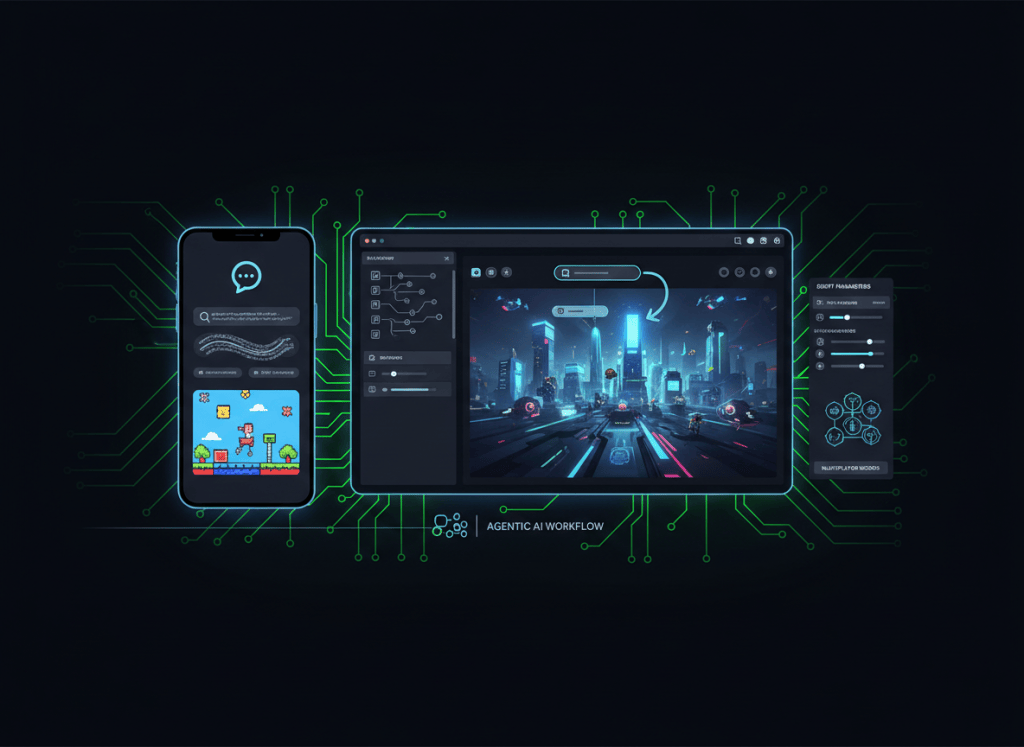
Meta is pushing game development toward a radically different workflow: describe the game first, then let an agentic engine assemble a playable project that can still be edited by hand.
The company introduced Horizon Create and Horizon Studio at Meta Connect 2026. Both run on the Meta Horizon Engine and are designed to turn natural-language instructions into complete 2D or 3D mobile games, including environments, characters, mechanics, progression, difficulty and multiplayer systems.
Prompting becomes part of the game-development loop
Horizon Create is the mobile side of the system. A creator can describe an idea, let the engine build while other projects or games remain active, then return to playtest and request changes. Horizon Studio moves the same project into a browser environment with visual scene editing, asset swapping and direct access to script parameters.
That distinction matters. This is not simply an AI chatbot writing isolated snippets of game code. Meta is trying to connect prompting, scene construction, gameplay systems, iteration and publishing inside one development pipeline. Projects can move between the phone and browser while retaining assets, systems and iteration history.
The coding question is control, not just generation
For programmers, the interesting question is what happens after generation. A useful game-development system has to survive iteration: designers need predictable state, tunable parameters, reusable assets and enough visibility into behavior to debug what the engine produced. Meta says Studio provides granular controls alongside prompting, allowing creators to manually arrange scenes and tune script parameters rather than relying exclusively on natural language.
That puts Horizon Studio in a different part of the tool spectrum from conventional engines such as Godot, where developers work directly with engine APIs and C# or GDScript. It also contrasts with the enormous custom simulation work behind dense open-world games such as GTA 6. Meta’s bet is that many smaller experiences can start at a higher level of abstraction.
Distribution is part of the development platform
The bigger technical-platform play is distribution. Meta says published games can become eligible to reach players across Horizon, Facebook and Instagram. That collapses several stages that normally sit outside the engine—hosting, discovery and player acquisition—into the same ecosystem that generated the project.
The Verge reported that the tools are aimed at making complete game creation accessible from phones and browsers. Early access is rolling out gradually, so the most important unanswered questions remain how complex generated projects can become, how well creators can debug them, and how much low-level control experienced developers ultimately receive.
The announcement lands as coding tools themselves are becoming more agentic. BitcoinVersus.tech recently examined how game systems increasingly depend on interconnected simulation logic. Horizon Create and Studio push in the opposite direction from that complexity at the interface: the creator states intent while the engine attempts to orchestrate more of the implementation underneath.
What to watch next
The real test will not be whether AI can produce a small playable demo from one prompt. It will be whether creators can repeatedly modify a project without breaking earlier systems, understand why generated behavior works, and push beyond templates when a game needs custom logic. If Meta can make that iteration loop reliable, prompt-driven creation could become another legitimate layer in game programming rather than merely a shortcut to prototypes.
Editor’s Note: BitcoinVersus.tech covers the intersection of gaming, programming, AI, hardware and open technology.
Support independent technology coverage: If you value our reporting, consider supporting BitcoinVersus.tech.
BitcoinVersus.tech is not a financial advisor. This article is for informational purposes only.


Leave a comment