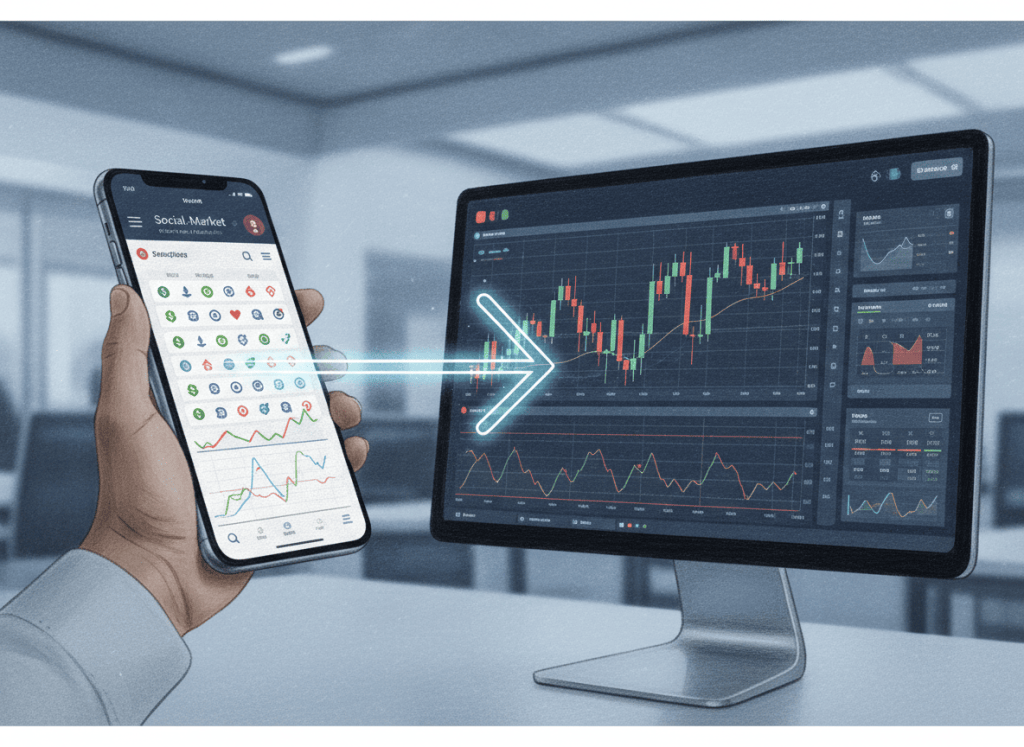
Webull is joining X’s expanding Cashtag trading system, giving U.S. users another path from a market conversation on the social platform to an outside brokerage where an actual stock or crypto order can be completed.
In its October 2 announcement, Webull said it will serve as an X Cashtag Partner for stocks and crypto. The integration links X’s real-time financial discussions and market signals with Webull’s brokerage infrastructure, while also creating a route for Webull to use social-market data such as sentiment, discussion trends and Cashtag activity.
The change matters because Cashtags are no longer just labels for finding posts about a ticker. X has been turning them into interactive market destinations with charts, related conversation and a trading handoff. TechCrunch reported that the U.S. rollout began with Interactive Brokers, Moomoo, Gemini, Kraken and Coinbase, with users redirected to a participating brokerage or exchange to sign in and complete the transaction.
Webull Extends the Cashtag Trading Network
X’s Business account introduced the Cashtag Partner concept as a bridge between financial conversation and the ability to act through a trading provider. Webull’s addition broadens that bridge with another large retail-investing platform and gives the partnership a second layer beyond simple referral traffic: Webull says X data could also help investors interpret what markets are discussing in real time.
The Important Detail: X Is the Handoff, Not the Broker
The product can look like trading inside a social feed, but the execution boundary is important. X surfaces the ticker, chart, conversation and provider choice; the selected brokerage or exchange handles account access and the trade itself. With Webull joining, the social network becomes more useful as a financial discovery layer without becoming the venue that directly executes the order.
That distinction also helps explain why the partner roster matters. Every additional brokerage or exchange makes the Cashtag interface more useful without requiring X to build the full custody, compliance and execution stack for every asset class. The social network can focus on discovery and routing while regulated financial platforms keep the transaction on their own systems.
Social Data Is Becoming Part of the Trading Interface
Webull’s announcement goes beyond adding another Trade button destination. The company specifically points to X Data and social-market signals, including sentiment, discussion trends and market narratives. That pushes the idea closer to a feedback loop: conversation can influence what investors notice, Cashtags organize that attention around assets, and the brokerage can potentially use those same signals as market context.
BitcoinVersus.Tech recently covered how Robinhood is adding AI trading agents that can monitor markets and act under user-defined conditions. Webull and X are approaching the same broader shift from a different direction: financial software is becoming less about opening a standalone quote screen and more about connecting information, conversation, analysis and execution into one continuous workflow.
The infrastructure around markets is changing too. Our coverage of the SEC’s proposed path for tokenized U.S. stocks to trade onchain shows how distribution and settlement models are being challenged at the same time that social platforms are changing the front end investors use to discover assets.
And the boundary between banking and crypto rails is narrowing as well. BitcoinVersus.Tech also examined Citi and Coinbase bringing stablecoin payments into bank infrastructure. Together, these developments point to a financial stack that is becoming more connected at every layer: social discovery at the top, programmable trading interfaces in the middle and increasingly interoperable payment and settlement rails underneath.
Why Webull Joining X Matters
The immediate change is straightforward: X users gain another brokerage option when moving from a supported Cashtag toward a trade. The more consequential change is strategic. A social post, real-time chart, crowd reaction and brokerage action can now sit in a much tighter sequence than they did when a user had to leave the conversation, search for the ticker again and independently open a trading app.
That convenience can be useful, but it also raises the value of context and skepticism. When the distance between seeing a narrative and acting on it gets shorter, the quality of the information in the feed matters more. The same system that can make legitimate market discovery faster can also accelerate reactions to hype, bots, coordinated promotion or low-quality analysis.
Webull’s arrival therefore makes X’s Cashtag program more than a novelty. It is another sign that retail finance is being rebuilt around connected surfaces where conversation, data and execution increasingly touch each other. The trade still happens at the brokerage, but the decision journey can now begin much earlier—inside the timeline itself.
BitcoinVersus.Tech
Advertisement
Editor’s Note:
We volunteer daily to ensure the credibility of the information on this platform is Verifiably True. If you would like to support our research initiatives, please donate here: 3C9o19EH5HSiwEPyCTmEKzxhNCbo2X6TTb
BitcoinVersus.tech is not a financial advisor. This media platform reports on financial subjects purely for informational purposes.


Leave a comment