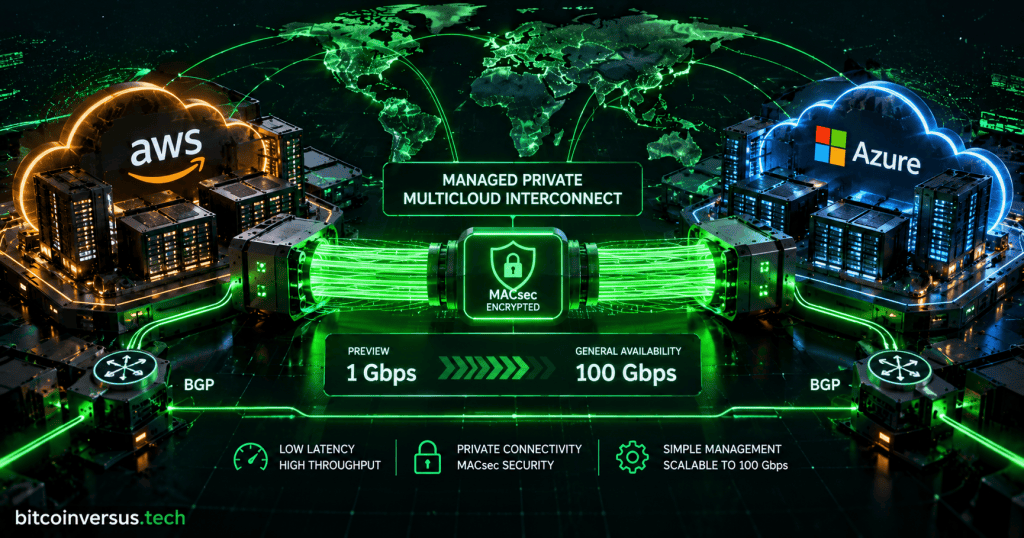
Amazon Web Services and Microsoft Azure have opened a public preview of a jointly engineered private interconnect that lets customers connect AWS virtual private clouds and Azure virtual networks without routing traffic over the public internet or manually assembling the physical and logical links themselves.
AWS’s networking announcement says Azure support is now available through AWS Interconnect – multicloud, extending the managed service across Microsoft Azure, Google Cloud and Oracle Cloud Infrastructure. Microsoft’s matching Azure Multicloud Interconnect service uses the same open network-interoperability specification from the Azure side.
Microsoft highlighted the launch in its official Azure X post, arguing that cloud-to-cloud connectivity should no longer take weeks or months to assemble.
The Preview Is 1 Gbps, Not 100 Gbps Yet
The bandwidth distinction matters. Azure’s current preview documentation lists 1 Gbps connectivity, managed resiliency and no Azure Multicloud Interconnect service or egress charge during the preview. Microsoft says the service is designed to scale to 100 Gbps at general availability, but that higher rate is a roadmap target rather than the present preview limit.
The Register’s independent coverage notes that the architecture is intended to replace a multistep process involving provider coordination, routing configuration, provisioning, monitoring and lifecycle management with a cloud-native managed connection.
What AWS and Azure Are Actually Managing
Historically, a private AWS-to-Azure path usually meant combining AWS Direct Connect, Azure ExpressRoute, a carrier or colocation provider, customer-managed routers, VLANs, point-to-point addressing and BGP sessions. The new managed interconnect abstracts much of that infrastructure behind cloud resources and an activation-key workflow.
Azure says the physical links are protected with MACsec by default and built across redundant infrastructure in separate locations. AWS handles the matching side of the connection through Interconnect – multicloud, while Azure uses ExpressRoute as the underlying transport beneath its managed resource.
This Is Networking Infrastructure, Not Just a Cloud Feature
The shift resembles the broader move toward software-defined interconnection. BitcoinVersus.Tech recently covered how Equinix Fabric One turns enterprise connectivity into an intent-driven service, reducing the amount of low-level network construction customers manage directly.
Underneath every simplified cloud workflow, however, the physical layer still matters. BitcoinVersus.Tech’s report on AT&T and Corning’s fiber-supply expansion shows how cloud growth continues to depend on glass, conduit, optical equipment and field installation even when provisioning moves into a web console.
Multicloud Traffic Is Becoming More Data-Center-Like
AI and data-intensive applications increasingly move large datasets between regions, platforms and specialized services. That pushes cross-cloud links toward the same requirements found inside high-performance data centers: predictable latency, high throughput, encryption, resilient paths and enough capacity to avoid making the network the bottleneck.
BitcoinVersus.Tech has already seen that pressure inside accelerator infrastructure, including WhiteFiber’s 136 Tbps distributed GPU supercluster link. AWS–Azure interconnect is operating at a different layer, but the engineering direction is similar: make geographically or administratively separate compute environments behave more like one networked system.
The Bigger Change Is Operational
The most consequential part of the announcement may not be raw bandwidth. It is the transfer of responsibility. Instead of forcing customers to design and maintain the entire cross-cloud transport path, AWS and Microsoft are turning that connectivity into a managed service with standardized provisioning, resiliency and security behavior.
For network engineers, that does not eliminate routing, failure-domain planning or observability. It changes where those responsibilities sit. The physical circuits, provider handoffs and encrypted backbone become increasingly abstracted, while architecture teams focus more on policy, topology, application placement, traffic engineering and cost.
BitcoinVersus.Tech
Advertisement
Editor’s Note
We volunteer daily to ensure the credibility of the information on this platform is Verifiably True. If you would like to support to help further secure the integrity of our research initiatives, please donate here: 3C9o19EH5HSiwEPyCTmEKzxhNCbo2X6TTb
BitcoinVersus.tech is not a financial advisor. This media platform reports on financial subjects purely for informational purposes.


Leave a Reply