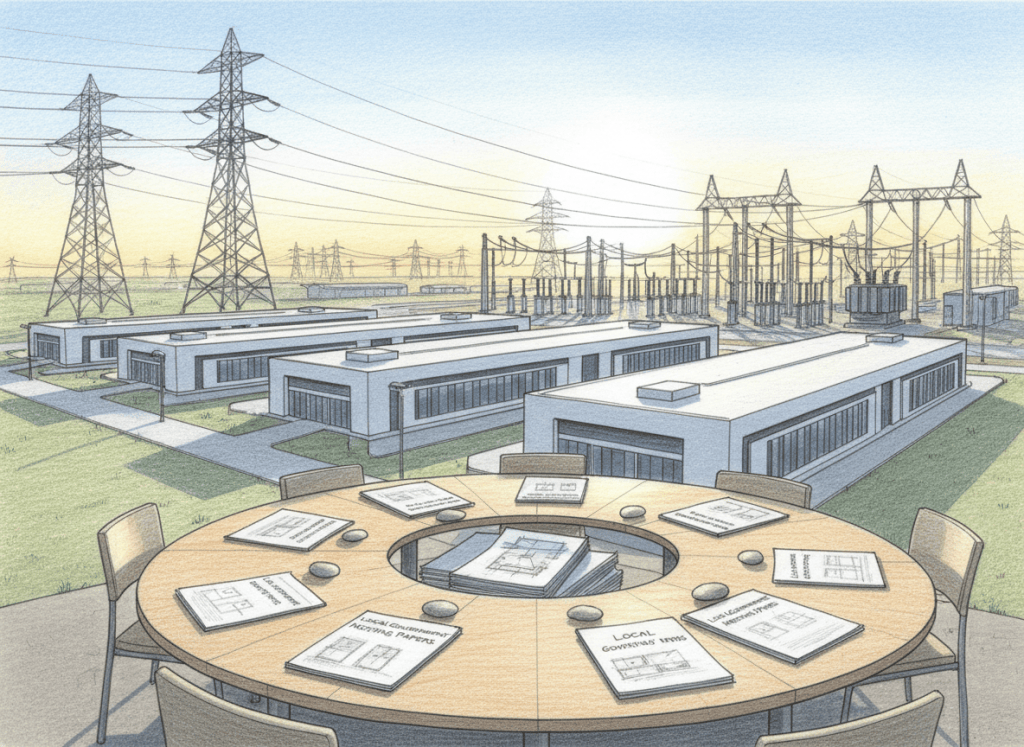
Amazon Web Services says it no longer uses nondisclosure agreements with government agencies on its data-center projects, a notable policy shift as hyperscale infrastructure faces growing scrutiny from communities over power, water, land use and permitting.
The change appears inside Amazon’s new Data Center Commitment, where AWS CEO Matt Garman says the company will engage communities earlier, host open houses and stop using NDAs with the government agencies it works with on projects.
That matters because secrecy has become one of the most politically sensitive parts of the data-center buildout. Local officials are often asked to negotiate land, utility infrastructure, tax treatment and development schedules before residents know which company is behind a project. Amazon’s new position moves at least one part of that process toward more public visibility.
The fight over data centers is becoming a transparency fight
WIRED reports that Amazon’s policy change arrives as community opposition to large data centers intensifies and NDA use becomes a recurring complaint in local permitting battles. The issue is no longer only how many megawatts a campus uses; residents increasingly want to know who is negotiating with local government, what infrastructure is being promised and which costs may eventually touch ratepayers.
BitcoinVersus.Tech recently covered Amazon’s Built Together community program, which focuses on education, workforce training and local infrastructure around data-center regions. The NDA decision is a separate governance change: it addresses how projects are discussed before and during approval rather than what communities receive after construction moves forward.
Garman summarized the broader initiative in a public X post announcing Amazon’s Data Center Commitment and arguing that getting the facts right is essential as the United States expands AI infrastructure.
Power agreements are part of the public-interest question
Data centers are increasingly negotiated as energy projects as much as computing projects. New campuses can require substations, transmission upgrades, generation contracts and long-term utility planning. That makes transparency around local agreements especially important when a project could influence how new grid infrastructure is financed.
That same issue is visible in Google’s Michigan data-center power agreement with ratepayer protections, where the utility structure itself became a central part of the public-policy story. The technical question is not simply whether a data center can obtain power, but how the surrounding community is insulated from costs created by very large new loads.
Amazon says its own approach is to work with utilities and regulators so the energy prices paid by its facilities are sufficient to cover the energy and infrastructure improvements required for those projects. The company is also promising annual public reporting on energy use, energy efficiency, water use, water efficiency and the share of energy coming from carbon-free resources.
Infrastructure credibility now affects build speed
The practical reason for the policy shift is straightforward: a technically viable site can still fail if the surrounding community does not trust the process. Data-center developers need land, power, cooling, fiber, permits and local political support. Losing any one of those can delay or kill a project.
At the same time, the physical systems inside these campuses are becoming more interconnected. BitcoinVersus.Tech recently covered AWS and Azure’s new managed private multicloud interconnect, another example of how cloud infrastructure is evolving from isolated facilities into increasingly coordinated networks. As the technical layer becomes more complex, public expectations around the physical footprint are rising with it.
Ending NDAs with government agencies does not automatically make every contract, utility agreement or contractor relationship public. It does, however, remove one mechanism that critics say can keep communities from learning about a project while major decisions are still being made.
The next stage of the AI data-center boom may be decided as much by trust as by megawatts. Amazon’s new policy suggests hyperscale operators increasingly understand that transparency is becoming part of the infrastructure stack.
BitcoinVersus.Tech
Advertisement
BitcoinVersus.Tech Editor’s Note:
We volunteer daily to ensure the credibility of the information on this platform is Verifiably True. If you would like to support to help further secure the integrity of our research initiatives, please donate here: 3C9o19EH5HSiwEPyCTmEKzxhNCbo2X6TTb
BitcoinVersus.tech is not a financial advisor. This media platform reports on financial subjects purely for informational purposes.


Leave a Reply