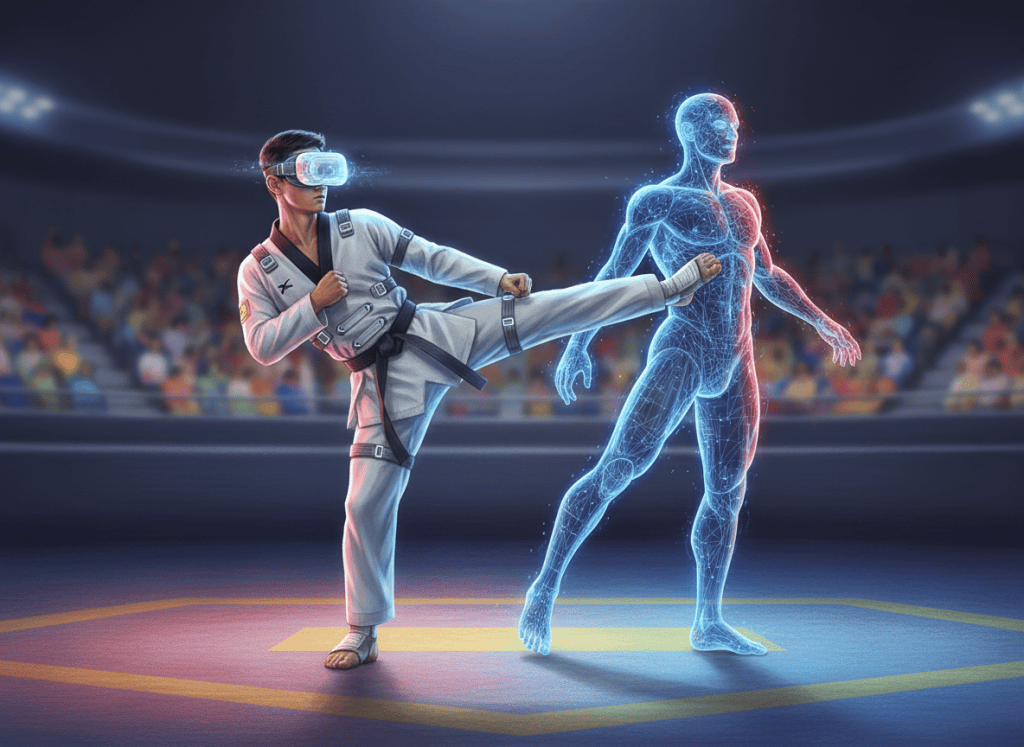
Jeus Gabriel Derick Yape has won the first Asian Games virtual taekwondo gold medal, turning one of the clearest sports-gaming crossovers at Aichi-Nagoya 2026 into a historic win for the Philippines. The 22-year-old beat Vietnam’s Ngoc Tuyet Sang Chau 2–0 in the mixed individual final while competing through a VR headset, body-tracking sensors and a digital avatar rather than making physical contact with his opponent.
The Olympic Council of Asia confirmed that Yape won the championship rounds 500–0 and 620–0 at Toyohashi Gymnasium on October 2. GMA News explained that virtual taekwondo converts real martial-arts movement into a digital contest using VR and motion-tracking hardware, with each round lasting 60 seconds.
Jeus Yape made virtual taekwondo history in its Asian Games debut
Yape’s win matters because this was not simply another esports tournament placed next to traditional sports. Virtual taekwondo asks athletes to perform actual kicks, manage distance, react to an opponent and maintain conditioning while software translates their movements into a scored digital fight.
In One Sports’ post from the event, Yape described the gold as unexpected after entering the competition focused primarily on earning a medal. The footage also shows how closely the event resembles a traditional post-match sports interview even though the competition itself takes place through a virtual combat system.
How virtual taekwondo turns real kicks into a video game fight
Athletes wear a VR headset plus motion trackers that capture movement from the body and legs. Their physical kicks are mapped to avatars inside the digital arena, where successful attacks reduce the opponent’s health or power gauge. The result looks like a fighting game, but the controller is the athlete’s own body.
That makes virtual taekwondo different from most competitive gaming. Reaction time and strategy still matter, but players cannot separate the game from real athletic movement. Flexibility, kicking speed, balance, cardiovascular conditioning and technical taekwondo skill all transfer directly into the digital contest.
The crossover fits a broader trend in which sports technology is turning physical performance into software-readable data. BitcoinVersus.Tech recently examined how IBM is converting US Open serves into biomechanics scores, while virtual taekwondo takes the next step by making the tracked movement itself the competition interface.
The mixed-gender format changes the usual combat-sports equation
Virtual taekwondo also breaks from familiar combat-sports structure because the mixed individual event places athletes into one digital competition rather than separating them strictly by traditional weight and gender divisions. Software normalizes parts of the virtual environment while preserving the value of timing, reach, movement selection and fitness.
That format gives the event an unusual position between martial arts and esports. It is recognizable to anyone who has played a fighting game, yet an elite gamepad player cannot simply walk in and replace the trained athlete. The body remains the input device.
Sports and gaming are moving toward the same motion-tracking layer
The larger story is not only Yape’s medal. Sports, gaming and simulation are increasingly using the same underlying technologies: computer vision, motion capture, real-time tracking, digital avatars and responsive physics engines.
That convergence is already visible elsewhere. Skild AI used simulated soccer to train humanoid movement, while competitive gaming itself continues to operate as a global spectator sport, as seen when Team Falcons won the 2026 Rocket League World Championship.
Virtual taekwondo now sits directly between those worlds. It rewards real athletic mechanics, presents the action through a video-game interface and produces a competition that can be understood both as martial arts and as digitally mediated sport.
Yape’s gold gives sports gaming a real medal-table moment
Yape finished the final with a combined 1,120–0 remaining-health advantage across the two rounds, giving the Philippines its fourth gold medal of the Games and making him the first champion of the Asian Games virtual taekwondo event.
The lasting question is whether virtual taekwondo becomes a permanent part of major international competition. Its first Asian Games appearance supplied the strongest argument possible: a real athlete, a real medal and a digital arena that still demanded genuine physical skill.
BitcoinVersus.Tech
Advertisement
Editor’s Note
BitcoinVersus.Tech covers sports, gaming, technology and the systems changing how competition is measured, trained and experienced.
If you value independent technology reporting, consider supporting BitcoinVersus.Tech with a Bitcoin donation: 3C9o19EH5HSiwEPyCTmEKzxhNCbo2X6TTb
BitcoinVersus.tech is not a financial advisor. This media platform reports on financial subjects purely for informational purposes.


Leave a Reply