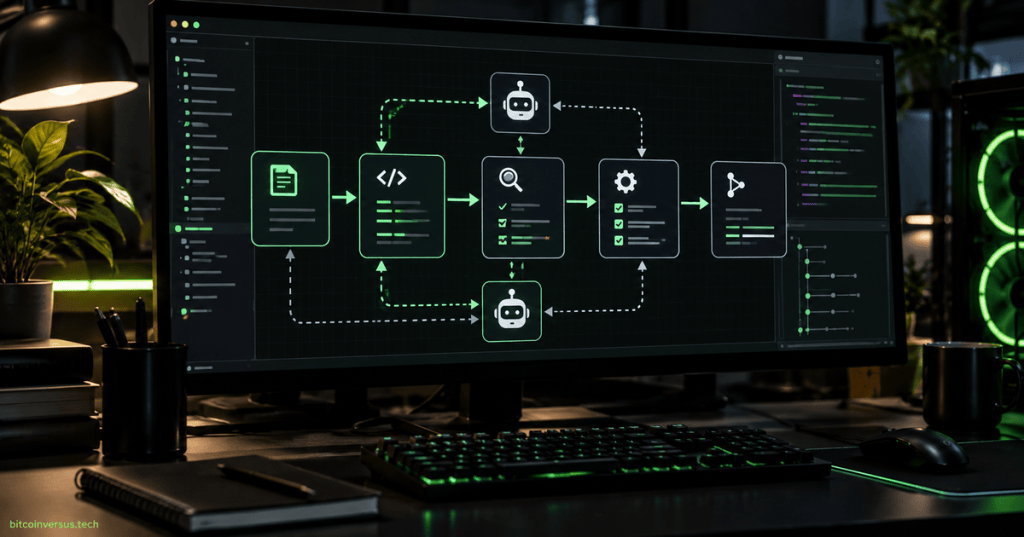
Kiro is turning multi-agent coding from an improvised chat pattern into a reusable development system. The new Workflows feature lets developers define software tasks as sequences, parallel branches, review stages and repeatable recipes. Kiro’s September 30 launch post says each step runs in its own fresh session so implementation, review and validation can stay separate instead of competing for one context window.
That changes a common AI-coding workflow. Instead of asking one agent to implement a feature and then asking the same conversation to review its own work, Kiro can assign those stages to separate sessions and pass the needed results forward. The runtime keeps track of the sequence while developers can pause, inspect or guide individual steps.
Kiro announced Workflows on X as a way to make multi-step agent development reusable rather than manually reconstructed for every task.
Coding Pipelines Become Saved Recipes
Kiro Workflows can be generated for a task or authored directly as JSON or YAML. Current documentation supports sequential stages, parallel branches, repeated stages and conditional stop logic. Developers can build a feature pipeline with implementation, review, test and pull-request stages rather than manually prompting each transition.
AWS’s Kiro coverage notes that workflows can run in cloud sessions and that developers can influence how work is divided and how much review is performed. The finished process can then be saved for reuse.
Fresh Context Is the Important Design Choice
Each workflow step starts with fresh context and receives only what earlier stages hand off. That means an independent reviewer does not automatically inherit the implementation agent’s full reasoning history, which can help make review meaningfully separate from the code-writing stage.
This fits the broader shift BitcoinVersus.Tech has been tracking in coding agents. GitHub used AI agents to help rewrite Copilot’s 430,000-line TypeScript runtime in Rust, showing how agentic coding is moving deeper into production engineering.
At the same time, Claude Code Mods can change agent behavior and interface from inside the coding environment. Kiro is solving a neighboring problem: formalizing how multiple specialized agents cooperate across one engineering job.
The coordination layer is becoming a product category of its own. BitcoinVersus.Tech also covered the growing focus on 100-agent orchestration, where state, sequencing, review and handoffs can matter as much as model selection.
Kiro Workflows pushes that idea into everyday software development. The unit of work is no longer only a prompt or one chat session. It can be a repeatable engineering process that investigates a codebase, implements a change, reviews it, validates it and prepares the result for delivery.
BitcoinVersus.Tech
Advertisement
Editor’s Note
We volunteer daily to ensure the credibility of the information on this platform is Verifiably True. If you would like to support to help further secure the integrity of our research initiatives, please donate here: 3C9o19EH5HSiwEPyCTmEKzxhNCbo2X6TTb
BitcoinVersus.tech is not a financial advisor. This media platform reports on financial subjects purely for informational purposes.


Leave a Reply