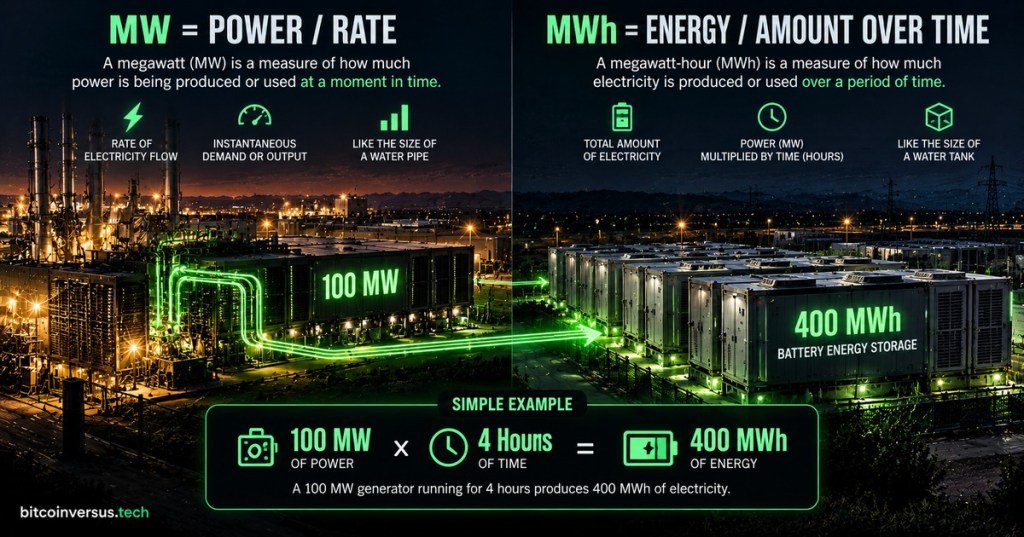
Megawatts and megawatt-hours look almost identical, but they answer two different questions.
MW tells you how fast electricity is being produced or consumed right now. MWh tells you how much electricity is produced, stored or consumed over a period of time.
The Short Definition
The U.S. Department of Energy defines a megawatt as one million watts of power and a megawatt-hour as a unit of electrical energy. One megawatt-hour equals 1,000 kilowatt-hours.
The simplest formula is:
Power in MW × Time in hours = Energy in MWh
So a machine, power plant or data center operating at 100 MW for four hours uses or produces 400 MWh of energy.
Think of MW as Speed and MWh as Distance
A useful analogy is a car. Miles per hour tells you the rate at which the car is moving. Miles tell you how far it traveled. Electricity works similarly.
MW is the rate. It describes the size of an electrical load or the instantaneous output capability of a generator. MWh is the accumulated amount. It adds time to the equation.
A 400 MW Data Center Example
When you read that a data center is rated at 400 MW, that number describes its power demand or electrical capacity at a given moment. BitcoinVersus.Tech recently covered a planned 400 MW AI campus in Japan.
If a 400 MW facility actually consumed 400 MW continuously for 24 hours, the math would be:
400 MW × 24 hours = 9,600 MWh
That is 9.6 GWh of energy in one day. The 400 MW number tells you the size of the load. The 9.6 GWh number tells you how much electricity that load would consume across 24 hours at that constant level.
Why Batteries Usually Have Two Ratings
Batteries make the difference especially easy to see because they are commonly described with both numbers.
The Department of Energy gives an example of a 60 MW battery with 240 MWh of energy storage. The 60 MW rating tells you the maximum power the battery can deliver. The 240 MWh rating tells you how much energy it can store.
At full 60 MW output, a 240 MWh battery has roughly four hours of energy:
240 MWh ÷ 60 MW = 4 hours
This is why saying only “a 100 MW battery” is incomplete if you want to understand how long it can run. A 100 MW / 100 MWh battery lasts about one hour at full output. A 100 MW / 400 MWh battery lasts about four hours at full output.
MW Describes Size; MWh Describes Work Done Over Time
Power plants, data centers, transformers and large electrical loads are often discussed in MW because engineers need to know how much power must flow through equipment at a particular moment.
Energy markets, electricity bills and storage systems often use MWh because they care about the total amount delivered or consumed over time. BitcoinVersus.Tech recently covered India planning 135 GW of transmission capacity alongside 50 GWh of storage. The GW figure describes power-system capacity; the GWh figure describes stored energy.
How This Connects to Behind-the-Meter Power
The same distinction matters when a facility generates electricity on-site. In our easy guide to behind-the-meter power, a 100 MW data center with 70 MW of on-site generation still needs roughly 30 MW from the grid while those loads and generators are operating at those levels.
But to calculate energy across a day, you must add time. If the 70 MW generators ran at that output for 24 hours, they would produce 1,680 MWh of electricity.
The Same Rule Works for kW, MW and GW
The prefixes only change the scale:
- 1 kilowatt (kW) = 1,000 watts
- 1 megawatt (MW) = 1,000 kW
- 1 gigawatt (GW) = 1,000 MW
- 1 MWh = 1 MW delivered for one hour
- 1 GWh = 1 GW delivered for one hour
If a 1 GW power plant operated at exactly 1 GW for 10 hours, it would produce 10 GWh of energy.
The Most Common Mistake
The easiest mistake is treating MW and MWh as interchangeable. They are not.
A 200 MW power plant does not “produce 200 MWh” unless you also specify one hour of operation at 200 MW. A 200 MW data center does not automatically use 200 MWh in a day. If it averaged 200 MW for an entire 24-hour day, it would consume 4,800 MWh.
The Easy Rule to Remember
MW answers: “How much power right now?”
MWh answers: “How much energy over time?”
Whenever you see an “h” added to the unit, time has entered the calculation. That one letter is the difference between the size of an electrical flow and the total amount of electricity that flowed.
BitcoinVersus.Tech
BitcoinVersus.tech is not a financial advisor. This media platform reports on financial subjects purely for informational purposes.


Leave a comment