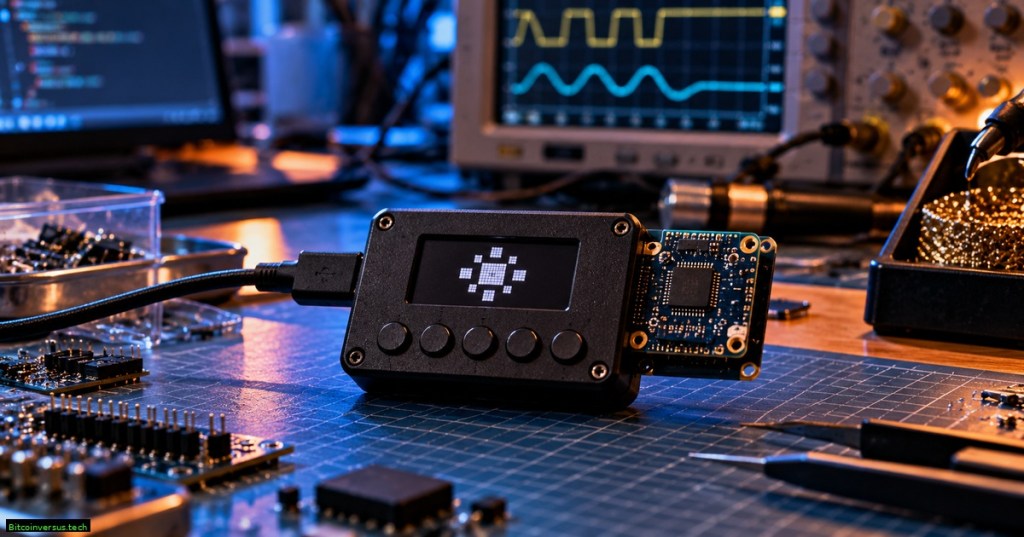
A student research project published through Ledger N3XT built an open-source Ethereum hardware-wallet prototype for roughly ₿0.000117 ($10) and used it to demonstrate an important distinction: keeping a private key inside dedicated hardware is self-custody, but it is not automatically transaction privacy.
The project, called Noir Wallet in the paper, uses an STM32F401 microcontroller, a small OLED display, five buttons, and a Microchip ATECC608A secure element. The researchers trace an Ethereum transaction from the secure element through firmware, USB, the browser, an RPC node, and finally the public ledger. Their conclusion is simple: the key can remain protected while transaction metadata becomes visible almost everywhere else.
A Cheap Secure Element Can Still Protect the Key
The prototype’s ATECC608A is a dedicated cryptographic co-processor that supports hardware-based key storage, ECDSA/ECDH, SHA-256, AES, and an internal hardware random-number generator. The research uses that chip as the hardware root of trust: signing keys can be generated and used without exposing the raw private key to ordinary application memory.
That is the same broad security goal behind commercial hardware wallets: isolate the secret that authorizes transactions from the general-purpose computer or phone that might be infected, compromised, or simply too complex to trust completely.
But the Transaction Still Leaves the Secure Boundary
The private key is only one part of the transaction path. Once the wallet prepares or signs a payment, the host computer can still see transaction details. The RPC provider can observe network-level and transaction metadata. After settlement, a public Ethereum transaction remains visible on-chain and can be analyzed through address reuse, interaction graphs, and clustering.
That means hardware can answer, “Did the private key stay isolated?” without answering, “Did anybody learn who paid whom?” The distinction is especially useful after incidents involving fake wallet software, including the fake Ledger Live app, or phishing delivered through otherwise trusted-looking infrastructure such as the Trezor phishing campaign. Hardware protects one layer; users still interact with software, networks, and public chains.
The Prototype Found a Real RNG Configuration Trap
The most useful hardware lesson in the paper came during bring-up. The researchers found that an unconfigured, unlocked ATECC608A did not provide usable entropy through the Random command. Instead, it returned a deterministic diagnostic pattern until the configuration zone was permanently locked.
On their prototype, that behavior produced the same seed material repeatedly. The paper treats this as a development-stage configuration failure rather than a broken cryptographic primitive: once the device is configured and locked correctly, the chip’s internal random-number generator is intended to provide hardware entropy. The broader lesson is that a secure element can be present on a board and still be used incorrectly.
The Display Can Still Lie
The prototype also exposes a second hardware boundary. Its STM32 microcontroller controls the screen while also sending commands to the secure element. If that MCU firmware were compromised, it could theoretically display one transaction while submitting another digest for signing. The private key would still never leave the secure element, yet the user could authorize the wrong transaction.
Commercial wallet designs spend real engineering effort on this problem. The study contrasts its low-cost architecture with designs where trusted-display behavior and the secure-element communication path receive stronger isolation. That helps explain why a ₿0.000117 prototype is useful research without being equivalent to a fully hardened retail device such as Bitkey or other mature hardware-wallet platforms.
The I2C Bus Is Another Trust Boundary
In the prototype, the OLED and secure element share an I2C bus. The raw private key remains protected inside the secure element, but a physical attacker monitoring that bus may still observe command traffic, digests, slot information, and display data. The paper proposes encrypted secure-element I/O and stronger separation of the display path as logical next steps.
This is the difference between protecting a secret and protecting an entire system. A wallet can have excellent key isolation while still exposing metadata through firmware, buses, displays, host software, USB, RPC infrastructure, or the blockchain itself.
Privacy Has to Be Added Above the Signing Hardware
The researchers map several privacy technologies onto the hardware stack. Stealth addresses can reduce recipient linkability. Selective-disclosure credentials can reveal only the facts a verifier needs. More computationally intensive zero-knowledge shielding can hide additional transaction information, but generating full proofs may exceed the memory and compute limits of a small 64 KB SRAM microcontroller.
That creates a practical architecture: keep authorization keys inside dedicated hardware, while more powerful companion devices generate privacy proofs or perform heavier computation. The hard part is preserving the privacy benefit without simply moving sensitive information into another untrusted computer.
The Bigger Hardware Lesson
The ₿0.000117 ($10) prototype does not prove that hardened commercial wallets should cost ₿0.000117. It proves something narrower and more useful: the basic hardware required to isolate a key can be inexpensive. The additional cost is in secure display design, encrypted internal communication, firmware assurance, physical tamper resistance, manufacturing controls, audits, supply-chain security, recovery design, usability, and years of adversarial testing.
For crypto hardware, that distinction matters. Self-custody protects control of the key. Privacy protects information about the transaction. System security protects the path between the two. A strong wallet needs all three to be understood separately.
BitcoinVersus.Tech
Advertisement
Editor’s Note
The Noir Wallet discussed here is a student research prototype published through Ledger N3XT, not a commercial Ledger hardware-wallet product. Ledger states that the student findings are the authors’ own. The prototype’s security limitations are explicitly documented by its researchers.
We volunteer daily to ensure the credibility of the information on this platform is Verifiably True. If you would like to support to help further secure the integrity of our research initiatives, please donate here: 3C9o19EH5HSiwEPyCTmEKzxhNCbo2X6TTb
BitcoinVersus.tech is not a financial advisor. This media platform reports on financial subjects purely for informational purposes.


Leave a comment