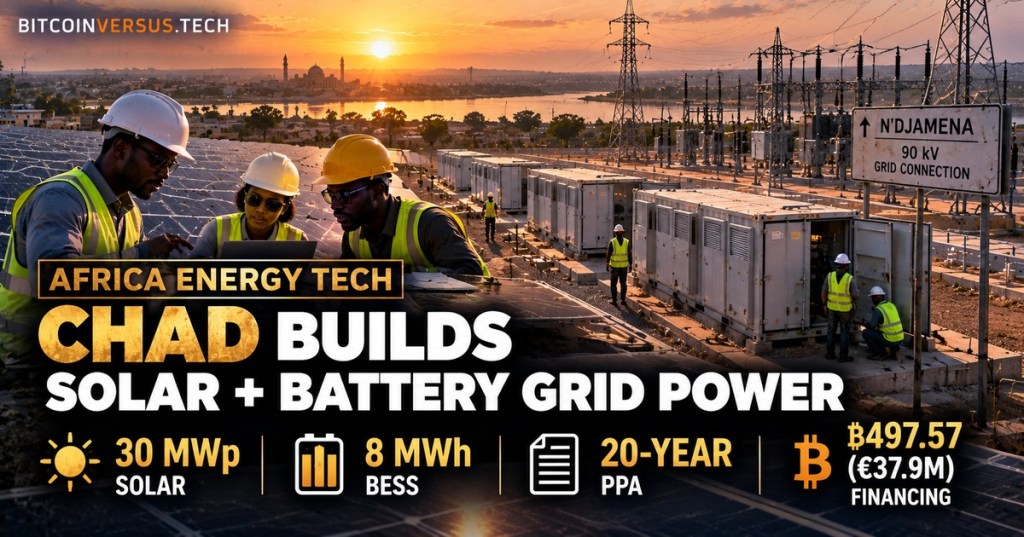
Chad is moving one of Central Africa’s more technically interesting renewable projects from financing into construction: two hybrid solar plants at Gassi and Lamadji near N’Djamena combining 30 MWp of photovoltaic generation with 8 MWh of battery storage.
Developer Qair announced the first disbursement from a financing package worth about ₿497.57 (€37.9 million), using the October 6 BTC/EUR reference rate. The plants will operate under a 20-year power purchase agreement with national utility Tchadelec. Qair’s project announcement says the package is designed to move the two sites through construction while pairing variable solar output with grid-scale storage.
Why the Battery Matters as Much as the Solar
The 30 MWp number describes the peak output of the photovoltaic modules. The 8 MWh number describes how much electrical energy the battery system can store. Those are different measurements, which is why BitcoinVersus separates MW from MWh when comparing generation and storage.
Solar production rises and falls with sunlight. A battery energy storage system can absorb electricity when production is high and release it when the grid needs support later. That same basic role appears in much larger projects such as the eight-hour Energy Vault battery project, although Chad’s system is being built at a much smaller scale.
The Financing Stack Is Almost as Engineered as the Power Plant
Qair’s financing is split across several institutions. The African Development Bank and Proparco are each providing roughly ₿199.55 (€15.2 million) in loans. The Sustainable Energy Fund for Africa is adding about ₿78.77 (€6 million) in reimbursable grants, while Proparco and Agence Française de Développement are providing another ₿19.69 (€1.5 million).
A separate partial-risk guarantee worth about ₿105.03 (€8 million) helps back a letter of credit covering Tchadelec’s payment obligations under the PPA. In plain language, the project is not relying on one lender or one source of risk protection. Debt, grant-style support, utility payment protection and commercial banking are being layered together to make the plants financeable.
Chad Is Part of a Much Bigger Sahel Solar Buildout
The African Development Bank says Gassi and Lamadji are part of its Desert to Power and Mission 300 programs. Desert to Power targets 10,000 MW of solar generation capacity across the Sahel while Mission 300 is aimed at expanding electricity access across Africa.
The engineering challenge is not simply adding solar panels. New variable generation has to be synchronized with the existing network, protected against faults, balanced against demand and supported when clouds or sunset reduce output. Storage helps, but substations, protection systems, inverters, controls and utility operating procedures still determine whether the new capacity strengthens the grid or creates new instability.
30 MWp Does Not Mean 30 MW Every Hour
The project’s 30 MWp rating is nameplate solar capacity, not continuous output. Actual annual electricity production depends on solar resource, downtime, temperature, soiling, conversion losses and other factors summarized by capacity factor.
That distinction is especially important when discussing African energy access. A grid needs electricity when customers need it, not only when a generator reaches its maximum rating. Combining photovoltaic generation with battery storage gives operators another tool for shifting some of that energy into higher-value hours.
Why This Is an African Energy-Tech Story
The important technology is the system, not any single component. Solar modules create the electricity. Power electronics convert and control it. Batteries time-shift part of the output. Grid equipment connects the plants to the national network. Software and protection logic coordinate how that equipment responds to changing generation and demand.
For Chad, Gassi and Lamadji are therefore more than two solar fields. They are a test of whether modern solar-plus-storage architecture, development-bank risk sharing and a long-term utility contract can work together to add dependable capacity in a market where energy infrastructure still has substantial room to grow.
BitcoinVersus.Tech
Advertisement
Editor’s Note
Bitcoin conversions use the October 6, 2026 BTC/EUR reference rate and are rounded for readability. BitcoinVersus.Tech reports the original euro-denominated financing amounts alongside BTC.
We volunteer daily to ensure the credibility of the information on this platform is Verifiably True. If you would like to support to help further secure the integrity of our research initiatives, please donate here: 3C9o19EH5HSiwEPyCTmEKzxhNCbo2X6TTb
BitcoinVersus.tech is not a financial advisor. This media platform reports on financial subjects purely for informational purposes.


Leave a Reply