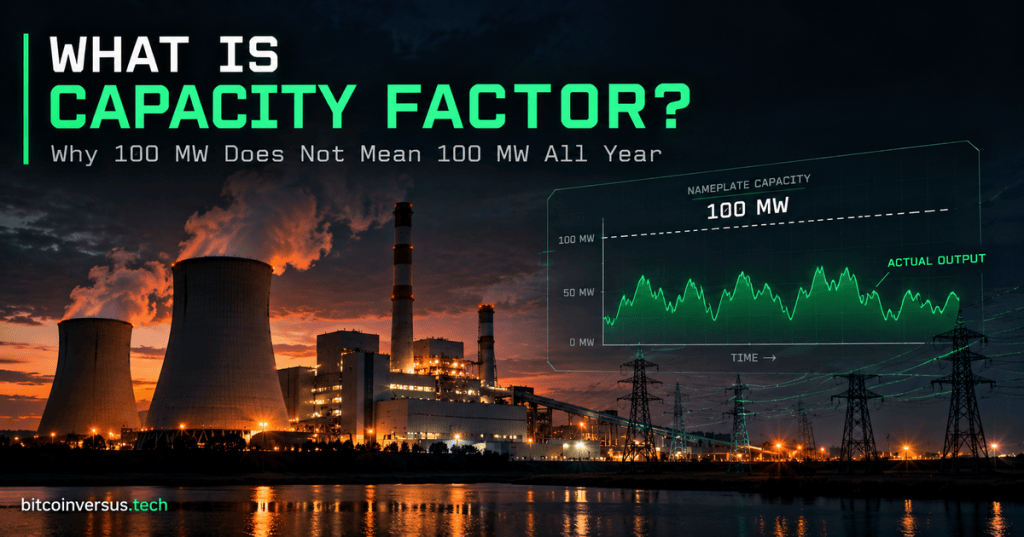
A power plant rated at 100 megawatts does not usually produce 100 MW every hour of the year. The missing piece is capacity factor: the percentage of a generator’s maximum possible energy output that it actually produces over a period of time.
This is one of the easiest energy metrics to misunderstand because “capacity” sounds like “generation.” They are related, but they are not the same thing.
CAPACITY FACTOR IS ACTUAL ENERGY DIVIDED BY MAXIMUM POSSIBLE ENERGY
The U.S. Energy Information Administration defines capacity factor as the ratio of the electrical energy a generating unit actually produces to the energy it could have produced if it had operated continuously at full power during the same period.
The basic formula is:
Capacity Factor = Actual Energy Output ÷ Maximum Possible Energy Output × 100%
To calculate the maximum possible energy, multiply the generator’s rated power by the number of hours in the period.
A 100 MW POWER PLANT MAKES THE MATH EASY
A 100 MW generator running at full output for 24 hours could produce:
100 MW × 24 hours = 2,400 MWh
Across a 365-day year, its theoretical maximum is:
100 MW × 8,760 hours = 876,000 MWh
If the plant actually generated 438,000 MWh during that year, its capacity factor would be 50%. If it generated 788,400 MWh, the capacity factor would be 90%.
If MW and MWh still feel interchangeable, BitcoinVersus.Tech’s MW vs. MWh explainer separates power from energy using the same kind of examples.
A LOW CAPACITY FACTOR DOES NOT AUTOMATICALLY MEAN A BAD POWER PLANT
Capacity factor tells you how intensively a generator was used. It does not, by itself, tell you whether the generator is efficient, profitable, reliable, clean, or well designed.
A peaking gas turbine may intentionally sit idle most of the year and run only when electricity demand and prices spike. A solar plant cannot generate at night. A wind farm depends on wind conditions. A nuclear plant is usually operated for long stretches between refueling and maintenance outages.
The U.S. Department of Energy’s generation-capacity explainer shows how differently technologies can be used. For 2024, DOE lists U.S. nuclear at more than 92% capacity factor, compared with about 60% for natural gas, 42% for coal, 34% for wind, and 23% for solar. Those figures are annual fleet averages, not permanent engineering constants.
CAPACITY FACTOR IS NOT THE SAME AS EFFICIENCY
Efficiency asks how effectively a machine converts its input energy into useful output. Capacity factor asks how much energy it actually generated compared with the maximum it could have generated at full rated output.
A plant can be highly efficient but have a low capacity factor because it is dispatched only occasionally. Another plant can have a high capacity factor while using an older conversion process. The two metrics answer different questions.
CAPACITY FACTOR IS ALSO NOT THE SAME AS UPTIME
Suppose a 100 MW plant is technically available for 8,000 hours in a year but spends much of that time operating at 50 MW. Its uptime may be very high, yet its capacity factor will still be well below 100% because the calculation uses actual energy output.
This distinction matters when evaluating generation intended for round-the-clock loads. BitcoinVersus.Tech recently covered the federal plan to support additional output from Vistra’s nuclear fleet, where increasing usable generation can matter even without building an entirely new power station.
WHY CAPACITY FACTOR MATTERS FOR DATA CENTERS AND BITCOIN MINERS
A 500 MW data center does not care only about the nameplate rating printed on a nearby power plant. It cares about how much usable energy can actually be delivered through the day, through maintenance periods, and through seasonal conditions.
That is why generation portfolios often combine different resources. Firm generation, variable renewables, transmission, batteries, and flexible loads can each solve different parts of the problem. BitcoinVersus.Tech’s coverage of India’s 135 GW transmission and 50 GWh storage expansion is a useful example of why power capacity, energy storage, and grid delivery must be considered together.
THE SIMPLE MENTAL MODEL
Nameplate capacity tells you how big the generator is. Capacity factor tells you how much of that theoretical output it actually delivered over time.
A 100 MW plant with a 90% annual capacity factor produces about twice as much yearly energy as a 100 MW plant with a 45% capacity factor. Both have the same nameplate capacity, but they do not produce the same amount of electricity.
That is why capacity factor is one of the fastest ways to move from a headline number to a more realistic understanding of an energy project.
BITCOINVERSUS.TECH
Advertisement
EDITOR’S NOTE
We volunteer daily to ensure the credibility of the information on this platform is Verifiably True. If you would like to support our research and publishing work, please donate here: 3C9o19EH5HSiwEPyCTmEKzxhNCbo2X6TTb
BitcoinVersus.tech is not a financial advisor. Content is provided for informational purposes.


Leave a Reply