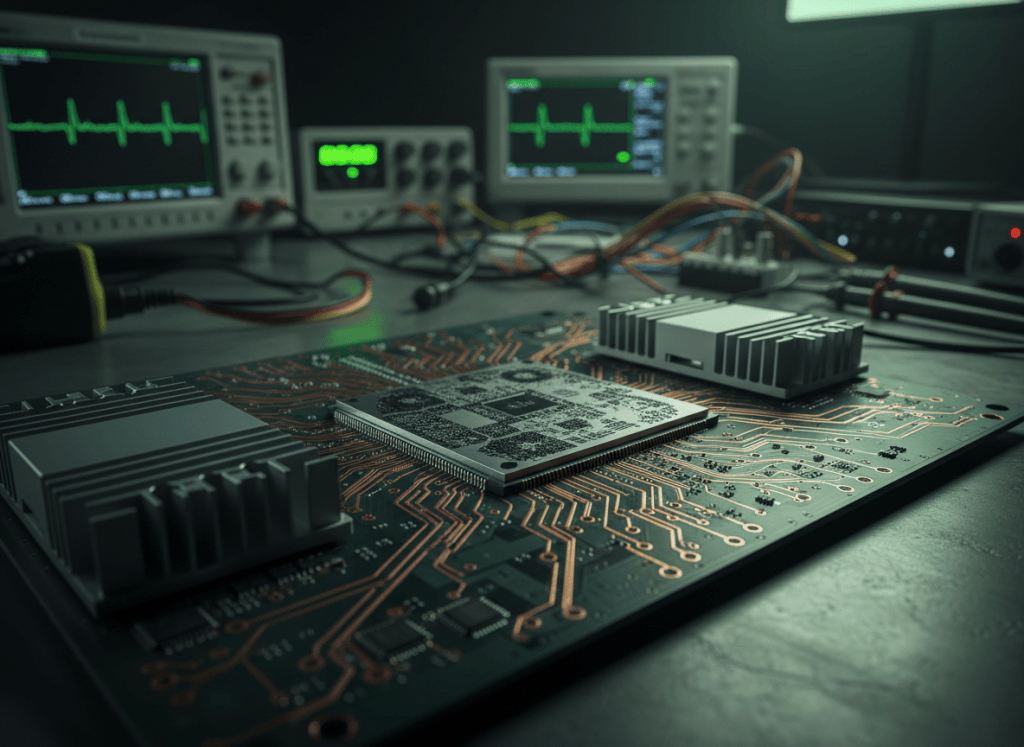
BGIN Blockchain has pushed a new Bitcoin mining chip past one of semiconductor development’s biggest milestones. The company says its 4 nm BT1 Bitcoin ASIC achieved first-pass silicon success after entering tape-out in October 2025, moving the design into system-level testing and production preparation.
This is a compute story more than a power story. The important question is what happens inside the miner: a purpose-built ASIC repeatedly performs Bitcoin’s SHA-256 hashing work, and improvements in chip architecture, physical design, packaging, firmware and board integration determine how much useful hashrate a machine can produce.
What “First-Pass Silicon” Means
ASIC development begins long before a finished mining machine exists. Engineers design and verify the chip, complete its physical layout, send that design for fabrication, then test the returned silicon. BGIN says BT1 reached first-pass silicon success, meaning its first manufactured silicon passed the milestone well enough for the program to proceed into broader performance, stability and system-level work.
That does not mean a commercial miner is already shipping. BGIN’s own disclosure says BT1 entered system-level testing and production preparation, while its SEC filing described the Bitcoin miner as still being refined and not commercially released at the time of the filing. The distinction matters: a working chip is a major engineering achievement, but the hashboard, control system, firmware, cooling interface, power delivery and manufacturing process still have to become a reliable product.
Why 4 nm Matters
The “4 nm” label describes the semiconductor process family used to manufacture BT1; it is not a literal measurement of one transistor feature. Moving mining ASICs onto advanced process technology can give designers more room to improve transistor density, switching behavior and overall compute efficiency, but the process node alone does not guarantee a great miner. Architecture and implementation still decide the real result.
BGIN has not yet published enough final commercial BT1 specifications to compare a finished machine fairly against current Antminer, WhatsMiner or Avalon systems. Until validated hashrate, wall power, efficiency, thermals, reliability and price are available, BT1 is best understood as a credible new chip program—not a proven market winner.
A New Competitor in SHA-256 Silicon
BGIN is not starting from zero. Its SEC filing says the company has designed proprietary ASICs for other proof-of-work networks and has a history of successful tape-outs. Bitcoin is the larger test because SHA-256 mining hardware is already a mature, fiercely optimized market.
The strategic significance is competition. More credible ASIC designers can mean more architectural experimentation, more machine choices and less dependence on a small group of established mining-hardware suppliers. BGIN even demonstrated a BT1-powered PortableBTC prototype at Bitcoin 2026, although it explicitly described that unit as commemorative and non-commercial rather than a promised production machine.
The Next Numbers to Watch
BT1 now has to prove itself outside the chip announcement. The useful scoreboard is straightforward: sustained TH/s, J/TH, error rate, operating temperature, board yield, firmware stability, machine uptime and purchase price. Those measurements will tell miners whether BGIN has simply produced working Bitcoin silicon or built the foundation for a competitive mining platform.
Sources: BGIN’s BT1 announcement and BGIN’s SEC annual filing.
Editor’s Note: BitcoinVersus.tech covers Bitcoin mining from the chip and hashboard to firmware, facilities and economics. This article is informational and is not investment advice.


Leave a Reply